
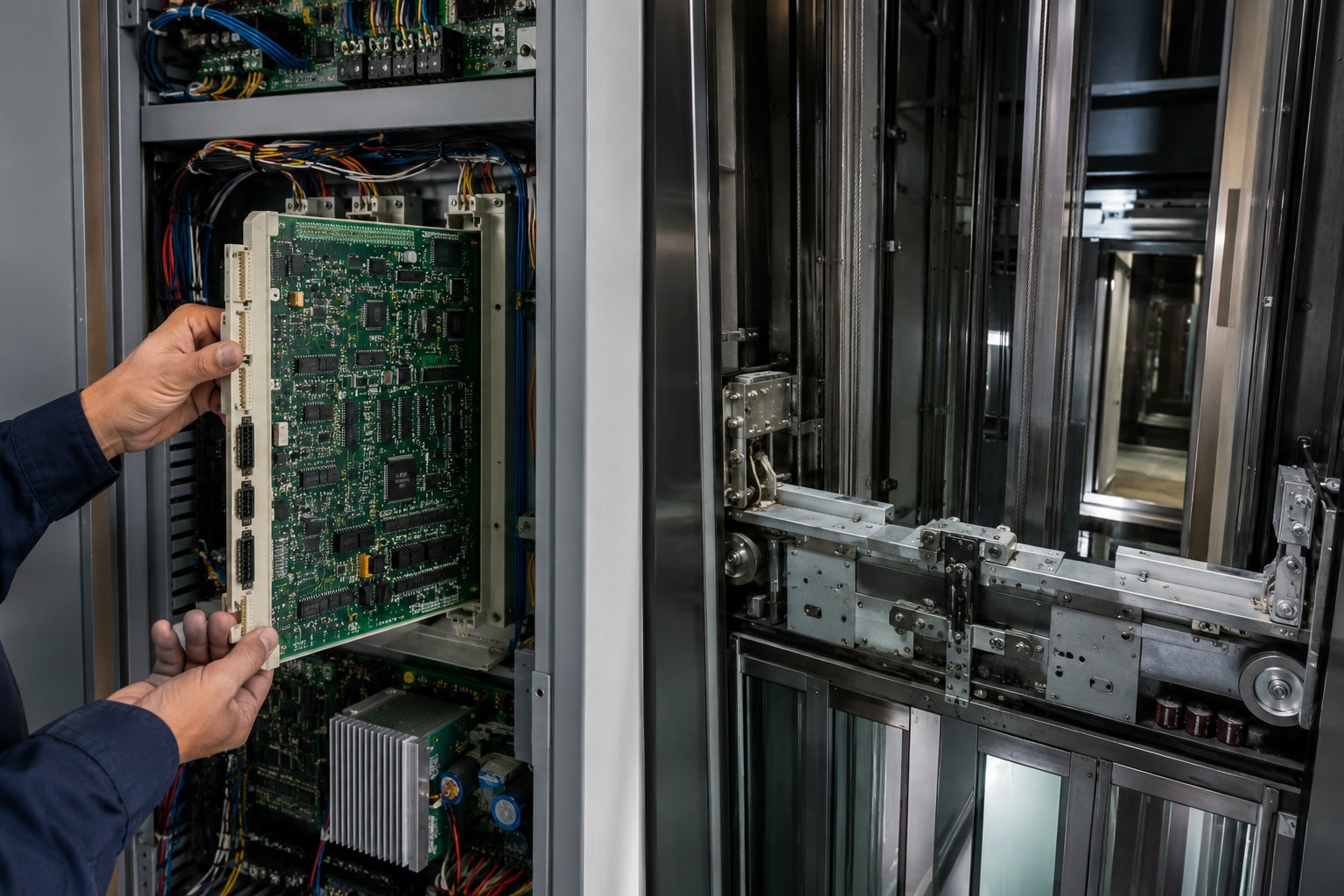
For U.S. elevator maintenance teams, the best way to select a Toshiba elevator board is to match the exact model, function, software or revision level, connector layout, voltage requirements, and application environment before placing an order. A good replacement is not simply a board that looks similar. It must fit the controller logic, communicate correctly with connected devices, and support stable elevator operation after installation and testing. Whether you are replacing a main motherboard, an expansion board, an inverter driver board, a safety circuit relay board, or a car top communication board, careful identification reduces downtime, protects technicians, and helps avoid repeat service calls.
Across the United States, technicians working in New York high-rise towers, Los Angeles mixed-use developments, Chicago office buildings, Houston hospitals, Miami residential towers, and Atlanta modernization projects often face the same challenge: a failed or aging control board can stop service quickly, but a rushed mismatch can create a bigger problem than the original fault. That is why reliable board sourcing matters. Buyers want accurate model matching, stable quality inspection, anti-static packing, responsive technical communication, and practical support for legacy and current Toshiba elevator systems.
The U.S. market also has strong demand for replacement electronics because many elevators remain in service long after original installation. Building owners often choose targeted component replacement rather than full modernization when they need to control budgets and shorten shutdown windows. In this environment, Toshiba elevator boards are commonly evaluated by independent maintenance companies, regional distributors, building engineering teams, and modernization contractors that need dependable parts with clear compatibility guidance.
Understanding Toshiba elevator board types
Toshiba elevator systems use several categories of electronic boards, and each one serves a different role inside the controller or field network. Understanding these categories helps buyers order the correct part and helps technicians diagnose faults more efficiently. The most common groups include the main controller board, inverter board, inverter driver board, expansion board, safety circuit relay board, I/O boards, communication boards, and car top boards.
The main controller board, sometimes referred to as the motherboard or central processing board, is the decision-making core of the system. It processes inputs, monitors operating status, manages logic, and coordinates signals with drive and door subsystems. If it fails, the elevator may stop completely, lose communication, or show irregular command behavior.
An inverter board or drive-related board works with the motor control system to regulate speed, acceleration, and deceleration. Technicians sourcing a replacement can review options such as Toshiba elevator inverter boards when diagnosing drive control faults. A driver board is more specific to power-stage control, signal output, and switching management. For these applications, buyers often compare specifications for Toshiba elevator inverter driver boards to confirm that the board fits the installed drive architecture.
Expansion boards increase system functionality. They may add extra I/O points, communication interfaces, monitoring support, or application-specific control capacity. In larger buildings, expansion boards are common when the elevator group has specialized dispatching, more landing signals, or additional interface requirements. Buyers looking for these functions may evaluate Toshiba elevator expansion boards as part of a board-level repair plan.
Safety circuit relay boards handle critical monitoring and interlock logic. These boards should be sourced with added caution because they affect safe operating conditions, door and lock status, and system enable logic. When safety functions are involved, technicians often need exact part matching and documented inspection before installation. In these cases, it is common to review Toshiba elevator safety circuit relay boards with extra attention to revision, relay status, terminals, and test procedures.
| Board type | Primary function | Typical installation area | Common fault symptoms | Replacement urgency | Key matching points |
|---|---|---|---|---|---|
| Main controller board | Central logic and system coordination | Controller cabinet | No run, random faults, boot failure, communication loss | Very high | Model, software version, connectors, processor family |
| Inverter board | Motor speed and drive regulation | Drive section | Drive trips, poor acceleration, unstable speed | High | Drive model, power rating, firmware, terminals |
| Inverter driver board | Gate drive and power-stage signal control | Inside inverter assembly | Motor not responding, switching errors, abnormal current faults | High | Drive generation, board code, component layout |
| Expansion board | Additional I/O or interface functions | Controller cabinet | Missing inputs, extra features offline, signal mapping faults | Medium to high | Port count, connector type, application logic |
| Safety circuit relay board | Safety chain supervision and relay logic | Controller or safety section | Safety open faults, no enable, intermittent shutdown | Critical | Exact part number, relay configuration, safety circuit design |
| Car top communication board | Signal exchange on car top devices | Car top box or related enclosure | Door operator communication loss, sensor failures, inspection issues | Medium to high | Harness type, protocol, car top device set |
The table above shows why exact board identification matters. Two boards can appear physically similar yet perform different roles or operate under different software logic. For that reason, experienced U.S. technicians rarely rely on visual similarity alone when ordering Toshiba elevator control boards.
When should a main controller board be replaced?
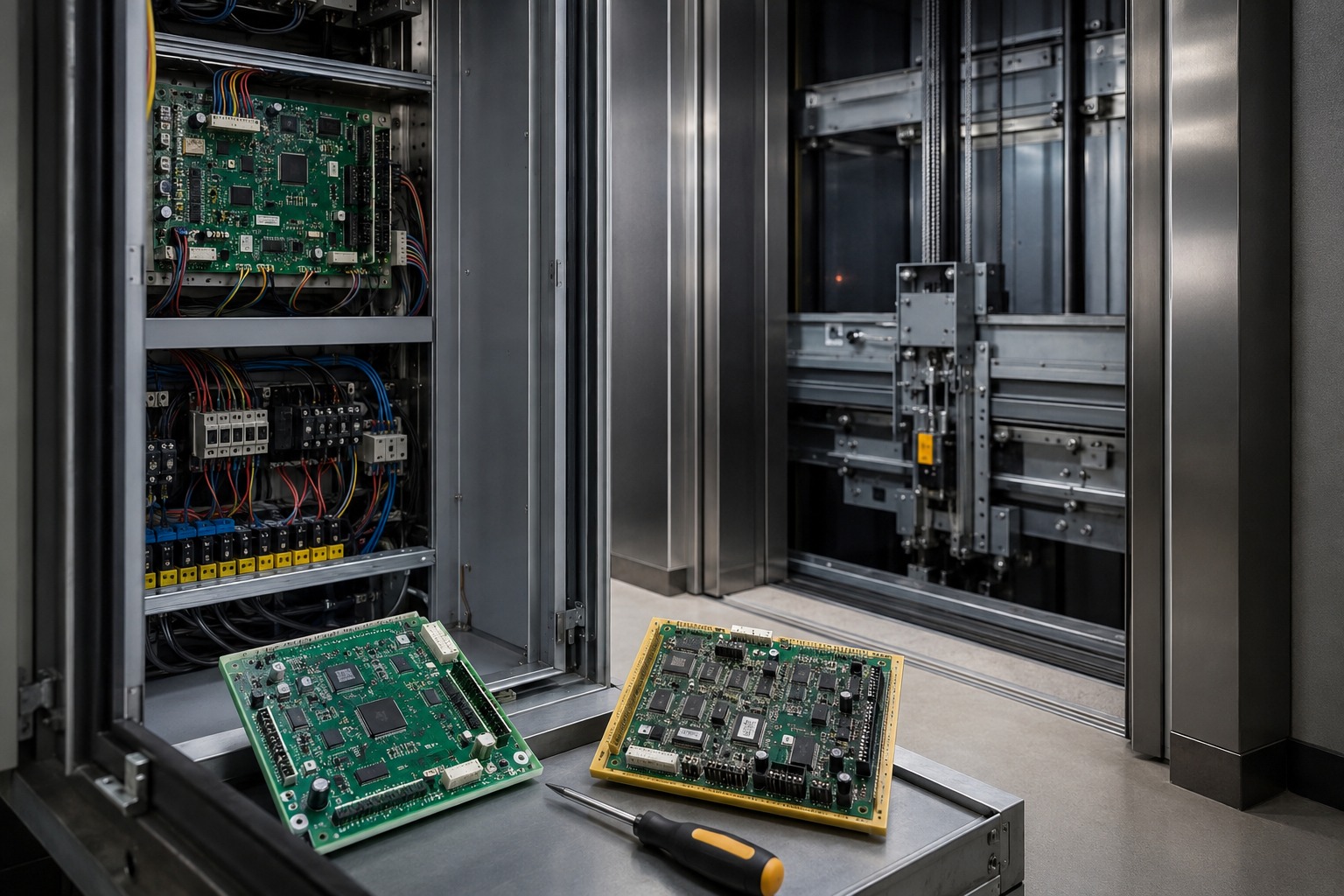
A Toshiba elevator motherboard should be replaced when repeated faults point to board-level failure and the problem cannot be resolved by power supply correction, connector cleaning, parameter recovery, relay replacement, or field wiring repair. In practice, technicians usually replace the main controller board after a structured troubleshooting process, not after the first shutdown event.
Common reasons for replacement include burn damage, failed communication chips, unstable processor behavior, severe corrosion, repeated reboot cycles, non-recoverable memory faults, or damaged traces caused by voltage spikes. In coastal markets such as Miami and along the Gulf Coast, humidity and salt exposure can accelerate corrosion. In older urban buildings in Boston, Philadelphia, or downtown Chicago, long equipment service life may contribute to aging capacitors, oxidation, and connector fatigue.
There are also operational signs that suggest the board may be beyond economical repair. If the elevator returns from service only briefly after multiple resets, if unrelated faults begin appearing together, or if the board cannot hold parameters reliably, replacement may be the safer and more cost-effective choice. Technicians should still confirm that upstream issues such as grounding problems, unstable incoming power, damaged harnesses, or inverter-related faults are not the true root cause.
| Condition observed | Likely cause | Repair first? | Replace board? | Risk if delayed | Recommended action |
|---|---|---|---|---|---|
| Board does not boot at all | Processor or power-stage failure | Yes, check supply and fuse | Usually yes | Complete outage | Verify power input, then replace if dead |
| Intermittent resets | Power instability, failing components, memory faults | Yes | Often yes if recurring | Unplanned shutdowns | Test supply, logs, heat condition, then decide |
| Visible burn marks | Short circuit or surge damage | Limited | Yes | Unsafe operation, repeat failures | Replace and inspect related circuits |
| Parameter loss after power cycle | Memory failure or firmware corruption | Yes | Often yes | Configuration instability | Backup data and replace if unrecoverable |
| Random communication failures | Comms chip fault, loose cables, grounding issue | Yes | Possible | Erratic service behavior | Rule out wiring before replacing board |
| Heavy corrosion or moisture damage | Environmental exposure | Minimal | Yes in many cases | Progressive failure | Replace and improve enclosure protection |
This replacement decision table is useful because it separates symptoms from actions. A motherboard is expensive compared with smaller field boards, so disciplined diagnosis helps buyers control inventory cost. At the same time, waiting too long to replace a failing central board can increase labor hours, tenant complaints, and callback frequency.
How to inspect expansion boards and driver boards
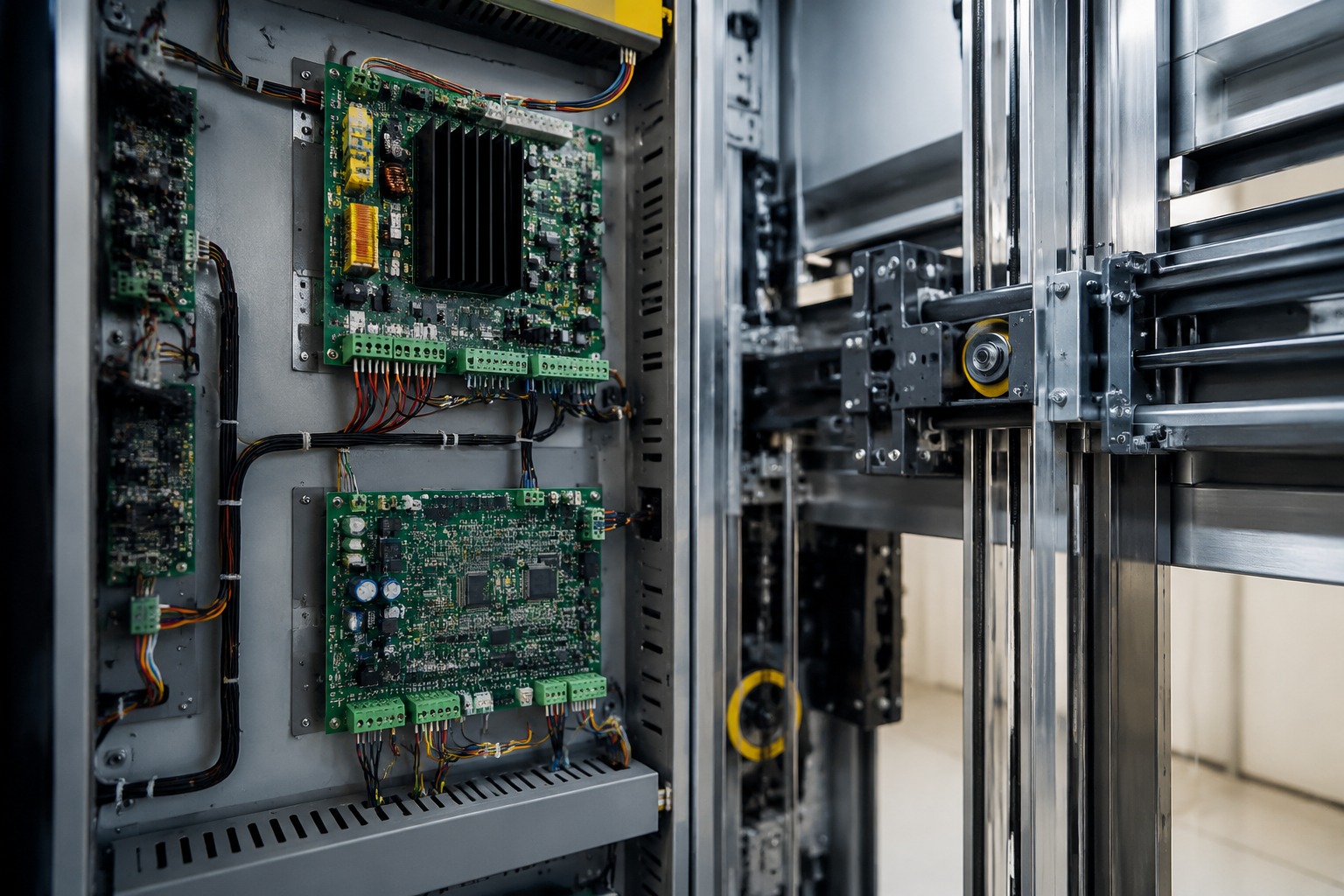
Expansion boards and driver boards should be inspected in a structured way before purchase, before installation, and again during commissioning. These boards may fail from heat stress, poor storage conditions, connector damage, or previous repair work. Since they often interact with other electronic modules, a minor mismatch can create hard-to-diagnose issues.
Start with the part number and board code. Then compare the revision label, software sticker if available, connector positions, daughterboard presence, terminal style, and mounting hole pattern. If the board came from removed stock, request photos of both sides, close-ups of connectors, and images of labels and major chips. U.S. technicians ordering remotely from outside their state often do this to avoid delays on jobs in Dallas, Phoenix, Seattle, or Denver where the maintenance window may be tight.
Visual inspection should look for cracked solder joints, swollen capacitors, scorched resistors, broken pins, oxidized contacts, missing components, and signs of liquid exposure. For driver boards especially, examine the gate driver section, isolation components, optocouplers, and heat-affected areas. If a board has been repaired previously, ask whether components were replaced with equivalent ratings and whether functional testing was completed under power.
| Inspection point | What to check | Why it matters | Typical risk | Acceptable result | Technician note |
|---|---|---|---|---|---|
| Part number label | Exact code and revision | Prevents mismatch | Wrong function | Matches original exactly | Photograph original before removal |
| Connector condition | Bent pins, wear, oxidation | Ensures signal integrity | Intermittent faults | Clean, straight, secure | Compare pin count carefully |
| Capacitors | Swelling, leakage, age | Affects stability | Reset or ripple issues | No swelling or residue | Inspect under strong light |
| Solder joints | Cracks, rework quality | Reduces hidden failures | Heat-related intermittence | Uniform and intact | Focus on heavy components |
| Burn or heat marks | Darkened areas, odor | Indicates overload history | Short life after install | No severe damage | Check surrounding components too |
| Test status | Bench or functional testing record | Improves confidence | Dead on arrival | Verified and documented | Ask for test method details |
The inspection checklist above helps technicians evaluate both new replacement stock and previously stocked boards. In many elevator service organizations, this process is now standard because labor costs in the United States are high, and one incorrect board shipment can easily cost more in field time than the board itself.
Buying notes for elevator safety circuit boards
Safety circuit boards deserve extra scrutiny because they influence whether the elevator is permitted to run. When buying a Toshiba safety circuit relay board, never assume compatibility based on shape alone. Confirm the exact board code, relay count, terminal configuration, harness arrangement, system generation, and application. Safety chain design can vary between jobs, especially in modernized equipment where original and replacement components have been mixed over time.
Buyers should ask whether the board was electrically tested, whether relays were checked under load, whether insulation condition was reviewed, and whether the board has any repaired traces or substituted components. A supplier that performs reliable incoming inspection and functional verification adds value because it reduces installation uncertainty. In the U.S. market, this matters for hospitals, airports, universities, and high-traffic residential buildings where downtime affects safety planning and public movement.
Another buying note is documentation. Even if the board is a direct replacement, technicians benefit from clear photos, label records, connector orientation references, and if possible, pre-shipment confirmation against the original board image. This simple step prevents preventable mistakes in the field.
| Buying factor | Why it is critical | Question to ask | Preferred answer | Risk if ignored | Best practice |
|---|---|---|---|---|---|
| Exact part number | Safety logic must match | Does the code match exactly? | Yes, verified by image | No-run or unsafe logic conflict | Cross-check original label |
| Relay condition | Mechanical wear affects function | Were relays tested? | Yes, function checked | Intermittent safety faults | Request test record |
| Terminal layout | Wrong terminals can miswire the chain | Does connector layout match? | Yes, pinout confirmed | Installation errors | Compare board photos side by side |
| Repair history | Prior rework can affect reliability | Has the board been repaired? | Declared clearly | Unexpected short life | Review rework quality carefully |
| Environmental condition | Storage affects board health | How was it stored? | Dry, anti-static protected | Moisture-related faults | Choose protected inventory |
| Traceability | Supports maintenance records | Can you provide photos and labels? | Yes, before shipment | Difficult follow-up support | Keep full service record |
The explanation behind this table is straightforward: safety boards are not the place for guesswork. Good procurement discipline protects both elevator uptime and technician confidence during startup and safety verification.
Typical use cases for car top communication boards
A car top communication board supports communication between the controller and devices mounted on or near the elevator car top. Depending on the system design, this may include door operator signals, inspection controls, leveling sensors, car top stations, and status communication for moving car equipment. When this board fails, technicians may see lost car top inspection control, unstable door behavior, missing sensor feedback, or communication-related fault codes.
These boards are especially important in systems with more distributed electronics, where not every function returns directly to the main cabinet through simple hardwired logic. In modernization work, a car top communication board can also become a key interface point if part of the system has been updated while other sections remain older.
Typical U.S. use cases include residential towers with frequent door cycles, medical facilities where smooth door operation is essential, hotels with heavy luggage traffic, and office buildings where reduced downtime is critical during peak hours. In cities such as San Francisco and New York, where building usage density is high, communication stability on door and car top circuits has a direct impact on passenger flow.
When sourcing a car top communication board, technicians should confirm enclosure fit, harness type, communication protocol, and associated car top devices. It is also wise to inspect cable wear and moving harness condition because board failure symptoms can sometimes be caused by damaged traveling cables or connector fatigue rather than the board itself.
Compatibility questions technicians ask before ordering
Compatibility is the most important pre-order topic for Toshiba elevator boards. Good technicians ask detailed questions before purchasing, because the cost of mismatch is measured in labor, service interruption, and return shipping time. The right questions help narrow the order quickly and accurately.
First, ask whether the board part number is an exact match, including every suffix and revision mark. Second, ask whether the board is intended for the same Toshiba controller family. Third, verify whether software or firmware version matters for the application. Fourth, confirm connector orientation and pin arrangement. Fifth, ask whether any related board must be replaced together, such as a driver board that depends on a paired power board revision. Finally, ask whether the supplier can compare your photos before shipping.
| Compatibility question | Why technicians ask it | What to verify | If answer is unclear | Impact on job site | Ordering advice |
|---|---|---|---|---|---|
| Is the part number exact? | Avoid wrong board family | Full code and suffix | Pause order | Board may not boot | Send label photo first |
| Does the revision match? | Minor revisions may change function | Revision letters or stickers | Request comparison images | Feature mismatch | Do not assume interchangeability |
| Is firmware relevant? | Software can affect communication | EPROM label or version note | Ask for board history | Fault codes after startup | Keep original data record |
| Are connectors identical? | Physical fit and signal mapping matter | Pin count and keying | Compare front and back photos | Installation delay | Check every plug location |
| Was the board tested? | Reduce field risk | Bench or live test status | Ask for test scope | DOA possibility | Prefer verified inventory |
| Can related components be reviewed? | Root cause may involve another board | System pairing requirements | Share fault code details | Repeat failures | Evaluate system, not only one part |
This table is practical for procurement teams and field mechanics alike. It can be used as a pre-order checklist, especially when the purchasing office is not physically on the job site. Many U.S. customers now send original board photos from mobile devices directly from the machine room, which speeds up model matching and improves accuracy.
Packaging and shipping protection for sensitive boards
Packaging and shipping protection are essential for elevator electronics. A properly matched board can still arrive unusable if static, moisture, vibration, or impact damage occurs during transit. This is particularly important for shipments traveling long distances within the United States or moving through major logistics hubs such as the Port of Long Beach, the Port of Los Angeles, Houston, Savannah, Newark, and inland distribution routes through Memphis, Dallas, and Chicago.
The best protection method starts with anti-static handling. Boards should be packed in anti-static bags, cushioned with shock-absorbing material, separated from hard metal movement, and secured inside rigid cartons. Sensitive connectors and corners need extra support. Moisture control is also useful, especially for shipments crossing humid coastal regions or changing climates rapidly during transit.
For high-value or time-sensitive boards, double boxing is recommended. Labels should distinguish fragile electronics from general parts. Buyers should also ask whether the supplier photographs the board before packing and whether serial labels or identifiers are documented. This helps resolve claims and simplifies receiving inspection.
| Protection step | Purpose | Recommended method | Where it helps most | Risk if skipped | Receiving check |
|---|---|---|---|---|---|
| Anti-static bag | Prevent electrostatic damage | Sealed ESD-safe bag | All electronic boards | Hidden electronic failure | Confirm sealed packaging |
| Connector shielding | Protect pins and sockets | Foam or cap protection | Boards with exposed connectors | Bent pins | Inspect before unpacking fully |
| Shock cushioning | Reduce impact damage | Foam layers or bubble wrap | Long-distance courier transit | Cracked solder joints | Check box crush signs |
| Moisture control | Limit corrosion risk | Dry packing with desiccant | Coastal or humid routes | Oxidation and residue | Inspect for condensation signs |
| Rigid carton or double box | Improve structural protection | Inner and outer carton system | Heavy logistics handling | Corner impact damage | Review outer and inner box condition |
| Photo documentation | Trace condition before shipment | Board and label photos | Returns and claim support | Dispute difficulty | Match received board to images |
The reason this shipping table matters is simple: shipping protection is part of product quality. Good packing lowers failure risk, reduces returns, and helps maintenance teams schedule installation with greater confidence.
United States market demand and sourcing patterns
The U.S. replacement market for elevator electronic boards is shaped by three forces: aging installed equipment, selective modernization, and the need to minimize service interruption in occupied buildings. Many properties prefer targeted repairs when the controller platform remains serviceable, especially in residential, healthcare, education, hospitality, and commercial office sectors. This keeps demand strong for Toshiba elevator control boards, driver boards, communication boards, and safety-related electronic modules.
Demand is not uniform across the country. Dense metro areas such as New York City, northern New Jersey, Chicago, Los Angeles, Washington, D.C., and San Francisco show high demand because of large installed bases and strict uptime expectations. Sun Belt cities such as Dallas, Austin, Charlotte, Orlando, and Phoenix also continue to add demand as building stock grows and modernization cycles accelerate.
The line chart illustrates a realistic growth trend in U.S. demand for replacement boards. Growth is supported by older elevator fleets, rising building service expectations, and the need for faster component-level repairs rather than waiting for full equipment renewal.
This bar chart shows where replacement demand tends to be strongest. Residential towers and office properties lead because of elevator usage volume, tenant expectations, and the need to shorten downtime during regular service hours.
Applications, industries, and practical case examples
Toshiba elevator boards are used in a wide range of applications beyond standard passenger service. Freight elevators, service elevators, hospital lifts, hotel guest elevators, and office tower groups can all require board replacement at different lifecycle stages. A driver board may be needed after repeated drive faults in a high-cycle service elevator. An expansion board may be required when additional signals or modernization interfaces are introduced. A safety relay board may become necessary after aging relay contact wear creates intermittent no-run conditions.
Consider a mid-rise residential property in New Jersey where intermittent faults occur during evening traffic. Initial suspicion may fall on the main board, but inspection reveals oxidation on a communication-related expansion board connector. Replacement of the correctly matched expansion board restores stable hall call processing. In another example, a healthcare facility in Texas experiences recurring drive trips. After power checks and parameter review, the issue is traced to a failed inverter driver board. Replacing that board restores consistent motor control without requiring immediate full drive replacement.
In a coastal Florida hotel, a technician may find corrosion on a safety-related board due to long-term moisture exposure. Here, the repair plan should include not only board replacement but also cabinet environment review, sealing improvement, and inspection of nearby connectors. In downtown Los Angeles or Seattle, where logistics and scheduling windows can be tight, accurate pre-shipment model matching can be the difference between one service visit and several return trips.
The area chart reflects a broader trend in the U.S. market: more buyers are choosing board-level repair and targeted component replacement when system condition and compliance requirements allow. This trend supports faster recovery and better maintenance cost control.
Choosing suppliers and evaluating value
Not every supplier adds value in the same way. For Toshiba elevator boards, the most useful suppliers are the ones that can help with technical matching, inspection discipline, stable sourcing, packaging quality, and responsive communication. Price matters, but a lower upfront price can become expensive if the board arrives mismatched, poorly protected, or without test confirmation.
When comparing suppliers, U.S. buyers often look at four areas: product identification accuracy, quality inspection process, packing standards, and service responsiveness. This is especially true for maintenance companies handling multiple brands and distributed service routes across several states.
The comparison chart highlights what sophisticated buyers value most. Matching accuracy and packaging protection rank near the top because they directly influence whether the part can be installed successfully without delay.
Our technical, manufacturing, and service strengths
For customers sourcing Toshiba elevator boards for the United States market, our role is not limited to quoting part numbers. On the technical side, we support model matching by checking part codes, photos, board function, and visible revision details to reduce ordering risk. Because elevator electronics vary by application, we focus on practical compatibility review rather than generic substitution. This approach helps maintenance companies and modernization teams narrow the correct board type faster, especially when dealing with inverter boards, driver boards, expansion boards, and safety-related modules.
On the manufacturing and quality side, we emphasize stable sourcing, incoming inspection, and condition review before shipment. Sensitive parts are checked for physical integrity, connector condition, label clarity, and overall board state so customers receive components that are better prepared for field installation. This is particularly important for buyers handling multi-site jobs or stocking inventory for urgent replacements. Consistent inspection standards help reduce uncertainty in the machine room and support more predictable controller repair results.
On the service side, we understand that elevator downtime affects residents, tenants, patients, and building operations. That is why responsive communication, clear product photos, careful packing, and shipping protection are part of the process. We serve maintenance companies, distributors, building owners, and modernization contractors that need reliable elevator parts support across control boards, inverter and frequency converter parts, door operator components, door locks, light curtains, guide shoes, oil cups, sensors, encoders, power supplies, buttons, COP panels, intercom parts, and other lift accessories. The goal is simple: help customers reduce downtime and source compatible replacement parts with less friction.
2026 trends: technology, policy, and sustainability
Looking toward 2026, three trends are shaping Toshiba elevator board sourcing in the United States. First is smarter diagnostics. More maintenance teams are relying on fault history, remote monitoring, and component-level analysis to decide whether a main board, expansion board, or driver board should be replaced. Better diagnostics reduce unnecessary part changes and support more efficient service planning.
Second is policy and lifecycle pressure. Building owners are increasingly focused on uptime, documented maintenance, and risk control. Even when there is no immediate full modernization, they still expect traceable repair decisions and reliable replacement parts. This favors suppliers that can provide accurate identification, photos, and stable communication during the procurement process.
Third is sustainability. Replacing only the failed electronic module instead of larger assemblies can reduce waste when technically appropriate. Buyers are also paying more attention to protective packaging, route efficiency, and inventory planning to lower repeat shipments and unnecessary replacements. In 2026, sustainable repair will likely mean better diagnostics, better matching, and better logistics rather than simply using fewer parts.
FAQ about Toshiba elevator boards
Can a visually similar Toshiba board be used as a substitute?
Not safely by appearance alone. Always verify full part number, revision, connector layout, and application details.
When is a motherboard replacement better than repair?
If the board has severe burn damage, unstable processor behavior, repeated non-recoverable faults, or heavy corrosion, replacement is often more reliable than board-level repair.
Do expansion boards need exact revision matching?
In many cases, yes. Even small revision changes can affect I/O mapping, communication behavior, or compatibility with the main controller.
How should a driver board be inspected before shipment?
Check labels, connector condition, heat damage, solder quality, missing components, and whether functional testing has been completed.
Why are safety circuit boards bought with extra caution?
Because they are tied to safety chain logic and run permission. Incorrect matching can cause no-run faults or unsafe control conflicts.
What does a car top communication board usually control?
It typically supports communication for car top devices such as inspection controls, door-related interfaces, and certain sensor or status circuits.
What information should a technician send before ordering?
Send the board label photo, both sides of the board if possible, the controller model, fault description, and photos of connectors or related modules.
How important is anti-static packaging?
Very important. Elevator boards can suffer hidden damage from electrostatic discharge even if there is no visible external damage to the carton.
Can shipping damage create intermittent faults?
Yes. Impact can crack solder joints or damage connectors, which may not appear until after installation.
What is the best buying strategy for U.S. maintenance companies?
Choose suppliers that combine accurate model matching, inspection discipline, protective packaging, and responsive communication, not just the lowest price.
In summary, selecting Toshiba elevator boards for reliable controller repair in the United States depends on precise identification, disciplined inspection, informed compatibility review, and secure shipping. Whether the need is a main controller board, expansion board, inverter driver board, safety circuit relay board, or car top communication board, the goal is the same: restore safe, stable operation with less downtime and fewer callback risks.