
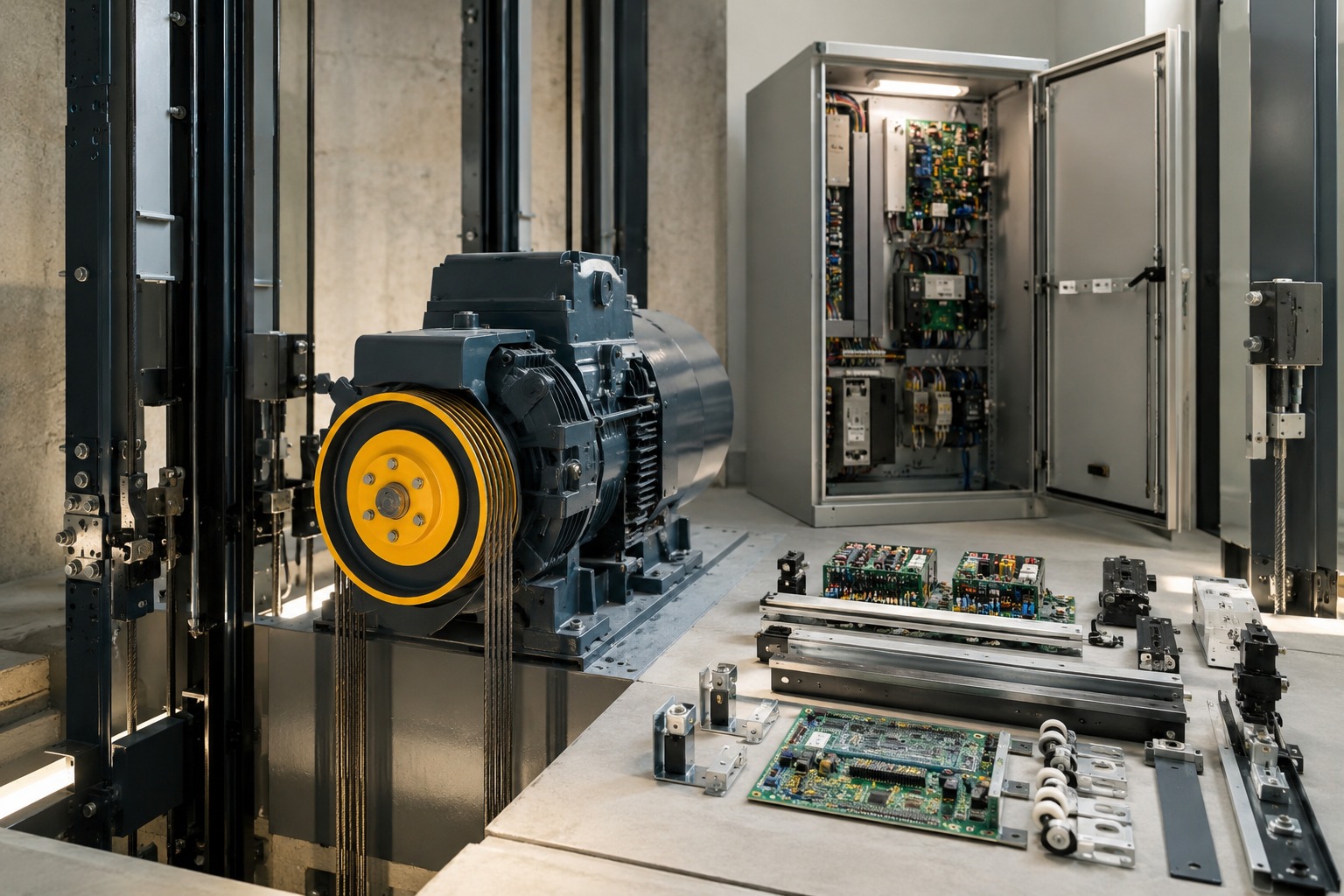
Elevator traction motors have a direct effect on ride quality, leveling accuracy, energy use, machine-room noise, and long-term service stability. In the United States, where building owners in cities such as New York, Chicago, Los Angeles, Houston, Miami, Seattle, and Atlanta manage both aging mid-rise assets and high-rise modernization projects, selecting the right traction motor is more than a component purchase. It is a system decision that affects downtime, code compliance, contractor labor, passenger comfort, and lifecycle cost.
The short answer is simple: the best replacement motor is not always the highest-power or newest-design option. The correct choice depends on sheave dimensions, rated load, speed, duty cycle, controller compatibility, encoder feedback, brake parameters, available installation space, and the building’s modernization goals. For many projects, permanent magnet synchronous motors are now preferred because they reduce energy consumption, improve ride smoothness, and support compact machine designs. At the same time, conventional geared solutions and carefully matched legacy replacements still make sense for cost-sensitive or phased modernization work.
This guide explains the main elevator traction motor types, the benefits of permanent magnet synchronous motor technology, practical notes for Hitachi HGP motor sourcing, how to match motor power with the controller, what to check during installation and alignment, which maintenance signs often appear before failure, and how to plan modernization for U.S. buildings through 2026 and beyond.
For maintenance companies, distributors, building owners, and modernization contractors, the goal is usually the same: reduce shutdowns, source compatible replacement parts quickly, and keep elevators operating safely. That is why experienced parts suppliers focus on careful model identification, stable incoming inspection, protective packaging for domestic and port-based transport routes, and responsive support for projects moving through hubs such as Long Beach, Newark, Savannah, Houston, and Los Angeles.
Why traction motors shape lift efficiency, noise, and ride quality
The traction motor is the force source that turns the drive sheave and moves the elevator car through the rope system. Because it interacts with the inverter, brake, encoder, bearings, machine frame, and suspension components, its performance directly affects multiple passenger-facing outcomes.
- Efficiency depends on motor design, control strategy, and operating load profile.
- Noise is influenced by electromagnetic design, bearing condition, brake release behavior, alignment, and structural vibration transfer.
- Ride quality is tied to torque smoothness, feedback accuracy, acceleration control, and leveling response.
- Reliability depends on insulation life, thermal management, bearing health, and the quality of installation.
In older office towers in Manhattan or Chicago’s Loop, passengers often notice jerky starts, machine-room hum, or poor leveling before a motor is officially diagnosed as weak. In newer multifamily towers in Austin, Nashville, or Seattle, owners are more likely to track energy efficiency, standby consumption, and modernization ROI. Both use cases point to the same conclusion: traction motors should be evaluated as part of the elevator drive system, not as isolated catalog items.
Traction motor types explained
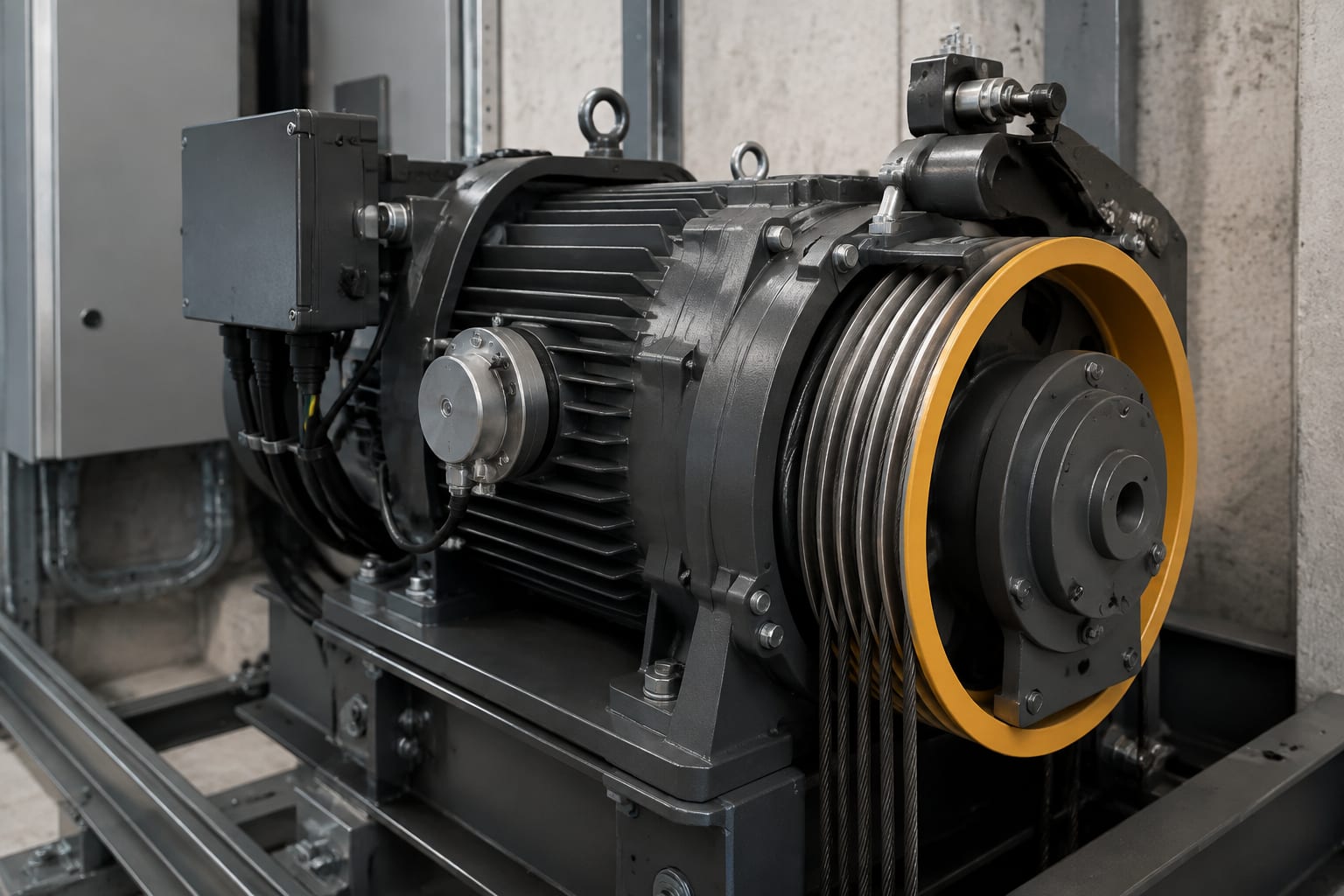
Elevator traction motors used in the United States generally fall into several practical categories: geared AC traction motors, gearless AC motors, permanent magnet synchronous motors, and application-specific variants matched to modernization or OEM systems. The right type depends on building height, speed, machine-room layout, and existing controller architecture.
Geared traction motors remain common in older low-rise and mid-rise buildings. They are often easier to service with familiar field practices and may be cost-effective where machine-room space is available and speed requirements are moderate. However, they usually generate more noise, require more mechanical maintenance, and are less efficient than modern gearless systems.
Gearless motors are common in higher-performance applications. Their direct-drive characteristics reduce mechanical losses and can improve ride smoothness. Permanent magnet synchronous motors, a major subset of modern gearless solutions, are increasingly used in both new installations and modernization work because they deliver high torque density and support compact machine designs.
| Motor Type | Typical Building Use | Main Advantages | Main Limitations | Noise Profile | Modernization Fit |
|---|---|---|---|---|---|
| Geared AC traction motor | Low-rise and mid-rise legacy systems | Familiar service practices, lower initial cost | Higher maintenance, lower efficiency | Moderate to high | Good for phased budget upgrades |
| Gearless induction motor | Mid-rise to high-rise systems | Smooth operation, fewer mechanical losses | Larger frame than PM in some cases | Low to moderate | Strong where controller support exists |
| Permanent magnet synchronous motor | Modernized and new efficient systems | High efficiency, compact size, strong torque control | Requires precise matching and setup | Low | Excellent for energy-focused projects |
| Machine-room-less PM motor | Space-limited buildings | Compact installation, reduced room needs | Access planning is critical | Low | Very good for urban retrofits |
| OEM-specific replacement motor | Brand-matched service work | Higher compatibility confidence | Longer lead times possible | Varies | Best for exact model replacement |
| Custom-adapted modernization motor | Mixed legacy equipment upgrades | Flexible engineering path | Needs detailed survey and integration checks | Low to moderate | Useful in complex retrofit projects |
The table above shows why there is no universal best motor type. A budget-driven replacement in a school district building in Ohio may justify a geared legacy-compatible solution, while a hospitality tower in Miami or a medical center in Dallas may benefit more from a PM synchronous system that lowers vibration and improves floor-to-floor consistency.
Permanent magnet synchronous motor benefits
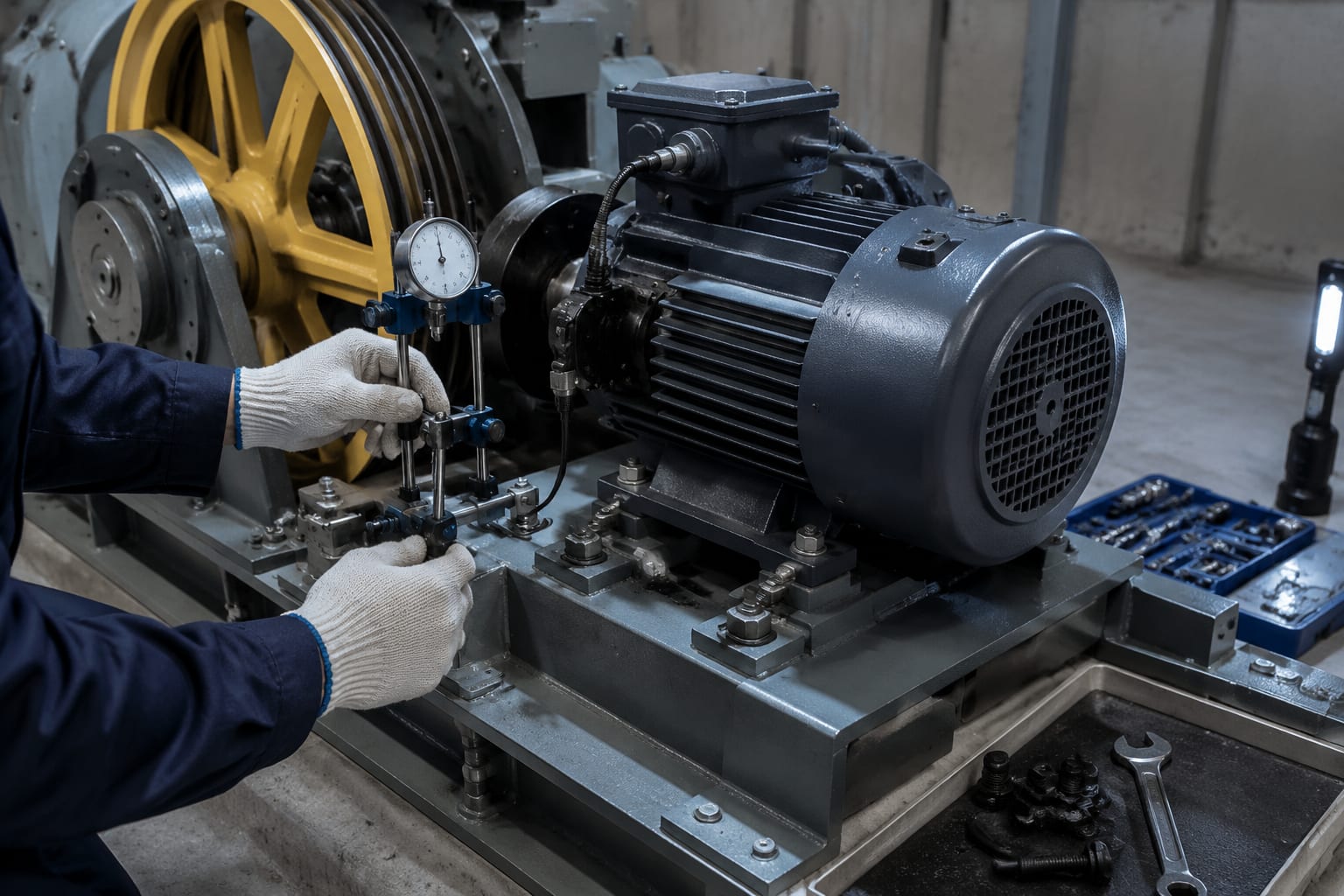
Permanent magnet synchronous motors have become a leading choice in U.S. elevator modernization because they address three pressures at once: energy savings, passenger comfort, and space efficiency. They typically provide higher efficiency than older geared arrangements because they reduce transmission losses and support precise variable-frequency control. The result is better torque response at low speed, smoother acceleration and deceleration, and improved leveling accuracy at landings.
For building owners, the most visible benefit is often a quieter and smoother ride. For service companies, the key benefit is better controllability when correctly matched with the inverter and encoder. For modernization contractors, compact dimensions can simplify projects in constrained machine rooms or machine-room-less layouts.
| Benefit Area | How PM Motors Help | Operational Impact | Who Benefits Most | Typical Project Result | Priority Level |
|---|---|---|---|---|---|
| Energy efficiency | Lower electrical losses and better torque control | Reduced utility costs | Owners and facility managers | Improved lifecycle economics | High |
| Ride comfort | Smoother acceleration and leveling | Better passenger experience | Hotels, offices, apartments | Fewer ride complaints | High |
| Noise reduction | Less gear noise and better dynamic control | Quieter machine operation | Residential and healthcare sites | Lower nuisance issues | High |
| Space savings | Compact design with high torque density | Easier retrofit planning | Urban modernization contractors | Better fit in tight spaces | Medium |
| Maintenance profile | Fewer mechanical transmission elements | Reduced mechanical wear points | Service teams | More predictable maintenance | Medium |
| Control integration | Works well with modern VVVF systems | Stronger speed and torque precision | Modernization specialists | Improved dispatch and leveling | High |
When considering a PM upgrade, buyers should verify not only motor power but also rated torque, base speed, overload capacity, brake voltage, encoder type, mounting geometry, sheave groove profile, and the inverter’s parameter range. In some cases, a project will also require updated power supplies, encoder interfaces, braking circuits, or machine bed modifications. A replacement that appears simple in a product photo can become costly if these details are not checked early.
For buyers seeking compatible PM options, sourcing through a supplier familiar with model matching can reduce errors. This is especially important when evaluating parts like a permanent magnet synchronous elevator motor for modernization where the project team needs to compare mechanical dimensions and controller-side communication requirements before shipment.
The line chart reflects a realistic market pattern: modernization demand in the United States has continued to rise as aging installed bases in major metro areas push owners toward efficiency, reliability, and parts availability upgrades. Demand is particularly strong in mixed-use and multifamily sectors where tenant expectations and operating costs are both under scrutiny.
Hitachi HGP motor sourcing notes
When sourcing Hitachi HGP elevator motors or compatible replacement units, the most important rule is to match by complete technical identity rather than by visual similarity alone. Nameplates, motor codes, load and speed ratings, brake data, encoder specifications, and sheave dimensions all matter. A wrong assumption can lead to installation delays, fault trips, or poor ride performance.
For U.S. buyers, the practical sourcing workflow usually includes collecting photos of the nameplate, machine assembly, brake, encoder, sheave, and terminal arrangement; confirming whether the motor is part of a broader modernization scope; checking whether the controller parameters are available; and verifying shipping constraints to the jobsite. Urban projects in Boston or San Francisco may have rigging and access limitations that affect replacement choices as much as electrical compatibility does.
| Sourcing Checkpoint | What to Confirm | Why It Matters | Common Risk | Best Practice | Outcome |
|---|---|---|---|---|---|
| Motor nameplate | Model, voltage, current, power, duty | Baseline compatibility | Ordering by appearance only | Provide clear close-up photos | More accurate quote |
| Sheave details | Diameter, grooves, rope count | Mechanical fit and traction behavior | Mismatched roping interface | Measure and document dimensions | Fewer field changes |
| Brake specification | Voltage, torque, release method | Safe stopping and controller integration | Brake mismatch alarms | Match brake data before shipping | Safer commissioning |
| Encoder type | Signal type, resolution, connector | Accurate speed feedback | Unstable leveling or trips | Verify with controller requirements | Smoother operation |
| Mounting dimensions | Bolt pattern, shaft position, frame size | Physical installation success | Unexpected adapter work | Review installation drawings | Lower labor time |
| Lead time and packaging | Transit planning and protection | Prevents downtime and transit damage | Schedule slips or damage in freight | Use protected export-grade packing | Better delivery reliability |
If your project involves a Hitachi system, it can be useful to compare technical details against a product reference such as this Hitachi HGP permanent magnet synchronous motor option. The purpose is not to assume one model fits all, but to organize dimensional and specification checks before purchase.
Sourcing notes also extend to logistics. Components entering through ports such as Long Beach, Newark, Savannah, or Houston should be packaged to resist moisture, shock, and handling damage. U.S. contractors often underestimate the effect of inland transport from port to warehouse to jobsite. Proper protective packaging and labeling reduce the chance of damaged encoders, brake covers, or connector assemblies before the motor ever reaches the machine room.
Motor power and controller matching
Matching motor power to the controller is one of the most common failure points in elevator modernization. A traction motor is not correctly matched simply because the kilowatt rating looks close. The inverter must be able to deliver the correct current, manage acceleration and deceleration profiles, handle regenerative conditions where applicable, and interpret encoder feedback correctly. The brake circuit and power supply must also align with the motor’s operating characteristics.
For example, if a PM motor is installed on a controller with poor parameter tuning or insufficient current margin, the result can be overcurrent faults, rough starts, thermal stress, or inconsistent floor leveling. On the other hand, a well-matched system can significantly improve dispatch quality and reduce nuisance callbacks.
| Matching Item | Motor Side Data | Controller Side Data | Why It Must Match | Typical Problem if Wrong | Field Recommendation |
|---|---|---|---|---|---|
| Rated power | kW or HP | Drive output capacity | Ensures adequate continuous operation | Overload trips | Check continuous and peak rating |
| Rated current | Nameplate current | Inverter current range | Protects motor and drive | Heating or nuisance faults | Review thermal margins |
| Rated speed | RPM or sheave speed basis | Frequency and speed control limits | Stabilizes travel performance | Ride instability | Parameter mapping review |
| Encoder feedback | Pulse/resolver specification | Feedback interface compatibility | Accurate closed-loop control | Leveling errors | Confirm connector and signal type |
| Brake data | Voltage and release timing | Brake control output | Safe start and stop behavior | Jerks or unsafe release timing | Test release sequence |
| Overload profile | Short-term torque capacity | Drive overload capability | Supports peak duty periods | Trips during traffic peaks | Use realistic traffic modeling |
The table highlights an important point for modernization planning in the United States: a replacement motor should be reviewed alongside the inverter, control board, encoder chain, and brake circuit. This is particularly important in hospitals, airports, mixed-use towers, and transit-adjacent buildings where heavy peak traffic exposes any weakness in tuning or capacity.
The bar chart shows stronger replacement demand in residential and office segments, which reflects the large number of aging elevators in these categories across U.S. metropolitan areas. Healthcare and hospitality also remain active because ride comfort, uptime, and noise control have direct operational value in those settings.
Installation and alignment checks
Even the right motor can perform poorly if installation and alignment are not handled correctly. Alignment errors can produce rope wear, vibration, abnormal bearing load, brake drag, sheave groove issues, and passenger discomfort. During replacement or modernization, installers should treat the motor as part of a precision drive assembly rather than a heavy mechanical swap.
Key checks include base flatness, mounting bolt torque, shaft and sheave alignment, rope position, brake operation, encoder integrity, grounding, cable routing, and no-load versus loaded test performance. In older buildings, technicians should also inspect machine bed condition, structural fatigue, and anchoring points. A motor installed on a compromised base will often transmit noise into the structure even if the motor itself is functioning correctly.
| Installation Check | What to Inspect | Acceptance Goal | Risk if Ignored | Tools Needed | Service Note |
|---|---|---|---|---|---|
| Machine base condition | Flatness, cracks, anchor points | Stable support platform | Vibration and misalignment | Straightedge, torque tools | Critical in older machine rooms |
| Mounting hardware | Bolt grade and torque | Secure fastening | Movement under load | Torque wrench | Recheck after trial runs |
| Sheave alignment | Rope path and groove line | True rope tracking | Uneven wear and noise | Laser or alignment tools | Important for long rope life |
| Brake operation | Release timing and clearance | Smooth safe start/stop | Jerking or drag heating | Meter and feeler gauges | Verify under loaded test |
| Encoder connection | Signal integrity and shielding | Stable feedback | Faults and poor leveling | Meter, controller diagnostics | Protect from cable stress |
| Noise and vibration test | No-load and full-load behavior | Consistent smooth operation | Hidden commissioning issues | Vibration meter, sound checks | Document baseline readings |
These checks are especially important in coastal or humid U.S. regions such as Florida, the Gulf Coast, or the Pacific Northwest, where corrosion and moisture exposure can affect hardware, insulation, and machine-room conditions. On modernization projects, field teams should not assume existing grounding or cable routing is adequate for new PM systems, which may be more sensitive to feedback integrity and parameter tuning.
Maintenance signs before failure
Traction motors rarely fail without warning. In many cases, maintenance teams can identify early signs and plan replacement before a shutdown becomes urgent. The challenge is that symptoms often look like general ride or control issues at first. A structured inspection routine helps separate motor-related problems from brake, inverter, rope, or structural causes.
Common warning signs include rising vibration, bearing noise, abnormal temperature increase, repeated leveling corrections, intermittent overcurrent faults, brake release hesitation, unusual odor from insulation heating, visible dust accumulation from wear, and inconsistent performance during peak traffic. Trending data over time is more useful than a single observation.
| Warning Sign | Likely Cause | How It Appears | Urgency Level | Immediate Action | Long-Term Response |
|---|---|---|---|---|---|
| Increasing vibration | Bearing wear or alignment drift | Noise and rough ride | High | Measure and inspect bearings | Plan overhaul or replacement |
| Thermal rise | Overload, poor ventilation, winding stress | Hot housing or repeated trips | High | Check current and cooling path | Review capacity and tuning |
| Brake drag symptoms | Improper release or wear | Jerky starts, heat, smell | High | Inspect brake timing and surfaces | Repair brake and verify controller logic |
| Leveling inconsistency | Encoder or torque control issues | Misleveling at floors | Medium to high | Check feedback signals | Retune or replace affected parts |
| Intermittent faults | Electrical instability or weak insulation | Random shutdowns | Medium to high | Review logs and insulation tests | Schedule deeper diagnostic work |
| Unusual mechanical noise | Sheave, bearing, or mount issue | Hum, scrape, or growl | Medium | Localize sound source | Correct alignment or component wear |
Maintenance teams in dense service territories such as New York City, Northern New Jersey, Southern California, or the Dallas-Fort Worth area often benefit from keeping a structured motor data file for each unit: nameplate details, past insulation readings, vibration baseline, fault history, brake measurements, and replacement part references. This improves decision speed when signs of decline start to appear.
The area chart illustrates a trend many U.S. contractors already see in the field: building owners are moving from reactive repair to planned modernization. Rising downtime costs, tenant expectations, and energy objectives are making scheduled upgrades more attractive than repeated emergency interventions.
Modernization planning tips
Successful traction motor modernization starts with a complete equipment survey. Before selecting a replacement strategy, the project team should document the existing machine, controller, brake, encoder, ropes, sheave, machine bed, power supply, and traffic profile. This creates a decision basis for whether to perform a direct replacement, a motor-plus-controller package upgrade, or a broader drive-system modernization.
In the United States, modernization planning should also consider local labor scheduling, AHJ expectations, building access restrictions, after-hours work windows, and shipping lead times. A project in downtown San Francisco may require a very different logistics plan than one in suburban Phoenix or industrial New Jersey. Rigging, hoisting path, and temporary shutdown communication can influence total cost as much as the motor price itself.
For 2026, three trends are shaping modernization decisions. First, sustainability pressure is increasing, especially among commercial property groups tracking ESG goals and utility usage. Second, digital diagnostics and predictive maintenance are becoming more common, making encoder health, vibration trends, and controller logs more valuable in planning replacement timing. Third, policy and building performance expectations are encouraging owners to replace older high-loss equipment with more efficient drive systems where practical.
A strong modernization plan should answer these questions:
- Is the current problem isolated to the motor, or does it include control and brake issues?
- Will an exact replacement reduce risk, or is a PM upgrade more cost-effective over the next ten years?
- Can the existing controller fully support the replacement motor?
- Are machine-room dimensions and rigging routes confirmed?
- What spare parts should be stocked to reduce future downtime?
- How will ride quality and energy savings be measured after commissioning?
Owners in multifamily, office, healthcare, education, hospitality, and mixed-use properties all benefit from phased planning. For example, a property portfolio in Atlanta or Denver may schedule modernization one bank at a time, prioritizing the units with the highest service calls or the worst energy performance. This approach controls budget while reducing the risk of simultaneous shutdowns.
The comparison chart shows why specialized sourcing matters in elevator traction motor work. Generic industrial supply channels may offer broad catalog access, but elevator projects usually need stronger model matching, dimensional review, packaging discipline, and compatibility support. This becomes especially important for OEM-related or modernization-sensitive projects.
United States market, industries, and applications
The U.S. market for traction motor replacement is driven by the age of the installed base, urban redevelopment, rising expectations for ride quality, and ongoing commercial-to-residential repositioning in some downtown cores. Cities with significant modernization activity include New York, Chicago, Los Angeles, Miami, Dallas, Houston, Boston, Philadelphia, Seattle, San Diego, and Washington, D.C. Port-linked trade hubs such as Newark, Long Beach, Savannah, and Houston also matter because imported components and replacement parts often move through these gateways before final delivery.
Different industries prioritize different motor characteristics:
- Residential buildings prioritize quiet rides, efficient operation, and low callbacks.
- Office towers prioritize handling peak traffic and minimizing tenant disruption.
- Healthcare facilities prioritize reliability, smooth leveling, and low vibration.
- Hotels prioritize passenger comfort and unobtrusive machine noise.
- Education and public buildings prioritize budget control and dependable uptime.
- Industrial and mixed-use sites prioritize durability and serviceability.
Applications also vary by building form. A low-rise suburban property may only need a straightforward legacy-compatible solution, while a high-rise urban redevelopment may require a PM motor with careful controller integration and machine-room access planning. In either case, the buying decision should be based on actual survey data, not assumptions.
Technological, manufacturing, and service capabilities that support sourcing
For buyers evaluating a supply partner, it helps to look beyond catalog listings and focus on practical execution. On the technology side, capable suppliers support model matching through nameplate review, drawing comparison, encoder and brake specification checks, and compatibility screening for elevator-specific applications. This reduces the risk of ordering a motor that fits the mounting pattern but fails at commissioning because the feedback interface or brake logic does not align with the controller.
On the manufacturing side, reliable sourcing depends on consistent quality inspection, stable handling of critical elevator components, and packaging that protects motors, encoders, and accessories through domestic and international transport. For projects routed through U.S. logistics corridors, careful packing and labeling are not minor details; they are part of uptime protection. Buyers frequently need confidence that replacement parts will arrive clean, protected, and traceable.
On the service side, responsive communication makes a measurable difference. Maintenance companies and modernization contractors often need quick support for model confirmation, photos, dimensional questions, and shipment updates. Fast feedback helps reduce downtime exposure, especially when a building in a high-traffic market is waiting on a motor or related parts. A supplier that understands elevator system matching can also help customers source associated components such as control boards, inverter parts, encoders, power supplies, guide shoes, door operator parts, sensors, and intercom accessories when a project reveals broader replacement needs.
For some Hitachi-related door or system projects, buyers may also need to distinguish between traction machine motors and other PM-driven components. A reference such as this Hitachi permanent magnet synchronous door motor can help clarify product category differences during procurement planning so the correct part family is selected.
Case examples from common U.S. project scenarios
In a mid-rise apartment modernization in Chicago, the original geared traction motor had increasing bearing noise and frequent leveling corrections. The owner initially wanted only a motor replacement, but survey results showed the existing feedback chain and brake timing were also contributing to the ride issues. A PM synchronous modernization path, combined with control retuning, reduced complaints and lowered machine-room noise.
In a healthcare facility near Houston, reliability mattered more than the lowest upfront cost. The project team prioritized thermal stability, brake consistency, and smooth floor approach. Detailed matching of motor current, encoder type, and controller interface avoided commissioning delays and reduced the risk of unplanned service outages in a mission-critical building.
In a coastal Florida hotel, corrosion exposure and humidity had accelerated wear on machine-room components. The modernization plan included not only a replacement traction motor but also inspection of cable routing, grounding, and protective finishing. This broader approach was necessary because environmental factors, not just age, were affecting performance.
Buying advice for local suppliers and project teams
If you are sourcing in the United States, ask for more than a price. Request model confirmation steps, dimensional review, brake and encoder verification, packing details, and expected lead times to your city or warehouse. Confirm whether the supplier understands elevator-specific compatibility rather than general industrial motor equivalence. This is especially important if the job will be installed under tight timelines in cities with high labor costs or restricted access windows.
A practical buying checklist includes:
- Clear photos of the existing motor nameplate and installation.
- Controller brand and parameter information where available.
- Sheave dimensions and rope details.
- Brake voltage and release method.
- Encoder type and connector information.
- Jobsite city, delivery route, and access constraints.
- Target outcome: exact replacement, phased upgrade, or full modernization.
These steps help maintenance companies, distributors, building owners, and modernization contractors avoid the most expensive mistake in replacement work: ordering a technically close part that still creates field incompatibility.
FAQ about elevator traction motors
How do I know whether I need a replacement or a full modernization?
If the motor problem is isolated and the controller, brake logic, encoder chain, and mechanical base remain sound, a replacement may be enough. If there are repeated faults, poor ride quality, obsolete controls, or difficult parts availability, a broader modernization is usually the better long-term decision.
Are permanent magnet synchronous motors always better?
Not always. They are often better for efficiency, ride quality, and compact design, but they require careful controller matching and installation planning. In some legacy or budget-constrained situations, a conventional compatible replacement can still be the right choice.
Can I match a motor by kilowatt rating alone?
No. You also need to confirm rated current, speed, torque profile, brake data, encoder type, sheave details, mounting geometry, and controller compatibility. Matching by power alone is a common source of project failure.
What are the earliest signs of traction motor trouble?
Watch for increasing noise, vibration, heat, leveling inconsistency, brake drag symptoms, intermittent faults, and unusual smells. Trend data from inspections is more useful than isolated observations.
Why does installation quality matter so much?
Because alignment, mounting integrity, brake setup, and feedback stability directly affect noise, ride quality, wear rate, and fault frequency. A correctly selected motor can still underperform if installed poorly.
What should U.S. buyers prepare before requesting a quote?
Prepare motor nameplate photos, machine photos, controller information, sheave dimensions, brake and encoder details, and jobsite delivery information. This speeds up compatibility review and reduces ordering risk.
How do future trends affect replacement planning in 2026?
Expect continued movement toward energy-efficient PM systems, more predictive maintenance using diagnostics, and greater owner interest in sustainability and lifecycle cost. Planning now with future serviceability in mind can reduce repeated modernization spending later.
In summary, elevator traction motors influence much more than movement. They shape comfort, noise, uptime, and operating cost. In the United States, where building conditions and service expectations vary widely by region and building type, the most successful projects combine detailed technical matching, careful installation, realistic modernization planning, and dependable sourcing support.