
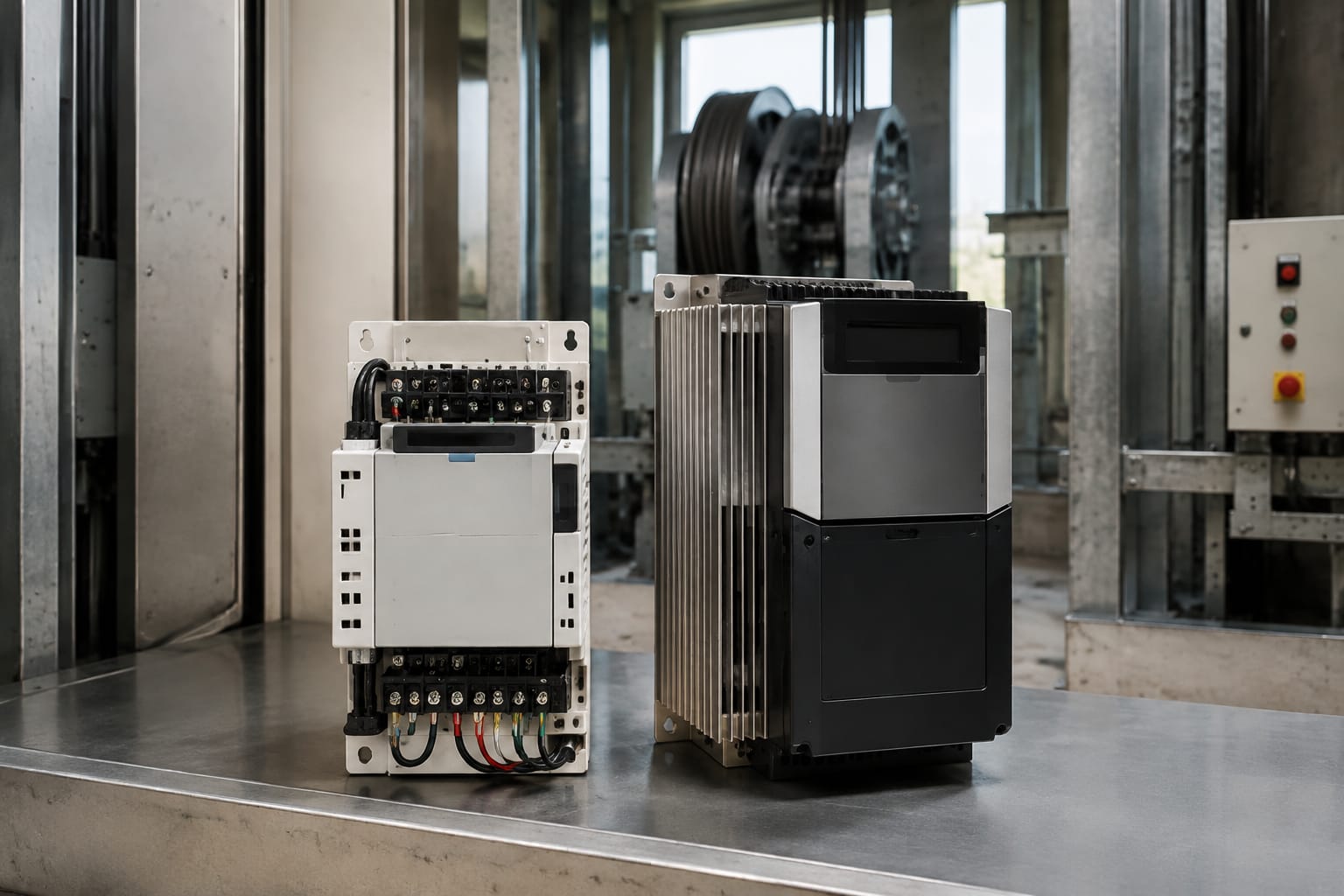
An elevator soft starter is generally the better fit when a fixed-speed motor needs reduced-voltage starting with a relatively simple control arrangement. A variable frequency drive (VFD) is the right choice when the elevator requires controlled acceleration, deceleration, leveling support, or variable-speed operation.
They are not interchangeable substitutes. A soft starter reduces the electrical and mechanical shock of starting, but normally hands the motor over to line-frequency operation after acceleration. A VFD continuously regulates motor speed and torque by changing output frequency and voltage. Before replacing either device, confirm the motor type, controller design, travel profile, protective devices, and available input power.
How an elevator soft starter works
An elevator soft starter limits the voltage applied to an AC motor during startup. Instead of immediately applying full line voltage, it uses power semiconductors, commonly SCRs, to ramp voltage upward over a set starting period. The motor develops torque more gradually, reducing the abrupt inrush and mechanical jolt associated with across-the-line starting.
Once the motor reaches operating speed, many soft-starter arrangements use a bypass contactor. The bypass contactor transfers the motor to full line voltage so the soft starter no longer carries the continuous motor current. The elevator then runs at its normal fixed speed, determined by the utility frequency and the motor’s design.
For elevator equipment, the useful distinction is straightforward:
- A soft starter controls the start and, in some designs, a controlled stop.
- It does not provide normal variable-speed motion during travel.
- It is commonly associated with fixed-speed or certain two-speed motor applications, subject to the controller and motor arrangement.
- It must be matched to motor current, duty cycle, starting torque requirements, and the mechanical brake sequence.
Soft starting can reduce shock to couplings, gears, belts where present, and other mechanical components. It can also reduce nuisance voltage dip concerns on smaller electrical services. However, reducing voltage also reduces available motor torque. A setting that is too conservative may leave the car unable to accelerate reliably, particularly with a heavily loaded car, high inertia, or a demanding traction system.
Soft starter limits in elevator service
A soft starter does not create the precision speed profile expected from modern variable-voltage, variable-frequency elevator systems. It cannot independently hold a crawl speed, optimize floor approach speed, or compensate for changing load with the same control range as a VFD.
It may also be unsuitable where the existing machine and controller depend on regulated torque throughout acceleration and deceleration. The decision should be based on the whole motion-control system, not simply on the starting-current rating printed on the motor nameplate.
How a VFD controls elevator motion
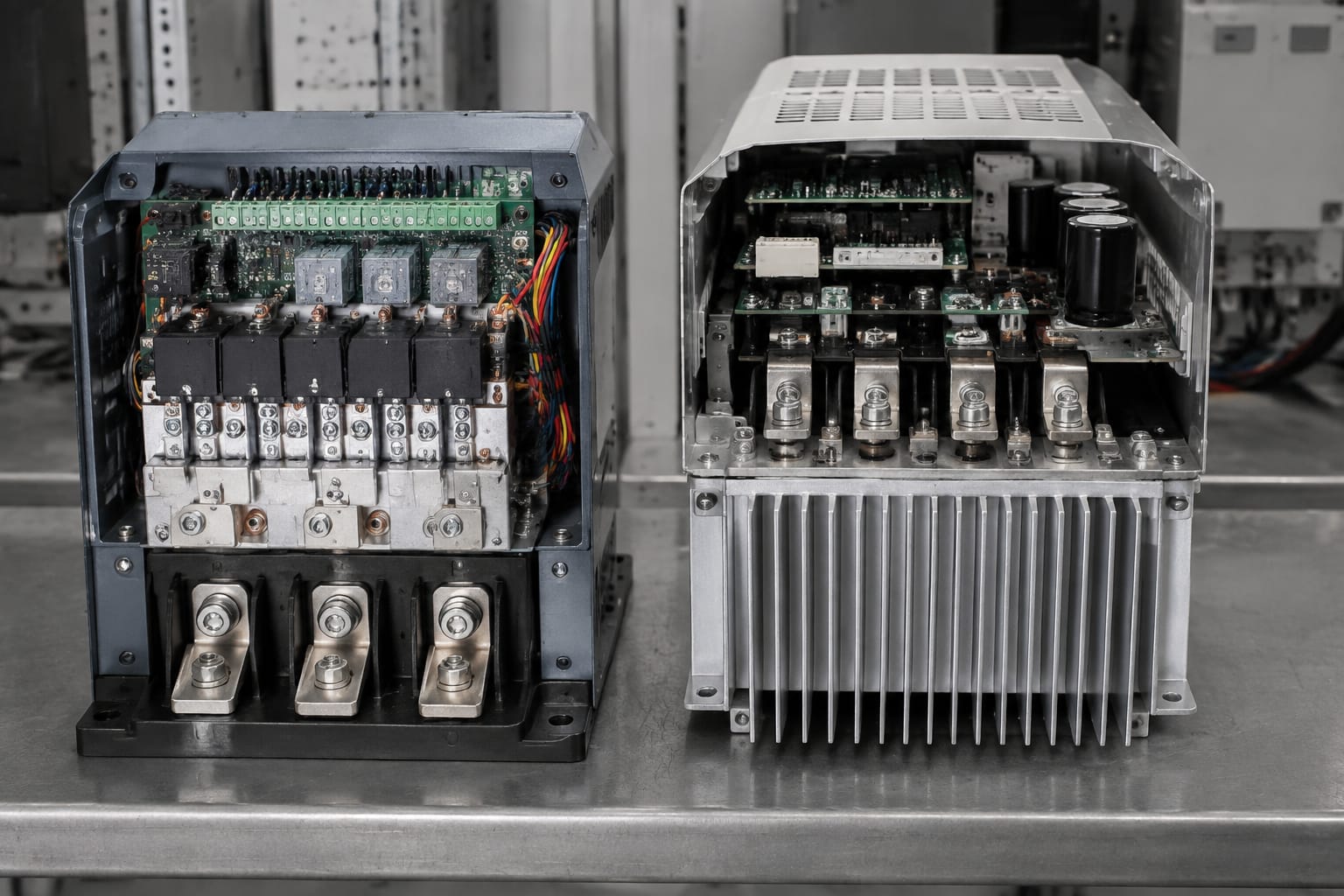
A VFD, also called an AC drive or variable frequency drive, first converts incoming AC power to DC and then electronically produces AC output at a controlled frequency and voltage. By varying that output, the drive changes the motor’s speed and available torque.
In an elevator application, the drive can manage a motion profile rather than merely soften the initial start. A typical profile may include:
- Controlled torque buildup before brake release.
- Smooth acceleration to contract speed.
- Constant-speed travel.
- Controlled deceleration as the car approaches the landing.
- Low-speed approach and stop coordination.
- Brake application after the motor is brought to an appropriate stopping condition.
The exact sequence depends on the elevator controller, motor, encoder or feedback arrangement, and drive programming. Modern systems may use open-loop vector control, closed-loop vector control, or other motor-control methods. Feedback devices such as encoders may be required where accurate speed regulation and leveling performance are needed.
A VFD can be used with suitable induction motors and, in properly engineered systems, permanent-magnet synchronous motors. Motor compatibility is not assumed: the drive must support the motor technology, feedback method, voltage, current, and application duty.
Why elevator drives need application-specific setup
A general-purpose industrial VFD is not automatically appropriate for elevator motion. Elevator operation has safety-chain interfaces, brake-control timing, inspection operation, rescue functions, leveling demands, and potentially high duty cycles. The controller and drive must be designed to communicate correctly, and all relevant safety functions must remain intact.
Drive parameters also matter. Incorrect acceleration, current limit, motor data, braking, or torque settings can cause poor starts, overspeed faults, stopping errors, or excessive heat. Use the equipment documentation and qualified elevator personnel when commissioning or changing motion-control parameters.
Starting current and motor stress
Both controls can reduce the shock of across-the-line starting, but they do so differently.
An across-the-line starter applies full voltage immediately. This can produce high inrush current and a sharp torque response. The exact current and torque depend on the motor and load, so selection should be based on measured or documented values rather than a generic multiplier.
An elevator soft starter reduces starting voltage and ramps it upward. This can lower the instantaneous current demand, but motor torque falls substantially as voltage is reduced. If the application needs high breakaway torque, a soft starter may require careful adjustment or may not be an appropriate solution.
A VFD controls frequency and voltage together. It can accelerate the motor from low speed while managing current and torque more deliberately. This gives it a major advantage in applications where the motor must produce predictable torque through the entire acceleration sequence.
| Attribute | Elevator soft starter | VFD elevator control |
|---|---|---|
| Primary purpose | Reduce starting shock | Control speed, torque, acceleration, and deceleration |
| Motor operation after start | Typically full-speed, line-frequency operation | Continuously variable output during travel |
| Starting current management | Reduced-voltage ramp | Current and torque managed through drive control |
| Starting torque flexibility | Limited by reduced-voltage method | Broader control when correctly configured |
| Mechanical stress reduction | Mainly at startup | During start, travel transitions, and stopping |
| Energy recovery capability | No | Possible only with a suitable regenerative or braking arrangement |
| System complexity | Lower | Higher, with more commissioning and compatibility requirements |
Neither approach eliminates the need for correct upstream protection. Branch-circuit protection, overload protection where applicable, disconnecting means, grounding, and controller safety circuits must be designed and verified for the installed equipment. Do not choose a protective device solely by matching a previous part number.
Speed control and ride quality
Ride quality is where the difference between an elevator soft starter and a VFD is most evident.
A soft starter can make the initial motor pickup less abrupt than a full-voltage start. It may improve the perceived transition from stopped to running in a suitable fixed-speed system. But after the ramp completes, the motor operates at its normal speed. The system has limited ability to shape acceleration, deceleration, or approach speed.
A VFD can provide a smoother overall travel profile because it controls speed throughout the run. Properly configured drive control can reduce abrupt acceleration, manage deceleration, and support consistent landing approaches. For modernization projects where passenger comfort, precision leveling, or transition quality is a priority, VFD control is usually the more capable approach.
That capability depends on the surrounding system. Poor ride quality can also originate from worn brakes, encoder issues, mechanical backlash, guide-rail conditions, improper car balance, damaged sheaves, or controller programming. Replacing a starter or drive without investigating the root cause can leave the original problem unresolved.
Do not confuse smooth starting with accurate leveling
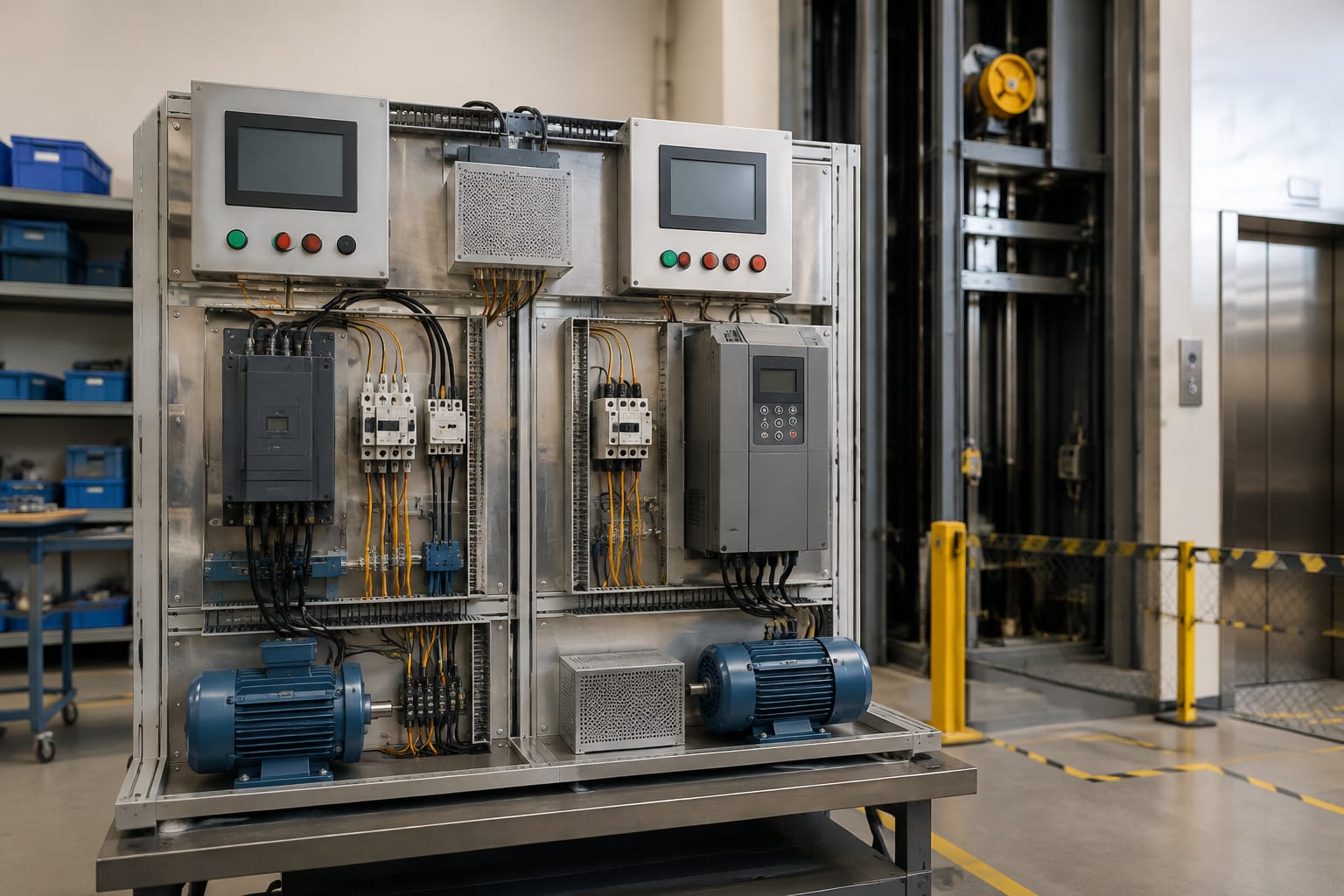
A soft start is not the same as precision leveling. Leveling accuracy depends on the controller’s position and speed information, motor control, brake behavior, and mechanical condition. A VFD may support better approach control, but it does not correct faulty landing sensors, worn brake components, or inaccurate position feedback on its own.
Typical elevator applications
The appropriate control method depends on the existing elevator architecture and project objective.
Situations where a soft starter may fit
An elevator soft starter may be considered when:
- The machine uses a compatible fixed-speed AC motor.
- The objective is to reduce startup current or mechanical shock.
- The controller is intended to operate with soft-start equipment.
- Full variable-speed travel is not required.
- The existing system has suitable contactors, bypass arrangements, and protection.
- The project scope does not justify a full motion-controller modernization.
This is often a replacement or maintenance decision, not necessarily an upgrade path to modern variable-speed performance.
Situations where a VFD is typically preferred
A VFD is generally more appropriate when:
- The elevator needs controlled acceleration and deceleration.
- Ride quality or landing approach performance is a key requirement.
- The controller is designed for VVVF or AC-drive operation.
- The project involves a broader traction-control modernization.
- The motor and feedback equipment are compatible with the intended drive.
- The system needs a designed solution for braking energy and fault handling.
Hydraulic elevators have different motion-control considerations, including pump-motor starting, valve operation, and hydraulic-system behavior. A VFD can be part of a hydraulic power-unit solution, but it should not be selected using traction-elevator assumptions.
Contactors and protection devices
Contactors and protection components remain important whether the elevator uses a soft starter or a VFD. Their roles, however, must follow the controller and drive manufacturer’s intended circuit design.
A soft-starter system commonly uses line contactors and may include a bypass contactor. The bypass component must be correctly rated for the motor current, utilization category, coil voltage, and control-circuit configuration. Contactors also need to be evaluated for mechanical condition, contact wear, coil operation, and auxiliary-contact requirements.
For replacement sourcing, verify the full part identity instead of relying only on the visible frame size. Useful checks include:
- Rated operational current and voltage.
- Coil voltage and AC/DC coil type.
- Number and arrangement of main and auxiliary contacts.
- Mounting method and physical dimensions.
- Interlocks, suppressors, and compatible overload components.
- Applicable controller wiring and safety-circuit function.
For examples of replacement categories, review Fuji AC contactor elevator parts or Siemens AC110V contactor elevator parts only after matching the actual electrical and mechanical requirements.
Protection around VFDs
VFD installations may require input fusing or circuit breakers, line reactors, filters, output reactors, braking components, and grounding practices specified for the drive and building electrical system. Drive output should not be switched with ordinary contactors during normal motor operation unless the equipment design explicitly permits it. Opening or closing a motor-side contactor while the VFD is energizing the motor can damage equipment or create faults.
An upstream circuit breaker must be selected using the equipment documentation and applicable electrical requirements, including available fault current and coordination needs. A small circuit breaker for elevator equipment is a product category, not proof that a particular breaker suits a given drive or motor circuit.
Retrofit and compatibility questions
Replacing a failed soft starter with a VFD, or vice versa, is rarely a one-for-one component swap. The controller logic, motor wiring, brake circuit, travel profile, and safety interfaces may all need changes.
Before planning a retrofit, document the existing installation.
Motor and machine checks
Confirm:
- Motor nameplate voltage, phase, full-load current, frequency, RPM, and insulation condition.
- Motor type, including induction versus permanent-magnet construction.
- Winding connection and available motor leads.
- Machine type, load characteristics, and car counterbalance condition where applicable.
- Presence and condition of encoder, tachometer, or other feedback devices.
- Brake voltage, rectifier arrangement, pickup and drop timing, and brake-switch monitoring.
A motor that has operated directly on line power may need further evaluation before being placed on a PWM drive output. Long motor leads, insulation condition, and output-voltage stress may influence whether additional output filtering is needed.
Controller and electrical checks
Confirm:
- Incoming utility voltage, phase, frequency, and grounding system.
- Main disconnect and branch-circuit ratings.
- Existing control voltage and interface signals.
- Safety-chain design and required inspection, emergency, and rescue functions.
- Available enclosure space, ventilation, and ambient conditions.
- Existing fault logs and the reason the original component failed.
Do not treat a recurring fault as proof that the starter or drive is defective. A low input voltage, failing motor, dragging brake, loose terminal, overheated enclosure, or incorrect parameter can produce similar symptoms.
Common replacement mistakes
Avoid these frequent errors:
- Selecting by horsepower alone instead of current, duty, and application requirements.
- Replacing a soft starter with a standard VFD without redesigning control and brake interfaces.
- Reusing contactors with an incompatible coil voltage or insufficient auxiliary contacts.
- Omitting line or output components required by the VFD documentation.
- Copying drive parameters from a different motor or elevator.
- Ignoring motor feedback requirements.
- Bypassing safety circuits to clear a fault or complete testing.
Elevator electrical work has significant safety implications. Isolation, verification of absence of voltage, stored-energy control, and applicable codes and site procedures are essential. Installation and commissioning should be performed by qualified personnel familiar with the specific elevator system.
Choosing the appropriate control method
Use the control objective as the starting point.
Choose an elevator soft starter when the existing equipment is a compatible fixed-speed system and the real need is a gentler, lower-current start. It can be a practical option when preserving the established control architecture is more important than adding variable-speed capability.
Choose a VFD when the project needs controlled motion throughout the run: smoother acceleration, managed deceleration, speed profiling, and stronger potential for ride-quality improvements. This normally requires a more complete engineering review because the drive becomes a central part of the motion-control system.
A useful selection checklist is:
- Define the problem: high inrush, harsh starts, poor ride, leveling issues, repeated faults, or a planned modernization.
- Identify the current control method and obtain motor, controller, and machine documentation.
- Determine whether the motor and feedback system support the proposed control method.
- Review brake control, contactors, protective devices, input power, and enclosure conditions.
- Compare the retrofit scope, not only the price of the starter or drive.
- Confirm commissioning responsibility, required parameters, and acceptance testing before ordering parts.
For B2B replacement planning, Kelevator can help source multi-brand elevator spare parts when the buyer provides the exact equipment details and required electrical characteristics. The correct next step is to collect the controller model, motor nameplate data, failed-part number, wiring information, and fault history, then validate the replacement against the system documentation before installation.
Related product references
For practical catalog examples related to this topic, review Fuji AC Contactor lift parts elevator accessories, SW contactor AC110V Siemens contactor elevator parts, and Small circuit breaker elevator equipment lift accessories. Confirm the exact model, dimensions, ratings, and connectors before ordering.