
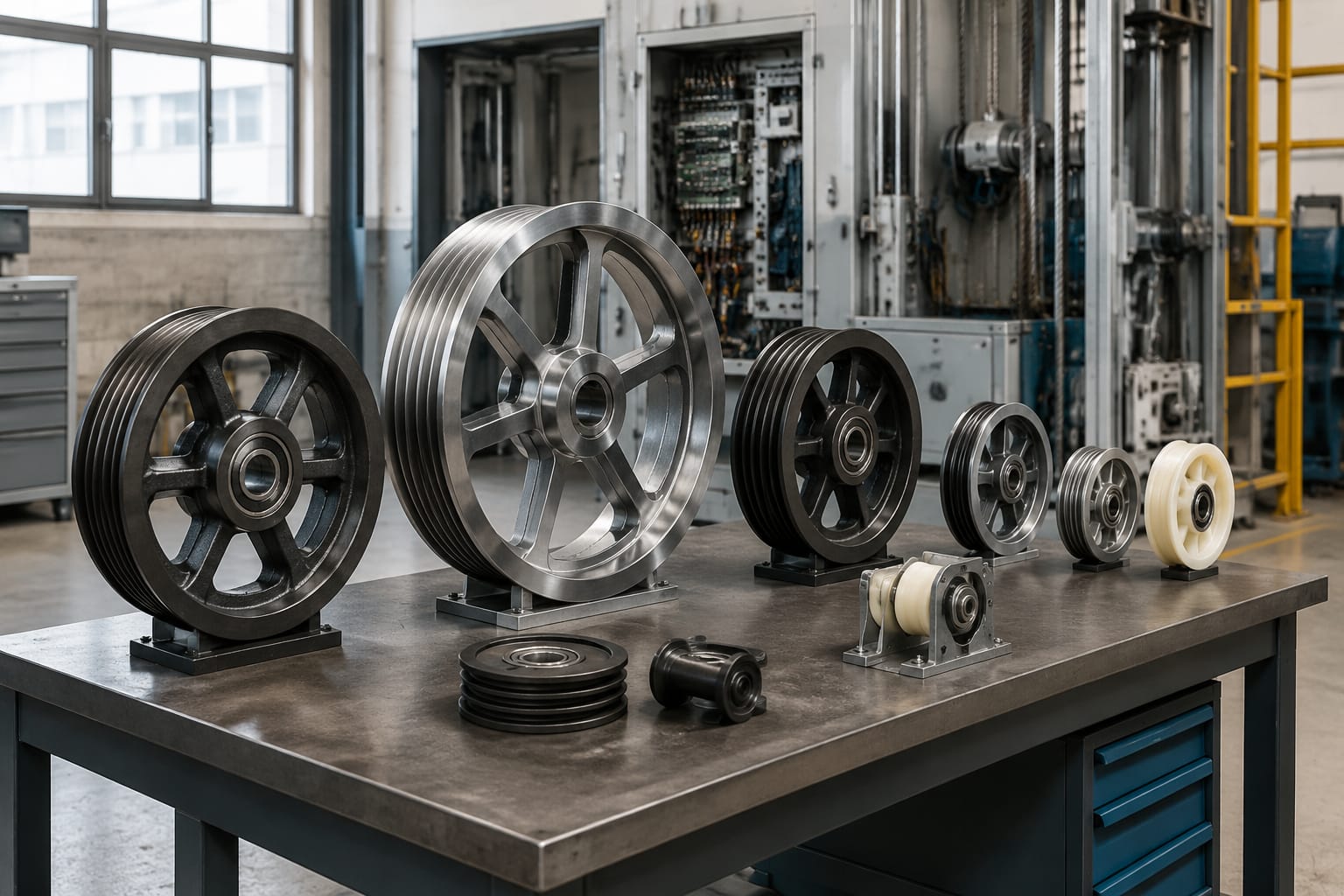
Elevator sheaves are grooved wheels that guide, support, or redirect ropes, belts, or door cables within an elevator system. A correct replacement is not chosen by outside diameter alone. The groove geometry, shaft or bore arrangement, bearing specification, rope or cable size, mounting details, and alignment requirements all determine whether a sheave will run quietly and safely.
For maintenance teams and sourcing professionals, the practical approach is to identify the sheave’s function first, inspect its working surfaces and bearings, document complete dimensions, and compare those details against the equipment’s approved requirements. A visually similar wheel can create accelerated rope wear, tracking problems, vibration, or door-operation faults if its profile or mounting is wrong.
Traction and deflector sheaves
Traction and deflector sheaves are associated with the suspension and counterweight system, but they do different jobs.
A traction sheave is the drive sheave in a traction elevator machine. Hoist ropes pass over its grooves, and friction between the ropes and grooves transfers the machine’s torque to move the car and counterweight. Groove condition is particularly important because it affects traction, rope pressure, and equal load distribution among ropes.
A deflector sheave, also called a deflection sheave in some documentation, redirects the hoist ropes to achieve the needed rope path and suspension ratio. It does not normally provide the driving traction. Depending on the elevator arrangement, it may sit near the machine, in the overhead space, or elsewhere in the roping path.
| Attribute | Traction sheave | Deflector sheave |
|---|---|---|
| Primary purpose | Transmits drive force to hoist ropes | Changes the direction of hoist ropes |
| Driven by machine | Yes | No |
| Groove condition affects | Traction, rope wear, leveling performance | Rope tracking, rope wear, equalization |
| Typical sourcing priority | Exact groove and machine compatibility | Exact rope path, shaft, bearing, and groove compatibility |
| Common concern | Worn grooves reducing traction or uneven rope loading | Bearing wear, misalignment, damaged grooves, rope tracking |
Why traction-sheave groove condition matters
The grooves on a traction sheave are engineered for a specific rope diameter, construction, and traction arrangement. As grooves wear, their shape can become wider, deeper, polished, asymmetric, or inconsistent from one groove to another. Those changes can reduce the intended rope contact and cause ropes to sit at different depths.
Uneven rope seating can lead to unequal tension. In turn, one rope may carry more load, wear faster, or slip differently than the others. Symptoms may include rope dust, abnormal machine noise, erratic leveling, or visible differences in rope position across grooves. These symptoms do not prove that the sheave alone is at fault, but they justify a complete inspection of ropes, tension, alignment, and machine condition.
Do not attempt to solve a traction issue by selecting a generic grooved wheel with a matching diameter. The manufacturer-approved groove profile and roping requirements govern the selection. Re-grooving, undercutting, or altering traction surfaces should be evaluated only under the applicable equipment requirements and by qualified elevator personnel.
Deflector sheaves still need precise matching
Because deflector sheaves do not drive the ropes, they can be underestimated during planning. Their grooves still control the rope path. A worn or misaligned deflector sheave can create side loading, abnormal rope contact, and accelerated wear at a point that may be difficult to see during routine service.
For a deflector sheave replacement, confirm:
- Number of rope grooves and their spacing
- Rope diameter and required groove profile
- Outside diameter and working face width
- Bore size, shaft arrangement, and keyway details where applicable
- Bearing type, dimensions, seals, and retention method
- Hub offset and the sheave’s position relative to its bracket
- Rotation direction only when the assembly design makes it relevant
- Mounting bracket, shaft, or axle configuration
A matching groove count without the same groove pitch or hub offset can put ropes out of line with the machine or hitch points.
Diverting, secondary, and door sheaves
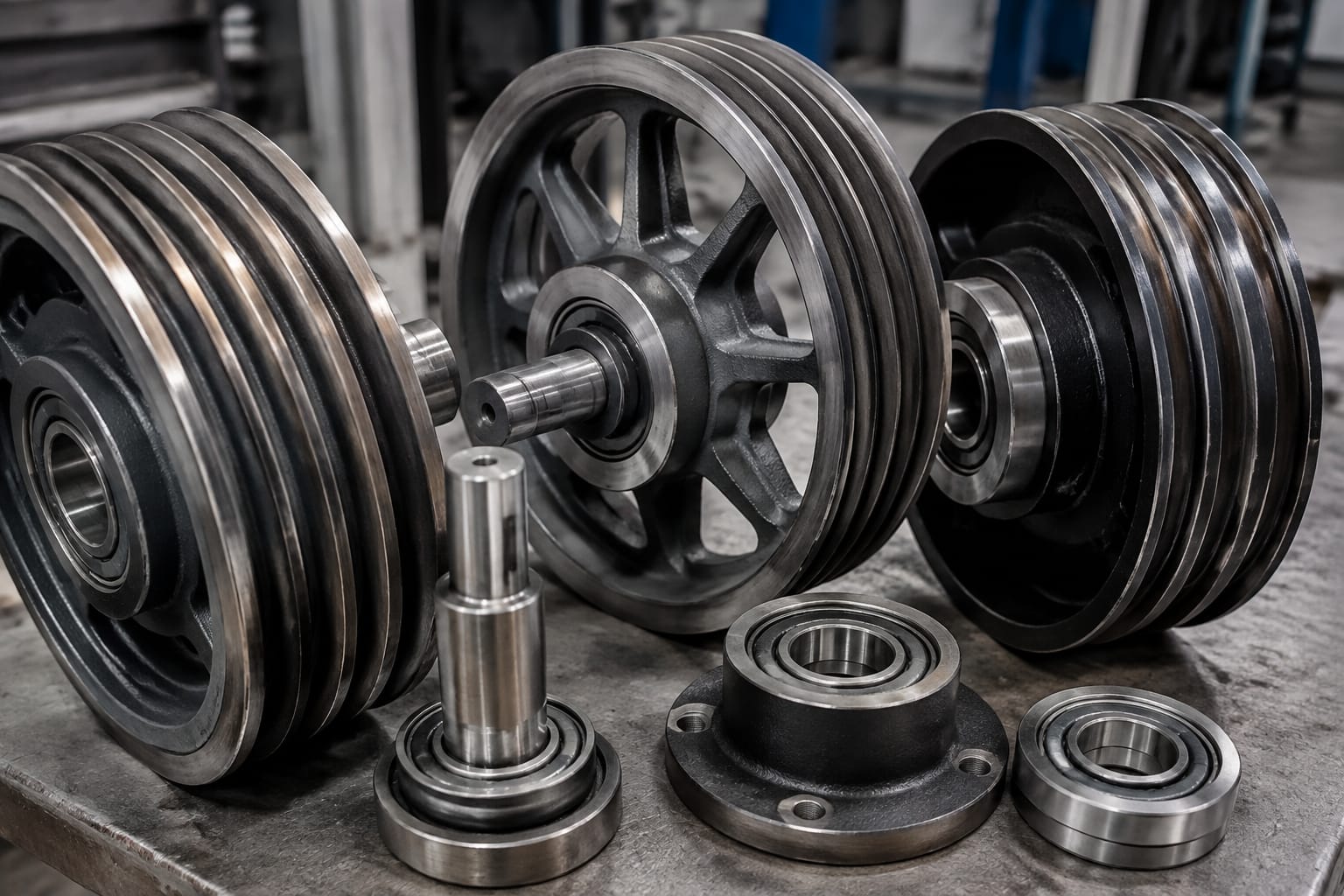
Not every elevator sheave handles hoist ropes. Smaller sheaves may guide governor rope, compensation rope, door cables, or other system-specific components. Their size and function vary, but the replacement principle remains the same: match the component to the system it serves.
Diverting and secondary sheaves
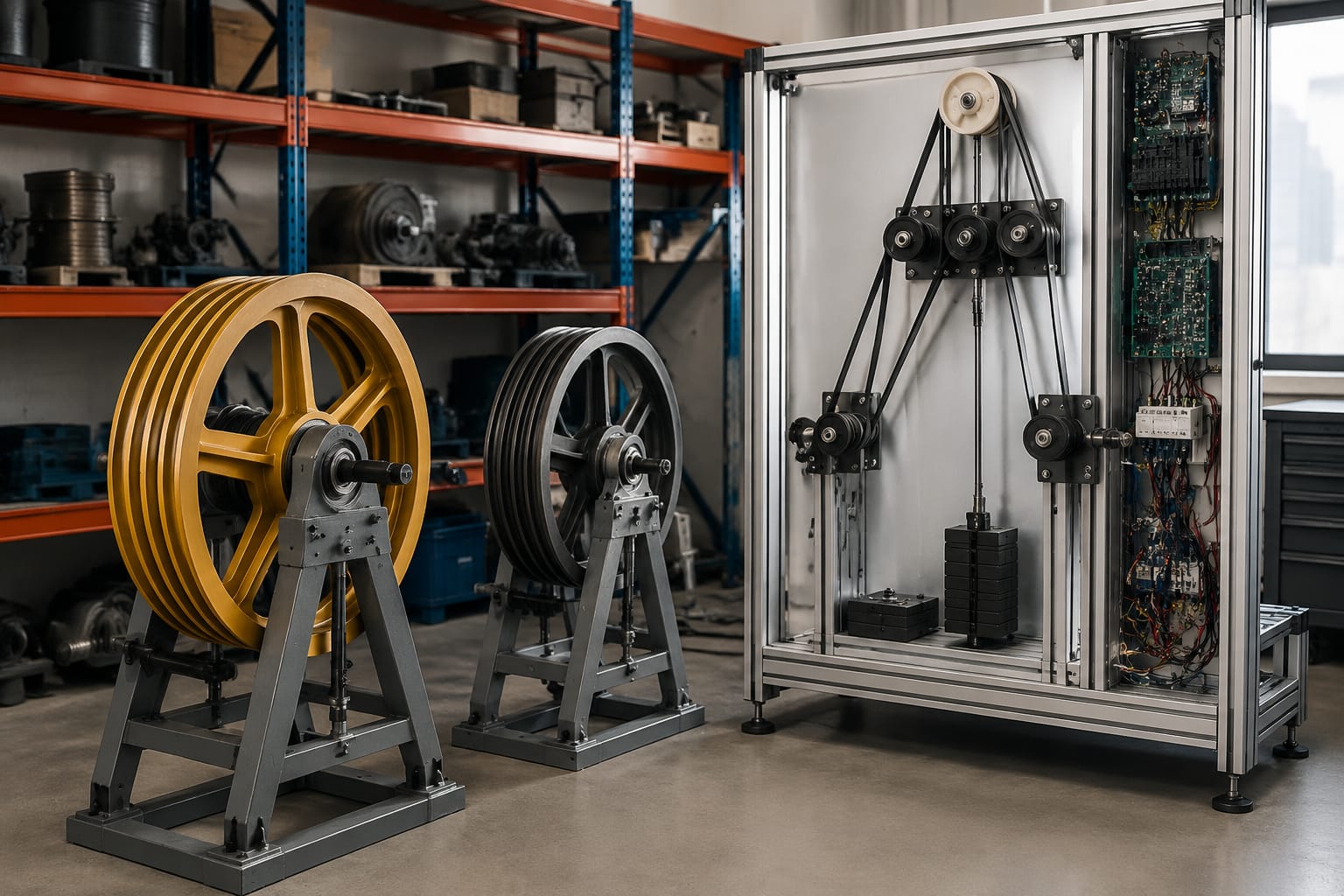
A diverting sheave is a general term for a sheave that redirects a rope path. In elevator usage, it may refer to a sheave in the hoist-rope arrangement or another rope-guidance position, depending on the equipment documentation.
A secondary sheave generally describes an additional sheave in a multi-sheave path rather than a universal component category. It may support a particular roping layout, redirect a rope around structure, or help establish a suspension ratio. The exact name on a work order is less useful than the component’s actual location, rope path, and assembly details.
Before ordering a diverting or secondary sheave, trace the rope route and record where the sheave sits in the assembly. Confirm whether the wheel is loaded by moving ropes, whether it is fixed on a stationary shaft, and whether the shaft, bearing, or complete bracket assembly is being replaced. These factors affect the correct part scope.
Door sheaves and door change wheels
Door operator components often use smaller grooved wheels to guide cables, belts, or door-hanger mechanisms. They may be called door sheaves, change wheels, cable pulleys, or hanging wheels depending on the assembly and supplier documentation.
Door sheaves must be evaluated in the context of the door operator and hanger system. Important variables include cable groove size, bearing type, wheel width, mounting thickness, bore dimensions, and whether the wheel is single-groove or double-groove. A wheel that fits the shaft but has the wrong groove location can cause cable tracking problems or interfere with the operator layout.
For examples of the dimensional information commonly used to identify these smaller parts, review a 74 x 19 door change wheel with a 6203 bearing or a double-groove door hanging wheel with a 6204 bearing. Those examples should not be treated as universal substitutions; the original assembly requirements still control.
Common door-sheave symptoms include:
- Scraping, chirping, or rumbling during door travel
- Cable riding against a groove edge or flange
- A visibly wobbling wheel
- Excessive play at the wheel or shaft
- Repeated cable fraying or abnormal cable dust
- Door reversal, rough travel, or inconsistent opening and closing performance
Door behavior can also be affected by rollers, hangers, track condition, operator adjustment, clutch engagement, and control settings. Inspect the whole mechanical path before attributing a fault to one wheel.
Sheave materials and groove profiles
Sheaves are commonly made from cast iron, steel, or other materials selected for the load, operating environment, and equipment design. Material alone is not a reliable selection criterion. Two cast wheels may have very different groove geometry, hub construction, bearing arrangements, and intended applications.
For traction-duty components, the groove profile is a functional surface, not a cosmetic detail. Typical profiles may be round-bottom, V-type, undercut, or manufacturer-specific variations. The appropriate profile depends on the elevator design, rope specification, and required traction performance.
For door and lighter-duty cable applications, grooves are sized to support the cable and guide it without pinching, flattening, or allowing unstable tracking. Groove width, depth, side angle, and edge condition matter. Sharp edges, burrs, flat spots, and uneven wear can damage cable strands even when the wheel continues to rotate.
When inspecting grooves, look for:
- Polished or glazed areas that suggest repeated slipping or abnormal contact
- Groove bottoms worn beyond their intended shape
- Unequal groove depths across a multi-rope sheave
- Cracks, chips, corrosion pits, or broken flanges
- Sharp edges or burrs that can abrade rope or cable
- Rope or cable contact concentrated on one side of a groove
- Embedded debris, hardened lubricant residue, or contamination
Do not rely on a visual check alone for critical suspension components. Use the applicable maintenance procedures and measurement criteria for the equipment being serviced.
Bearings, shafts, and mounting
A sheave is an assembly element, not simply a wheel. Its bearings, shaft relationship, retention hardware, and mounting geometry affect rotation and alignment.
Some sheaves rotate on a fixed shaft through internal rolling bearings. Others may use bushings, a hub arrangement, or a shaft that is part of a larger bracket assembly. The bearing may be identified by a standard number, but that number should be verified directly from markings and dimensions where possible. A bearing designation alone does not confirm the complete sheave is correct.
Bearing checks
A bearing inspection should assess more than whether the sheave turns. With the equipment safely out of service and following applicable procedures, check for:
- Radial or axial play beyond the equipment’s permitted condition
- Roughness, binding, or a notch-like feel during rotation
- Audible growling, rumbling, or clicking
- Damaged seals, contamination, corrosion, or evidence of lubricant loss
- Heat discoloration or signs of a seized bearing
- Evidence that the bearing outer race has moved in the hub
- Loose retaining rings, collars, nuts, or other retention parts
A noisy bearing may be the immediate failure, but inspect the shaft and housing too. A scored shaft, worn bearing seat, bent axle, damaged bracket, or distorted hub can shorten the life of a new bearing or replacement sheave.
Mounting details often decide compatibility
Record whether the sheave is supplied as a bare wheel, a wheel with bearings installed, a shaft-and-wheel assembly, or a complete bracket assembly. Sourcing only the wheel may not resolve the repair if the shaft or mounting hardware is worn.
Key mounting details include the bore diameter, bore length, keyway size and position, hub projection, threaded fastening points, spacer arrangement, retaining method, and wheel location between mounting plates. Photographs should show the part installed before removal as well as both sides after removal.
Common wear and noise symptoms
Elevator sheave problems commonly announce themselves through noise, vibration, tracking changes, or abnormal wear. These symptoms are useful diagnostic leads, not stand-alone proof of a failed component.
| Symptom | Possible sheave-related causes | Other conditions to rule out |
|---|---|---|
| Rumbling or growling | Worn, contaminated, or damaged bearing | Machine bearing, roller, gearbox, or operator noise |
| Squeal or chirp | Rope or cable slip, dry contact, groove damage | Door track friction, rope condition, misalignment |
| Repeated cable fraying | Sharp groove edges, improper groove size, tracking error | Cable routing, tension, adjacent hardware contact |
| Wheel wobble | Bearing play, loose retention, worn shaft or hub | Bent bracket, loose mounting hardware |
| Uneven rope seating | Worn or mismatched grooves, alignment problem | Unequal rope tension, rope-size variation |
| Vibration | Damaged wheel, bearing defect, runout, imbalance | Drive issue, rail condition, other rotating components |
| Door travel becomes rough | Door sheave wear or bearing failure | Hanger roller, track, operator, clutch, adjustment issue |
A common mistake is replacing the noisiest component without finding the source of the load or misalignment that damaged it. For example, a replacement door sheave may become noisy quickly if a cable is routed off-center or a mounting bracket is bent. Likewise, replacing a deflector sheave without correcting rope alignment can continue to wear the ropes unevenly.
Inspection and measurement checklist
Inspection should be performed by qualified personnel with the elevator secured and placed in an appropriate maintenance condition. Follow the applicable equipment documentation, site procedures, and safety requirements. Never place hands near moving ropes, rotating sheaves, or door-operator components during operation.
Use a caliper, micrometer, tape or circumference tool as appropriate, straightedge, flashlight, and camera. For critical groove work, use the specified gauges and manufacturer criteria.
Document the following before removing a sheave:
- Equipment identification: Manufacturer, controller or machine information when relevant, elevator model, and the part number shown in documentation or on the component.
- Function and location: Traction, deflector, diverting, governor, door, or another system position. Photograph the part in its installed orientation.
- Outside diameter: Measure the wheel’s outside diameter, not an estimate based on appearance.
- Face width: Measure the grooved working width and total width where they differ.
- Groove details: Count grooves; record groove pitch, width, depth, profile, and flange configuration. Identify the rope or cable diameter.
- Bore and hub: Measure bore diameter, bore length, hub diameter, hub length, hub offset, and any keyway or spline details.
- Bearing information: Capture bearing markings, inside diameter, outside diameter, width, seal type, and quantity.
- Shaft and retention: Record shaft diameter, spacers, collars, snap rings, fasteners, washers, and locking features.
- Mounting geometry: Measure centerline offsets and distances that affect rope or cable alignment. Photograph brackets and adjacent components.
- Condition evidence: Photograph grooves, rope or cable contact areas, bearing damage, wear patterns, and any damaged hardware.
Take measurements in more than one location when checking a worn wheel. An outside diameter can be misleading if there is localized wear, damage, or a nonuniform casting. Likewise, a single groove measurement is insufficient for a multi-groove sheave where unequal wear is suspected.
Information needed for sourcing
A good sourcing package allows a supplier to evaluate whether a proposed elevator sheave is a direct match, a known compatible replacement, or only a component requiring further verification. The more complete the information, the less likely it is that a visually similar but incompatible part will be ordered.
Provide these details in the inquiry:
- Equipment manufacturer and model, if known
- Original part number and all markings from the old sheave
- Clear photos of the front, back, bore, grooves, bearing markings, and installed location
- Sheave type and function in the system
- Outside diameter, total width, and grooved face width
- Number of grooves, groove pitch, and groove profile
- Rope, belt, or cable diameter and construction where relevant
- Bore, shaft, keyway, hub, and offset dimensions
- Bearing part number and measured dimensions
- Whether bearings, shaft, bracket, fasteners, or spacers are required
- Quantity required and whether the parts serve multiple identical units
- Any confirmed issue, such as bearing noise, groove wear, cable damage, or broken flange
For parts tied to traction systems, include the exact machine and rope-system details rather than requesting a wheel solely by dimension. A traction wheel switch component for Otis elevator applications illustrates why product-family identification matters: related elevator components can have highly specific application requirements even when their names sound generic.
Questions to ask before approving a replacement
Before purchasing or installing a proposed replacement, confirm:
- Is it specified for the exact equipment application or supported by verified dimensional comparison?
- Does the groove profile match the required rope, belt, or cable type and size?
- Are the bearing number, fit, sealing, and retention arrangement correct?
- Does the hub position preserve the original alignment?
- Are required shaft, spacer, hardware, or bracket components included?
- Is the proposed item a complete assembly or a bare sheave?
- Does the intended repair require additional rope, cable, bearing, or alignment work?
Importers, distributors, and maintenance contractors should preserve the measurement record with the purchase documentation. That record is useful for receiving inspection and for future repeat orders, especially when original markings are incomplete.
Kelevator supplies multi-brand elevator spare parts for B2B importers, distributors, maintenance contractors, modernization companies, and OEM buyers. A complete technical package helps a supplier assess the correct replacement scope without treating a generic diameter or photo as enough identification.
Alignment and testing after replacement
Correct installation is only the beginning. The replacement sheave must run in the correct plane and guide the rope or cable without side loading, rubbing, or abnormal noise.
Before returning the equipment to normal operation, verify that:
- The sheave, shaft, bearings, retention components, and mounting hardware are installed according to the applicable procedures.
- The wheel rotates freely through its intended travel without binding or contact with guards, brackets, or adjacent components.
- Ropes, belts, or cables sit fully and consistently in their grooves.
- The rope or cable path is aligned with adjacent sheaves, pulleys, hitch points, or door-operator components.
- There is no flange contact, edge riding, abnormal rubbing, or visible oscillation.
- Fasteners and locking devices are correctly secured.
- Guards and covers are restored before functional testing.
- The equipment is tested under the relevant maintenance and acceptance procedures, with attention to noise, tracking, vibration, and normal operation.
For traction equipment, confirm rope condition, tension equalization, traction behavior, and leveling performance as required by the system’s maintenance procedures. For door applications, cycle the doors and observe full opening and closing travel, cable tracking, reversal behavior, and unusual sound.
A replacement sheave should solve the documented defect without introducing a new alignment or compatibility issue. Retain the old part until the replacement has been verified, particularly when dimensions or markings may be needed to resolve a discrepancy.
When sourcing elevator sheaves, start with the sheave’s job in the system, then provide complete measurements, bearing details, groove information, and installed-location photos. That process gives maintenance and purchasing teams the information needed to compare options accurately and avoid a replacement that only appears to fit.