
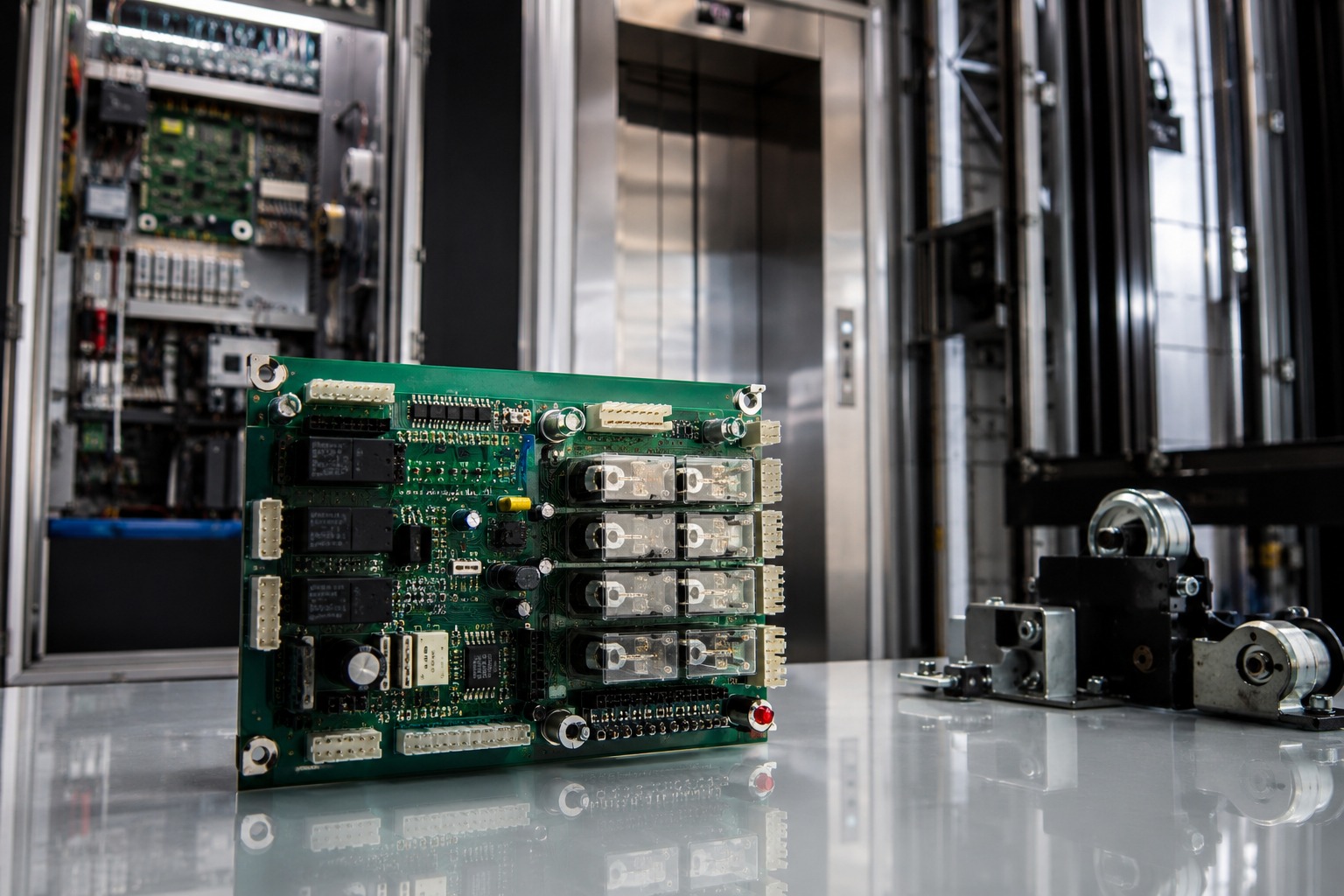
For Toshiba elevator systems in the United States, a safety circuit relay board is one of the most important control components tied to safe lift operation. It helps monitor and pass critical safety signals through the elevator’s protection chain, including door locks, emergency stop conditions, overspeed-related interfaces, and other interlocked inputs required before the car is allowed to run. When this board fails, an elevator may stop unexpectedly, refuse to start, hold doors open, show intermittent faults, or drop out of service until the safety chain is restored and verified by qualified personnel.
For building owners, maintenance contractors, and modernization teams in cities such as New York, Chicago, Los Angeles, Houston, Miami, Seattle, and Atlanta, fast and accurate replacement sourcing matters because downtime quickly affects tenants, visitors, patient flow, hotel operations, and freight movement. In major logistics corridors near the Port of Los Angeles, Port of Long Beach, Port of Houston, and Port Newark, maintenance schedules and part availability often determine whether a repair is completed the same week or delayed by international lead times. That is why technicians usually focus on exact model matching, relay logic confirmation, connector layout, board revision, and post-installation safety testing rather than buying on price alone.
This guide explains how Toshiba elevator safety circuit relay boards work, which fault symptoms are most common, how technicians verify compatibility, what suppliers should document, and what trends are shaping the U.S. market through 2026. It also covers where these boards fit alongside related Toshiba control products such as a Toshiba elevator expansion board and a Toshiba elevator car top communication board, both of which may interact with broader system diagnostics depending on the controller architecture.
How Safety Circuit Relay Boards Function in Elevator Protection
A safety circuit relay board acts as a control-layer interface for the elevator safety chain. In practical terms, it receives, checks, and routes signals from safety devices that must be in the correct condition before car movement is permitted. In many Toshiba systems, the board works with relays, terminal logic, feedback circuits, and controller inputs to confirm that monitored devices are closed, normal, and ready. If one required device opens or fails to confirm, the board removes the run permission and the elevator stops or remains parked.
The board itself is not just a passive mounting plate for relays. Depending on the system design, it may include signal conditioning, voltage distribution, diagnostic LEDs, protective components, connector interfaces, and relay outputs linked to the main control board. This matters because two boards that look similar may behave differently if relay timing, trace paths, terminal assignments, or board revisions are not identical.
In the field, technicians often see safety relay boards associated with the following functions:
| Safety Function | Purpose | Typical Linked Device | Operational Effect | Failure Impact | Service Note |
|---|---|---|---|---|---|
| Door interlock monitoring | Confirms hoistway and car doors are secured | Door locks, gate switches | Allows travel only with confirmed closure | Car will not start or may stop at landing | Check contact continuity and lock alignment |
| Emergency stop chain | Monitors stop circuit integrity | E-stop buttons, pit stop, top stop | Interrupts run command when opened | Unit remains out of service | Inspect field wiring and reset status |
| Safety device feedback | Verifies safety subsystem condition | Governor, safety gear interface | Blocks movement on abnormal signal | Hard safety fault condition | Requires formal troubleshooting sequence |
| Relay isolation | Separates field circuits from control logic | On-board relays and terminals | Improves signal stability | Intermittent operation if relay sticks | Check coil voltage and contact wear |
| Diagnostic indication | Provides visual fault cues | LEDs and status outputs | Speeds maintenance checks | Misleading if board logic is damaged | Use meter readings, not LEDs alone |
| Run permission output | Sends safe-to-run condition to controller | Main controller interface | Enables normal elevator operation | Controller records safety open fault | Verify signal level and wiring path |
The table above shows why this board is so central: even if the drive, door operator, and dispatch logic are healthy, the elevator still will not run if the safety chain cannot be validated. In mixed-use towers, hospitals, data centers, and manufacturing plants, this makes the safety relay board a high-priority service part because its failure can mimic problems in several other subsystems.
From a product perspective, Toshiba safety circuit relay boards are often sourced as dedicated replacement boards for specific controller families, but technicians may also evaluate them together with related control hardware. If you need a replacement, a properly matched Toshiba elevator safety circuit relay board should be selected using board number, machine serial reference where available, connector count, relay arrangement, voltage rating, and photo verification.
Common Symptoms of Safety Circuit Relay Board Failure
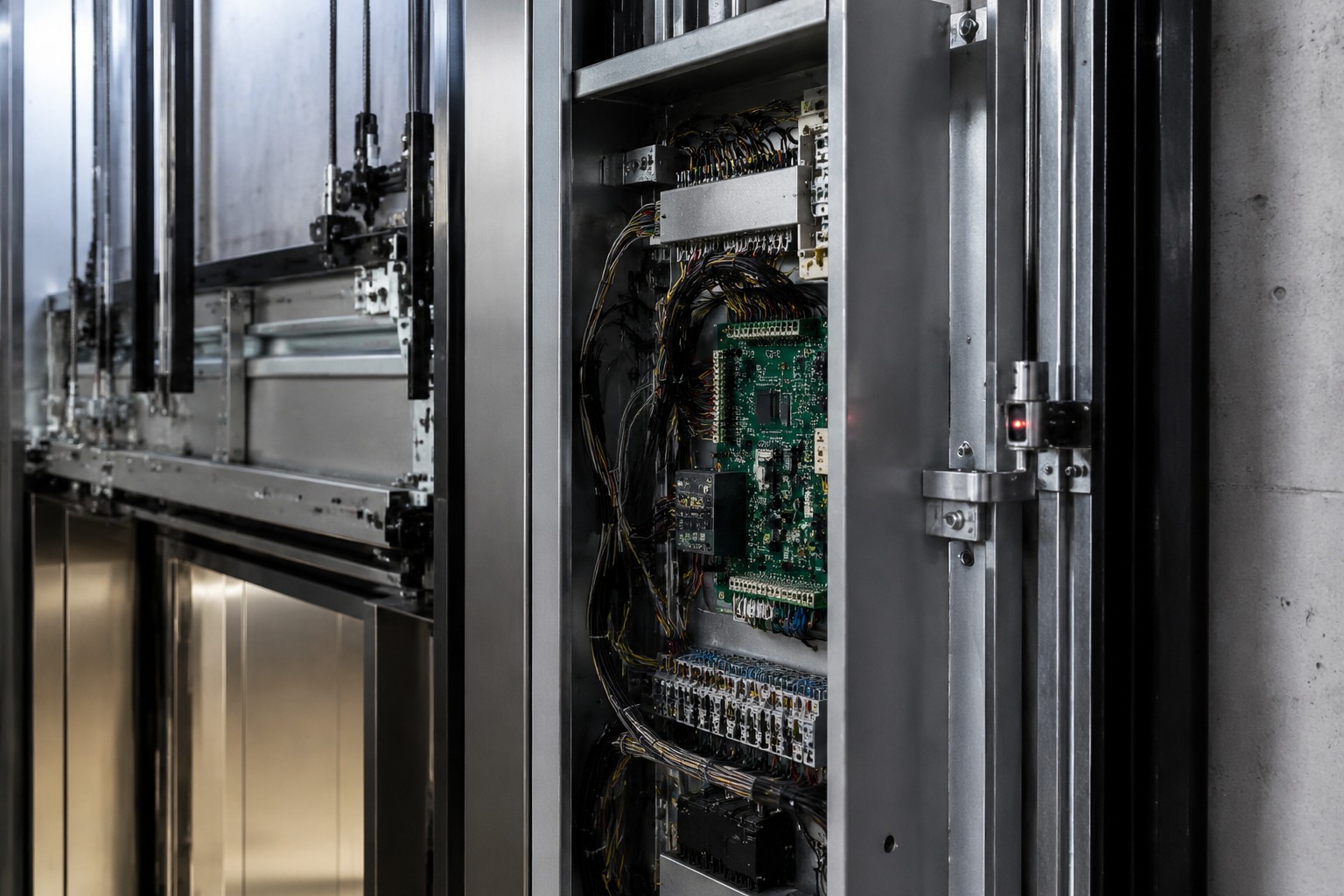
When a safety circuit relay board begins to fail, the symptoms are not always dramatic. Some failures are hard faults that shut the elevator down immediately, while others are intermittent and only appear during vibration, temperature change, peak traffic, or after the car has been running for several hours. This is why experienced U.S. elevator technicians document exact symptoms before replacing the board.
Typical signs include the car refusing to run after doors close, nuisance shutdowns during normal service, unexplained safety chain open alarms, relay chatter, burned contact odor, visible heat marks, or inconsistent LED indication. In older buildings in Boston, Philadelphia, San Francisco, and Detroit, aging boards may also show oxidation on terminals or reduced relay contact reliability after years of thermal cycling.
| Observed Symptom | What the Building Notices | Likely Board-Related Cause | Possible Non-Board Cause | Urgency | Technician Action |
|---|---|---|---|---|---|
| Elevator will not start | Car is parked and unavailable | Relay output not closing | Door lock open in field circuit | High | Check safety chain continuity end to end |
| Intermittent shutdown | Random service interruptions | Loose solder joint or weak relay contact | Vibration-sensitive wiring fault | High | Inspect board under load and vibration |
| Relay chatter | Buzzing or clicking in controller cabinet | Unstable coil drive or damaged relay | Low control voltage supply | Medium to high | Measure coil voltage and supply stability |
| False safety open alarm | Frequent callbacks | Signal path issue on board | Field switch misalignment | High | Compare input and output status points |
| Burn mark or heat damage | Elevator removed from service | Overheated trace or contact failure | External short or wiring issue | Critical | Do not re-energize before inspection |
| Status LEDs inconsistent | Hard to diagnose fault pattern | Board logic failure | Incorrect input condition | Medium | Confirm with schematic and meter tests |
The explanation behind these symptoms is important. A safety board can fail electrically, mechanically, or environmentally. Electrical failures include damaged traces, failed protective components, and unstable control signals. Mechanical failures often center on relay contacts, socket fatigue, or connector wear. Environmental failures come from dust, humidity, condensation, heat, and vibration. In coastal markets like Miami, Tampa, and New Orleans, corrosion is an especially common concern, while in inland industrial markets like Cleveland or Pittsburgh, particulate contamination and cabinet heat may be more relevant.
Another common field mistake is replacing the board before verifying the complete safety chain. Since open door locks, damaged traveling cables, bad stop switches, and weak power supplies can all present similar symptoms, technicians usually test the field side and control side before concluding that the relay board itself is defective.
Toshiba Relay Board Sourcing Notes for the U.S. Market
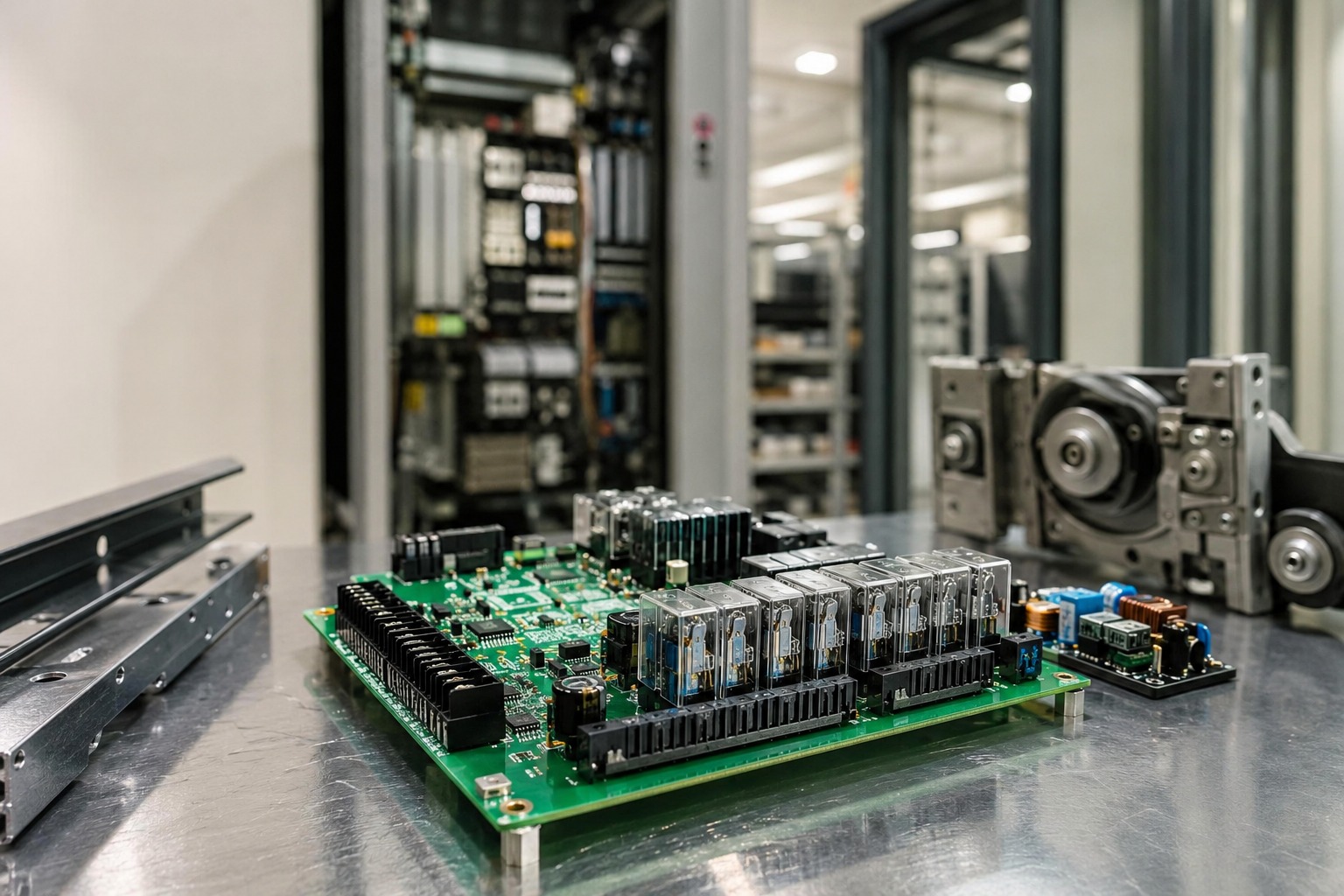
Sourcing Toshiba elevator parts in the United States often involves a balance between speed, compatibility confidence, documentation, and packaging quality. For safety-related boards, buyers typically avoid vague descriptions such as “fits Toshiba elevator” because controller families, revisions, and terminal layouts may vary across installations, modernization projects, and regional service histories.
Good sourcing practice begins with collecting clear board photos, all printed part numbers, any sticker codes, relay brand and rating information, connector positions, mounting dimensions, and cabinet context. Many maintenance firms send photos from the machine room or controller cabinet so a supplier can cross-check whether the board aligns with the expected Toshiba system architecture.
| Sourcing Factor | Why It Matters | Best Practice | Common Risk | U.S. Buyer Concern | Supplier Response |
|---|---|---|---|---|---|
| Exact board number | Primary compatibility reference | Match full code and suffix | Ignoring revision letters | Wrong part arrival | Photo and code verification before shipment |
| Connector layout | Prevents wiring mismatch | Compare every terminal block position | Same size, different pinout | Field installation delay | Provide annotated photos |
| Relay ratings | Critical for switching behavior | Confirm coil voltage and contact form | Substitute relay mismatch | Unsafe or unstable operation | Share relay marking details |
| Board revision | Some revisions replace others, some do not | Check supersession status | Assuming all revisions are equal | Return freight and downtime | State revision compatibility clearly |
| Condition and testing | Impacts reliability after install | Use inspected and verified units | Untested stock | Repeat shutdowns | Record inspection process |
| Protective packaging | Prevents transit damage | Use anti-static and shock protection | Bent pins or cracked relays | Damage in domestic delivery | Package for courier handling |
For buyers in the U.S., lead time can vary depending on whether the item is already stocked domestically, staged through a regional warehouse, or moving through international channels connected to Long Beach, Oakland, Savannah, or Newark. That is why many contractors ask for three things up front: availability status, estimated dispatch date, and whether the supplier can verify the board against the customer’s cabinet photos before shipping.
There is also a difference between sourcing for emergency repair and sourcing for planned maintenance. An emergency repair in a high-rise office tower in Manhattan or a hospital in Dallas usually prioritizes immediate compatibility confirmation and express shipping. A planned maintenance program for a university campus in Austin or a hotel group in Las Vegas may build a spare-parts strategy around multiple boards, including safety relay boards, communication boards, and expansion boards, to reduce repeat downtime.
As a supplier serving maintenance companies, distributors, building owners, and modernization contractors, we focus on stable sourcing channels, careful model matching, and packaging that protects sensitive elevator electronics in transit. That approach is especially valuable for parts that cannot be treated as generic because relay arrangement and circuit function must align closely with the original Toshiba system.
The line chart reflects a realistic growth pattern in replacement demand driven by aging installed equipment, modernization activity, and tighter uptime expectations in commercial and healthcare buildings across the United States.
How Technicians Confirm the Correct Replacement Board
Compatibility verification is where experienced elevator technicians reduce risk. Even when a Toshiba relay board appears visually similar, technicians normally use a structured checklist to confirm whether it is suitable for the exact elevator system. This process protects safety, avoids wiring errors, and prevents costly repeat visits.
The first step is identification. The board number, printed codes, and revision labels are reviewed against service records and cabinet photos. Next, the physical layout is compared: terminals, plug connectors, mounting holes, relay locations, fuse positions, and component population. After that, the electrical side is checked: supply voltage, coil voltage, contact type, and signal path expectations from the schematic.
| Verification Check | Field Method | What Must Match | Why It Is Important | Possible Warning Sign | Result if Ignored |
|---|---|---|---|---|---|
| Part number review | Read board labels and service log | Base number and suffix | Confirms intended application | Missing or partial code | High risk of wrong board |
| Revision comparison | Check printed rev marks | Approved cross-revision status | Some updates change logic behavior | Different revision with no note | Unexpected faults after install |
| Connector mapping | Photo-by-photo terminal comparison | Pin count and position | Prevents miswiring | Offset plug shape or extra port | Damage or no operation |
| Relay specification | Read relay markings | Coil voltage and contact arrangement | Supports correct switching performance | Different relay family | Unreliable chain response |
| Mounting dimensions | Measure standoffs and cabinet fit | Hole pattern and clearance | Prevents stress on board | Forced fit required | Mechanical damage over time |
| Schematic alignment | Compare control drawings | Signal route and terminal function | Confirms true functional compatibility | Labels differ from print | Misdiagnosis and callbacks |
This table shows that compatibility is both physical and functional. A board can fit inside the controller cabinet yet still be wrong if the relay logic, output path, or revision behavior differs. This is why strong suppliers ask for multiple photos and not just a short part description.
From a technological capability standpoint, our team supports part matching by reviewing board numbers, connector patterns, relay details, and system photos before shipment. For customers managing properties across multiple states, this helps standardize procurement decisions and reduce uncertainty, especially when service teams in different cities are working from different local records.
Technicians also consider the system context. In some Toshiba installations, a safety relay board issue may be investigated alongside neighboring boards that exchange signals or share cabinet power distribution. This is one reason why experienced buyers sometimes order related control items during major maintenance windows rather than addressing boards one by one only after failure.
Testing the Safety Chain After Board Replacement
Replacing a safety circuit relay board is not the end of the job. After installation, the entire safety chain must be tested according to applicable procedures, site conditions, and service practices. This ensures that the board is not only powered correctly, but also interacting properly with door circuits, stops, safeties, and controller logic.
In the U.S., post-replacement testing is especially important in high-liability environments such as hospitals, airports, municipal buildings, and residential towers. In markets like Washington, D.C., Denver, Phoenix, and Orlando, site managers often expect documented verification before the elevator returns to normal service.
| Test Step | Purpose | How It Is Performed | Expected Result | Failure Clue | Follow-Up Action |
|---|---|---|---|---|---|
| Visual installation check | Confirm proper fit and wiring | Inspect connectors, standoffs, labels | No loose or misaligned connection | Tilted board or unseated plug | Correct installation before power-up |
| Supply voltage check | Verify correct board power | Measure input voltage at board terminals | Stable voltage within expected range | Low or fluctuating reading | Trace control power source |
| Safety chain continuity | Confirm closed circuit path | Test circuit through interlocks and stops | Continuous path when all devices normal | Open segment detected | Locate field-side interruption |
| Relay response test | Check board switching behavior | Observe relay pickup and dropout conditions | Clean, repeatable response | Chatter or delayed action | Review voltage and relay health |
| Functional run test | Verify normal operation | Run elevator through multiple cycles | Stable service with no safety faults | Random stop or trip | Continue system-level diagnostics |
| Recorded fault review | Ensure no hidden errors remain | Check controller logs or indicators | No repeating safety-related alarms | Latent intermittent codes | Extend observation period |
The table above should be viewed as a practical sequence rather than a substitute for site procedures. The key point is that a replacement board must be proven within the complete safety chain. If the board works but a field device remains unstable, the elevator may still go back out of service after the technician leaves.
For larger portfolios, some maintenance firms build a test checklist into their internal work order system. This approach is increasingly common in multi-building operations around Chicago suburbs, Northern New Jersey, Southern California, and the Dallas-Fort Worth metroplex because it creates consistent records and supports easier troubleshooting on later callbacks.
The bar chart indicates where demand is often strongest in practice: high-traffic buildings with strict uptime expectations and older installed elevator fleets tend to replace safety-related boards more frequently.
What Documentation a Supplier Should Provide
Because safety circuit relay boards are control parts tied to protected elevator operation, documentation should be taken seriously. A good supplier does not need to produce unnecessary paperwork, but should provide enough information for the buyer and technician to verify what is being shipped and how it relates to the requested application.
At minimum, buyers usually want a quotation that identifies the part clearly, a photo set of the actual or representative board, condition information, shipping details, and traceable communication about compatibility assumptions. For maintenance companies handling multiple Toshiba sites, this documentation also supports inventory control and future reordering.
| Document Type | What It Should Include | Why Buyers Need It | When It Is Most Important | Risk if Missing | Good Supplier Practice |
|---|---|---|---|---|---|
| Quotation sheet | Part number, description, quantity, lead time | Confirms the offered item | Before order approval | Ordering ambiguity | List exact board code and condition |
| Board photos | Front, back, connectors, labels | Supports visual matching | Compatibility review stage | Wrong layout not spotted | Use high-resolution images |
| Inspection record | Visual checks, key points reviewed | Builds confidence in supplied stock | Used or legacy parts sourcing | Unknown condition risk | Document packaging and appearance status |
| Packing information | Anti-static, cushioning, carton details | Protects electronics in transit | Long-distance shipping | Transit damage disputes | Share packing photos on request |
| Compatibility note | Basis for match confirmation | Clarifies assumptions | When revision or label is unclear | Misunderstanding between parties | State “matched by code/photo/customer data” |
| Invoice and shipping record | Commercial and tracking details | Supports receiving and traceability | All purchases | Poor internal records | Provide prompt dispatch updates |
The explanation behind supplier documentation is simple: strong records reduce risk for everyone. They help the buyer approve the correct item, help the technician confirm what arrived, and help the supplier resolve questions quickly if a revision or field detail changes. In the U.S. market, this is especially useful for multi-site maintenance providers that handle jobs in several states at once.
From a manufacturing capability perspective, we prioritize product identification, careful quality inspection, stable handling procedures, and protective packaging so boards arrive in serviceable condition. While elevator electronics may travel through busy freight networks linked to major hubs such as Memphis, Louisville, Los Angeles, and Newark, careful packing and clear labeling help reduce transit-related delays and part confusion on arrival.
Maintenance and Inspection Tips for Longer Service Life
While relay boards are replaceable parts, many failures can be delayed through good maintenance practices. The goal is not to over-service the board itself, but to maintain the environment and connected circuits so the board is not stressed unnecessarily.
Routine cabinet cleaning, stable control power, secure terminal connections, and periodic checks for heat or corrosion all help extend service life. In older machine rooms, temperature management can also matter. Excessive heat shortens relay life and accelerates component aging. In coastal or humid climates, cabinet sealing and moisture control deserve special attention.
| Maintenance Item | Inspection Frequency | What to Look For | Benefit | Common U.S. Site Example | Practical Tip |
|---|---|---|---|---|---|
| Terminal tightness | Scheduled preventive visits | Loose or discolored connections | Reduces intermittent faults | High-vibration mechanical rooms | Check with power-safe procedures |
| Board cleanliness | Quarterly or site-based | Dust, oil film, residue | Prevents heat buildup and tracking | Industrial buildings near loading areas | Use approved dry cleaning methods |
| Relay condition | During fault investigation | Chatter, heat marks, wear signs | Early failure detection | Older office towers | Listen during operation and inspect visually |
| Cabinet temperature | Seasonally | Excessive internal heat | Preserves electronic life | Sun-exposed top-floor machine rooms in Phoenix | Review ventilation and load patterns |
| Moisture and corrosion | Seasonal humidity checks | Oxidation, condensation traces | Avoids signal instability | Coastal properties in Miami | Inspect after storms or HVAC issues |
| Power quality | When faults repeat | Voltage dip or fluctuation | Prevents nuisance trips | Mixed-use urban buildings | Check control supply under real load |
The table highlights a practical truth: many board failures are accelerated by surrounding conditions. A clean, dry, stable controller environment can substantially reduce nuisance faults. Conversely, ignoring cabinet heat, loose terminations, and corroded contacts can lead to repeated service calls even after new parts are installed.
From a service capability standpoint, responsive communication matters just as much as the part itself. Buyers often need quick photo review, model matching support, shipping coordination, and realistic lead time updates. We support customers with responsive quoting and application review so maintenance teams can move from fault diagnosis to part replacement with fewer delays.
The area chart shows a broader trend in the U.S. market: more owners are moving from reactive emergency replacement toward planned modernization and preventive spare-parts management.
FAQ About Safety Circuit Relay Boards
What is the direct purpose of a safety circuit relay board in a Toshiba elevator?
Its direct purpose is to process and relay critical safety-chain conditions so the controller knows whether elevator movement is permitted. If the chain is not healthy, the board helps block operation.
Can a faulty safety board cause the elevator to stop even when the drive is fine?
Yes. The elevator may remain out of service if the safety chain cannot be confirmed, even if the drive, motor, and door operator are otherwise functioning.
Are all Toshiba relay boards interchangeable?
No. Part number, revision, connector arrangement, relay specification, and system application must be checked carefully. Visual similarity alone is not enough.
What should I send a supplier to verify compatibility?
Send clear photos of the front and back of the board, all labels and codes, connector close-ups, relay markings, and if possible a photo showing where the board is installed in the controller cabinet.
Should technicians replace relays on the board or replace the full board?
That depends on the site, parts availability, service policy, and technical condition. For many buyers, full board replacement is preferred when exact matching stock is available because it can reduce labor uncertainty and speed return to service.
What if the fault remains after replacement?
Then the issue may be elsewhere in the safety chain, such as field interlocks, stop switches, wiring, power supply instability, or another linked control board. Post-installation testing is essential.
How important is packaging when shipping relay boards across the United States?
Very important. Sensitive control boards can be damaged by static, vibration, and impact during courier transit. Anti-static protection and cushioning should be standard.
Which industries most often buy these boards?
Commercial real estate, hospitals, hotels, residential high-rises, industrial sites, universities, airports, transit facilities, and modernization contractors are frequent buyers because elevator uptime is mission-critical.
What are the main buying priorities for U.S. customers?
Accurate model matching, documentation, realistic availability, stable quality inspection, protective packaging, and responsive service usually rank above low unit price.
How do 2026 trends affect this product category?
Three major trends are shaping demand. First, modernization activity is increasing as older controller systems age. Second, policy and compliance pressure continue to support better documentation, traceability, and maintenance discipline. Third, sustainability goals are encouraging longer service life through repair planning, spare-parts strategy, and replacement of only the needed control components rather than broader wasteful change-outs.
The comparison chart reflects how U.S. buyers often evaluate suppliers for safety-related elevator boards: technical confidence and fast response typically matter as much as the physical product.
In closing, Toshiba elevator safety circuit relay boards are small components with major operational importance. They sit at the center of whether an elevator can prove its safety chain and return to service. For building owners and contractors across the United States, the smartest path is to combine accurate diagnosis, exact compatibility verification, careful sourcing, and thorough post-replacement testing. That approach reduces downtime, avoids repeat callbacks, and supports safe, stable lift performance in everything from office towers and hospitals to hotels, campuses, and industrial facilities.