
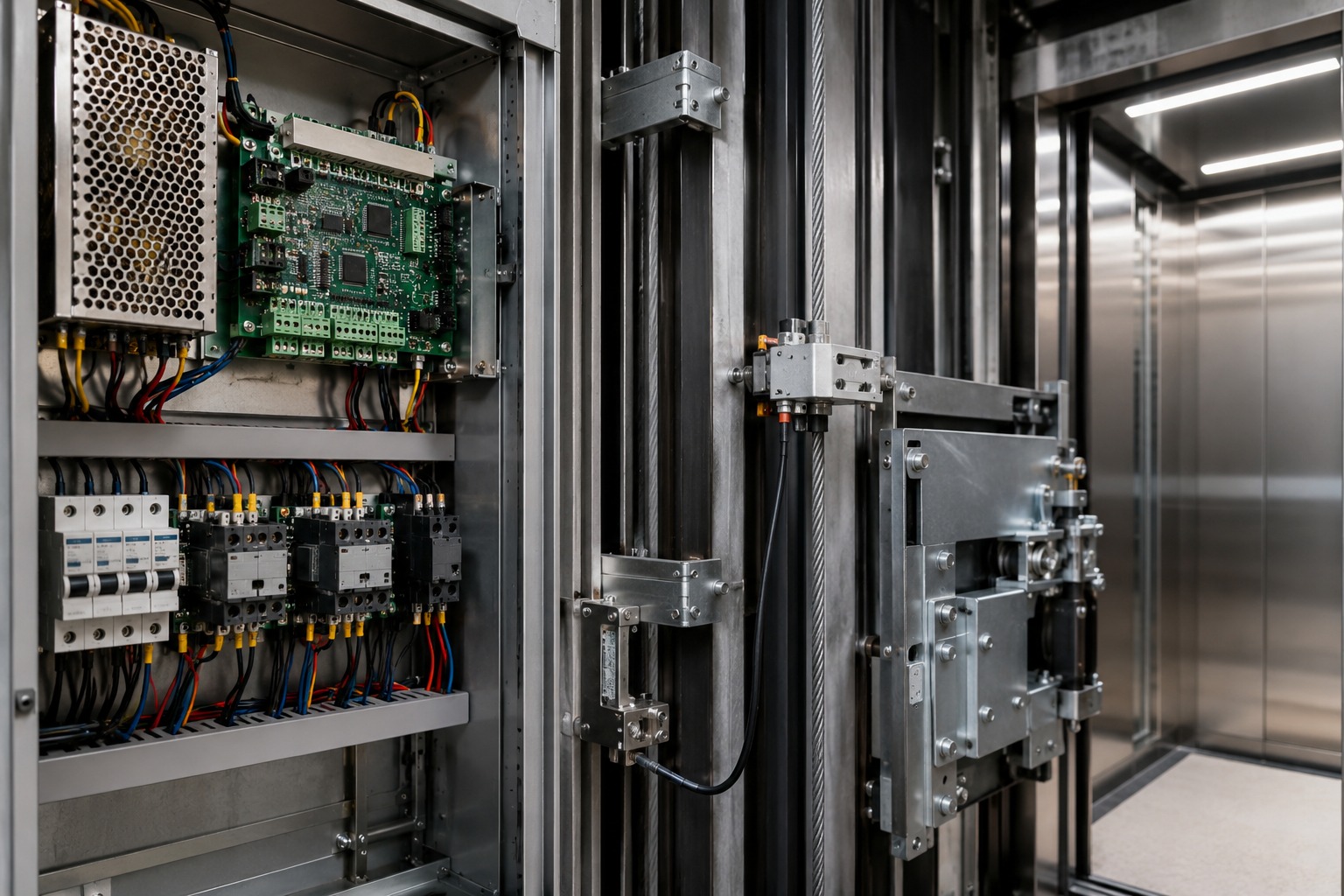
Elevator power supply parts do much more than convert voltage. They support controller logic, door operation, brake release, communication lines, COP and LOP buttons, intercom circuits, leveling feedback devices, and emergency lighting. In the United States, a wrong power supply choice can lead to nuisance shutdowns, unstable communication, brake faults, battery charging problems, and avoidable callbacks. For maintenance companies, building owners, and modernization contractors, the practical question is simple: which power supply type fits the elevator design, the actual load, and the site conditions?
The direct answer is that elevator power supply selection should start with the function of the circuit, then move to input voltage range, output voltage stability, current margin, heat conditions, mounting size, terminal layout, and brand or model compatibility. A controller logic line may need a stable low-noise DC output; a brake release circuit may need a higher surge capacity; emergency lights may require battery-backed power or a dedicated charging design. In a high-traffic building in New York City, Chicago, Los Angeles, Houston, or Miami, even small power fluctuations can become large service issues when elevators cycle constantly during peak hours.
For the United States market, many field teams are replacing aging linear or relay-heavy supply assemblies with more efficient switching modules, but this should never be treated as a one-size-fits-all swap. A controller may accept a broad-range switching unit, while an older brake power path may depend on very specific release and holding characteristics. That is why careful model matching, output verification, and protected packaging matter when sourcing replacement parts. If you are reviewing options for a standard lift accessory, a compatible elevator switch power supply can be a practical starting point, but the final choice still depends on the circuit role and the actual site load.
The U.S. elevator service market is also changing. More modernization work is being done in dense urban corridors and logistics hubs near the Port of Los Angeles, Port of Long Beach, Port of New York and New Jersey, Savannah, Houston, and Seattle. These regions often combine older elevator assets with newer building expectations for uptime, remote communication, and emergency readiness. As a result, buyers increasingly ask for power supplies that are not only electrically compatible, but also easy to verify, trace, and replace during short maintenance windows.
Elevator power supply demand in the United States market
Demand for elevator power supply parts in the United States is influenced by modernization cycles, labor availability, code compliance, building energy targets, and the age of installed equipment. In cities such as Boston, Philadelphia, San Francisco, and Washington, DC, many elevators remain in service long after their original control electronics become difficult to source. In these cases, replacement power supply boards and constant-voltage units are often among the first parts reviewed because unstable DC power can create symptoms across multiple subsystems at once.
From a purchasing perspective, the market is split across routine maintenance, emergency repair, planned modernization, and distributor stocking. Maintenance firms often prioritize fast model matching and repeatable quality, while building owners focus on reducing downtime and avoiding repeat callouts. Modernization contractors look for compatibility across mixed-brand sites, especially where controller, inverter, and door equipment may have been changed over time.
| Buyer Type | Main Need | Typical Voltage Focus | Common Risk | Purchase Priority | Expected Outcome |
|---|---|---|---|---|---|
| Maintenance company | Fast replacement | 24VDC, 48VDC, 110VAC | Wrong terminal match | Lead time | Shorter downtime |
| Distributor | Stock versatility | Multi-input modules | Slow-moving inventory | Cross-model use | Broader coverage |
| Building owner | Reliability | Emergency and logic circuits | Repeat failures | Service continuity | Fewer callbacks |
| Modernization contractor | Integration | Controller and brake lines | Legacy mismatch | Compatibility | Smoother retrofit |
| Facility manager | Lifecycle planning | Lighting and communication | Deferred maintenance | Documentation | Predictable budgeting |
| Emergency service team | Rapid diagnosis | Critical control outputs | Misdiagnosing downstream faults | Field verification | Safer restart |
The table above shows why there is no universal “best” power supply. The correct choice depends on the service scenario. A maintenance contractor in Dallas may need a quick 24VDC board replacement to restore communication and door logic, while a modernization contractor in Atlanta may need a broader redesign of the supply architecture to support new controls.
This growth trend reflects increased modernization activity, stronger expectations for uptime, and the replacement of aging boards in high-use commercial and residential towers. Looking into 2026, demand is likely to keep rising as remote monitoring, smarter diagnostics, and energy-focused upgrades become more common across the U.S. market.
Main power supply types in elevators
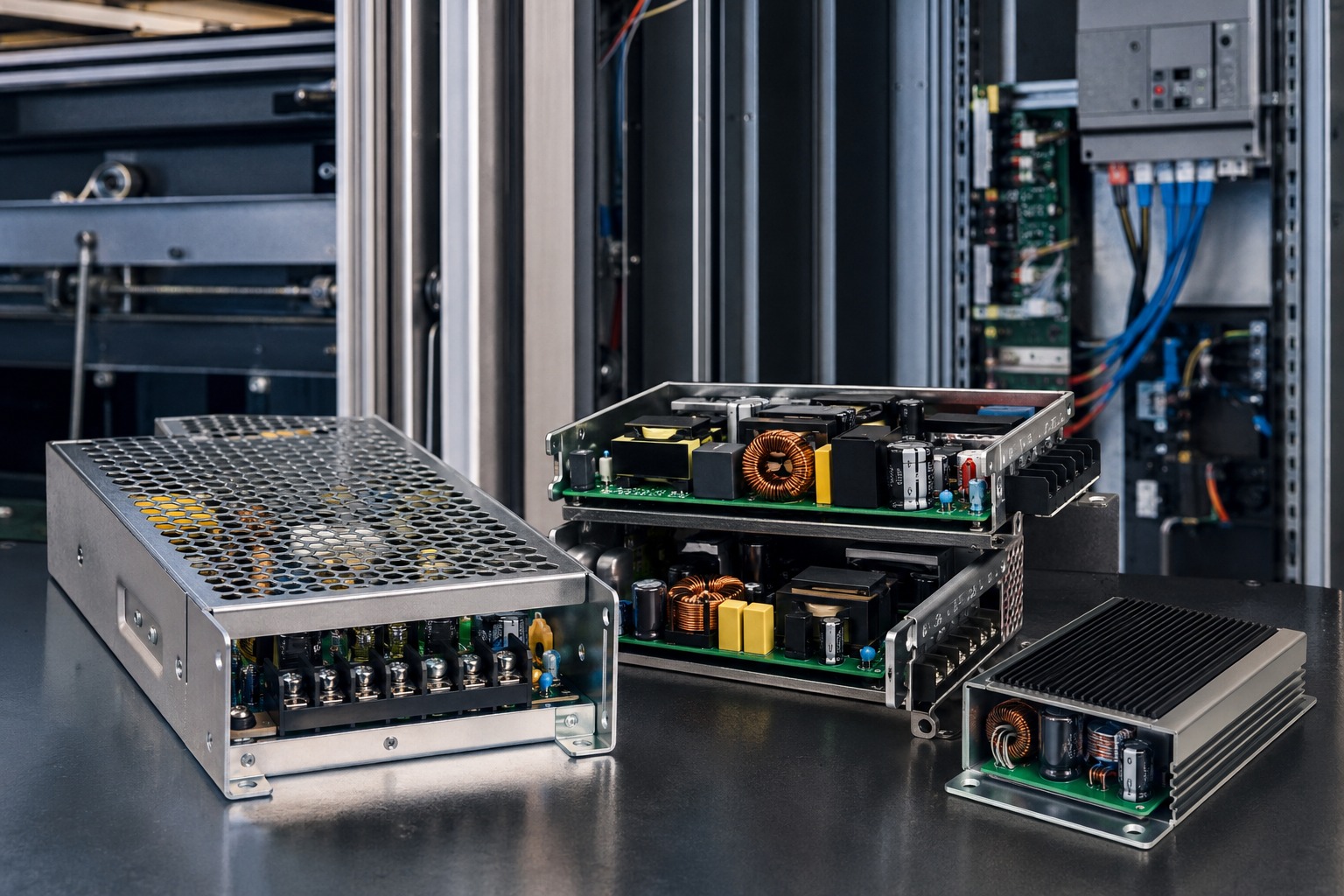
Elevator systems use several power supply types, each with a different purpose. The main categories include AC input power units for controllers, switching power supplies for logic and peripherals, constant-voltage power boxes for stable outputs, brake release or brake holding power sections, battery-backed emergency lighting supplies, and specialized AVR or regulation boards. A single elevator may use more than one of these at the same time.
In practical field service, the most common distinction is between the main controller supply and branch supplies feeding devices such as encoders, light curtains, door operator boards, intercoms, and car operating panels. A stable branch supply can prevent false fault indications that might otherwise look like board failure, communication loss, or sensor malfunction.
| Power Supply Type | Primary Function | Typical Output | Common Elevator Use | Strength | Watch Point |
|---|---|---|---|---|---|
| Switching power supply | Efficient AC to DC conversion | 24VDC / 48VDC | Controller logic, sensors, boards | Compact and efficient | Noise and load margin |
| Constant-voltage power box | Stable regulated output | Specified DC voltage | Sensitive control circuits | Output consistency | Exact model matching |
| AVR power board | Voltage regulation | Varies by design | Brand-specific assemblies | Integrated control fit | Board-level compatibility |
| Brake release supply | Energizes brake coil for release | AC or DC depending on system | Traction machine brake circuit | High functional importance | Inrush and holding current |
| Emergency lighting supply | Supports car lighting during outage | Battery-backed DC | Cab emergency light | Passenger safety | Battery condition |
| Communication supply | Powers intercom or phone path | Low-voltage DC | Emergency communication | Continuous support | Voltage drop |
The explanation from this table is straightforward: each supply type should be chosen by function first, not by appearance. Two boards may look similar, but one may be intended for low-noise logic power while another is designed for a more rugged output path. That is why branded or application-specific parts remain important, especially in mixed equipment environments.
When a site needs a board-level replacement for logic distribution, a switching power supply board for elevator accessories may fit well if the output, footprint, and connector pattern match the original design. On some installations, especially where older brand-specific assemblies are involved, a dedicated regulated product such as an AVR power board 24V/51V for Hitachi elevator applications is the safer route.
Switching power supply board selection
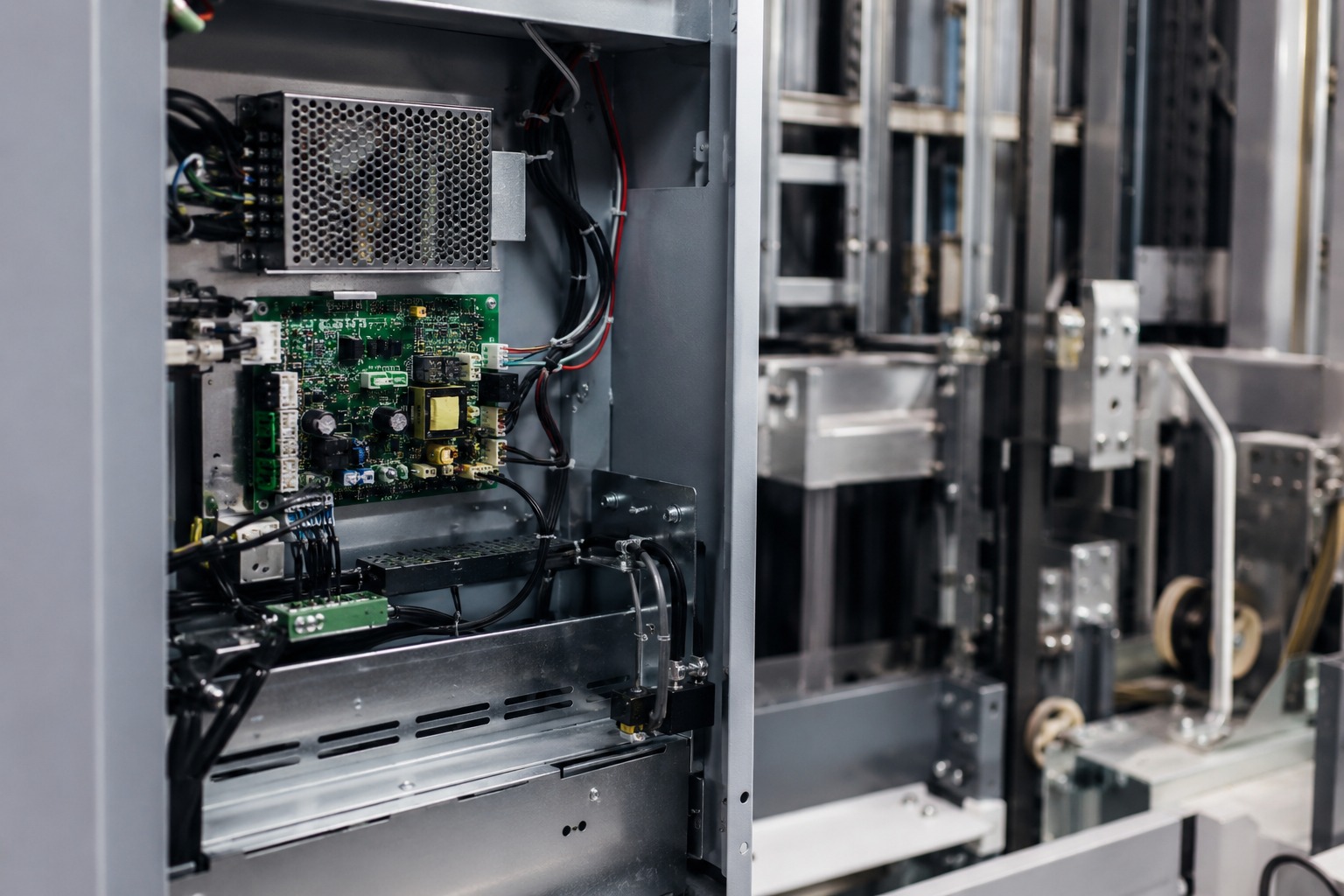
Switching power supply boards are widely used because they are efficient, compact, and suitable for many low-voltage control tasks. However, selection should go beyond output voltage alone. You should confirm the input range, rated current, peak current handling, ripple tolerance, thermal performance, grounding method, mounting dimensions, terminal configuration, and whether the board is intended for continuous enclosure operation.
Selection becomes especially important in machine rooms and control cabinets exposed to summer heat in Phoenix, Las Vegas, inland Southern California, or Gulf Coast humidity near Houston and New Orleans. An undersized supply may pass a bench test but fail under real cabinet temperatures. Likewise, a board that runs close to maximum output in normal service can age quickly and create intermittent faults that are hard to trace.
| Check Item | Why It Matters | Recommended Practice | Common Mistake | Field Impact | Decision Rule |
|---|---|---|---|---|---|
| Input voltage range | Ensures acceptance of site power | Verify actual incoming voltage | Assuming universal input | No startup or stress failure | Match site and board spec |
| Output voltage | Protects downstream electronics | Measure under load | Checking no-load only | Logic instability | Stay within tolerance |
| Rated current | Supports steady demand | Add 20% to 30% margin | Using exact nameplate load | Heating and trips | Choose headroom |
| Peak or surge capacity | Handles startup spikes | Review device inrush | Ignoring transient load | Intermittent resets | Confirm surge support |
| Mounting and terminals | Reduces installation risk | Compare photos and drawings | Forcing fit in cabinet | Loose wiring | Match footprint and layout |
| Heat and airflow | Affects service life | Check enclosure temperature | Ignoring ambient heat | Premature aging | Derate if needed |
This checklist explains why many replacement issues are not caused by “bad parts” alone. They often come from hidden load growth, cabinet heat, or overlooked surge demand. A board selected with margin usually lasts longer and reduces nuisance troubleshooting.
For more specialized regulated assemblies, some buyers prefer a constant-voltage power supply box for Hitachi elevator systems where output stability and enclosure format are critical. The right choice depends on whether the site needs a generic replacement approach or a closer application-specific match.
Brake release power supply requirements
The brake release circuit is one of the most safety-sensitive electrical functions in an elevator. Its supply must provide the correct voltage and enough current to release the brake reliably, while also supporting proper holding characteristics where applicable. Some systems use separate release and hold phases; others depend on a simpler fixed-output design. Either way, weak voltage, excessive drop, or unstable output can cause delayed release, chatter, or repeated faulting.
When technicians review brake-related supply issues, they should consider coil resistance, measured current draw, cable length, connector condition, relay contact quality, and whether the power source is AC or rectified DC. Replacing a brake supply without checking the coil and control path can mask the root cause. In high-rise installations with frequent starts, such as office towers in Manhattan or downtown Chicago, brake circuit reliability directly affects ride quality and shutdown risk.
| Checkpoint | What to Verify | Typical Problem | Test Method | Operational Effect | Service Note |
|---|---|---|---|---|---|
| Output voltage | Specified release voltage | Low output under load | Meter during release | Brake may not open fully | Measure live condition |
| Current capacity | Enough for inrush and hold | Supply undersized | Clamp or series measurement | Chatter or drop-out | Check startup peak |
| Coil condition | Resistance within range | Aging or partial short | Resistance test isolated | Overload on supply | Do not blame board first |
| Wiring and terminals | Tight, low-resistance path | Loose terminal heating | Visual and thermal check | Intermittent release failure | Inspect under vibration |
| Rectification path | Healthy diode or rectifier stage | Half-wave or unstable DC | Waveform or diode check | Noisy brake action | Check upstream components |
| Duty cycle suitability | Continuous or repeated operation fit | Overheating after cycles | Repeated functional test | Trips during busy periods | Simulate real traffic |
The explanation here is that brake supply evaluation must be dynamic, not static. Bench voltage alone is not enough. You need to see what happens when the brake actually releases and when the elevator cycles repeatedly.
Emergency lighting power supply planning
Emergency lighting is a passenger-facing safety function. During a utility power interruption or internal supply failure, the cab should not be left dark. Planning this power path requires attention to battery capacity, charger condition, lamp type, runtime expectations, load sharing with communication devices, and test intervals. In multifamily towers, hospitals, hotels, and public buildings, emergency lighting complaints are often one of the first signs that backup power components are aging.
Planning should also consider modernization timing. A building in Los Angeles may be replacing old cab fixtures with LED lighting, which can reduce emergency load and extend battery runtime. But the charger and switching logic still need to be compatible. A lower lighting wattage does not automatically mean the old emergency supply is healthy.
| Planning Factor | Why It Matters | Typical Range or Focus | Failure Symptom | Recommended Action | Expected Benefit |
|---|---|---|---|---|---|
| Battery condition | Determines runtime | Age, voltage, charge retention | Short illumination time | Scheduled capacity testing | More reliable outage response |
| Charger output | Maintains battery readiness | Stable float charging | Undercharged battery | Verify charging voltage | Longer backup life |
| Lamp technology | Affects load draw | LED versus legacy lamps | Excessive battery drain | Match supply to fixture load | Better efficiency |
| Switching logic | Controls transfer during outage | Automatic activation | No light on power loss | Test live transfer function | Safer passenger experience |
| Shared circuit load | Prevents overload | Lights plus communication devices | Runtime shorter than expected | Separate critical loads if needed | Predictable backup performance |
| Inspection schedule | Finds hidden deterioration | Routine monthly or quarterly checks | Surprise outage failure | Document test intervals | Compliance support |
This table shows that emergency lighting planning is not just a battery purchase decision. It is a system decision involving charger health, transfer behavior, and actual runtime under installed load.
Voltage ratings and load checks
Voltage ratings and load checks are the core of safe power supply replacement. The rated output printed on a board is only part of the story. What matters in service is the measured voltage under normal operating load, how much current the connected devices really draw, and whether startup or brake release creates short surges. If the supply feeds communication boards, door sensors, and COP lighting from the same output, the combined load may be higher than expected from the schematic alone.
For a reliable check, technicians usually record input voltage, no-load output, loaded output, current draw during steady state, current draw during switching events, cabinet temperature, and visible connector condition. The goal is to determine whether the power source has adequate margin. A good rule in many elevator control applications is to avoid running a supply at its absolute rated maximum in continuous service.
The chart above shows where replacement demand is often strongest. Office towers and residential high-rises create frequent cycling and high uptime expectations, making accurate voltage and load verification especially important.
From a technology standpoint, our approach in this area centers on careful model matching and technical review before shipment. That includes checking output class, connector style, enclosure format, and application role for controller, inverter, door operator, and accessory circuits. This technical capability is important when customers need compatible replacements rather than generic substitutions, particularly for branded systems used across the U.S. modernization market.
Common power failure symptoms
Elevator power supply problems rarely announce themselves with a single obvious sign. More often, they appear as scattered symptoms: intermittent communication faults, dim or flickering COP indicators, random board resets, erratic door behavior, weak intercom performance, emergency light failure, or brake faults that only happen during busy traffic. Because these symptoms cross subsystem boundaries, the power source should be checked early in the troubleshooting process.
| Observed Symptom | Likely Supply Issue | Other Possible Cause | Best First Test | Urgency | Service Direction |
|---|---|---|---|---|---|
| Controller resets randomly | Output sag or ripple | Main board fault | Measure DC during operation | High | Check supply margin first |
| Door sensors misread | Unstable low-voltage line | Sensor contamination | Verify sensor supply voltage | Medium | Inspect supply and wiring |
| Intercom weak or dead | Communication supply failure | Cable issue | Check dedicated output | High | Restore emergency communication |
| Brake release fault | Insufficient current delivery | Coil degradation | Voltage under release load | High | Test supply and coil together |
| Emergency light not working | Battery or charger issue | Lamp failure | Power-loss functional test | High | Check backup path |
| Buttons or indicators flicker | Output instability or loose terminal | Panel board issue | Loaded voltage and terminal inspection | Medium | Tighten and retest |
The key explanation is that a power supply issue can imitate many other faults. Good troubleshooting therefore starts with measurement, not guesswork. That saves time, avoids unnecessary board swaps, and reduces repeat service visits.
Replacement and testing workflow
A disciplined replacement and testing workflow improves safety and reduces repeat failures. The process should begin with lockout and confirmation of the affected circuit, followed by photo documentation, label verification, and voltage measurement. The removed part should be compared not only by part number, but also by input, output, current rating, mounting format, and terminal arrangement. After installation, testing should cover no-load output, loaded output, interaction with the connected circuit, and repeated functional cycles.
On the manufacturing side, supply quality matters because elevator service teams depend on parts arriving clean, protected, and consistent. Our manufacturing capability focuses on stable sourcing, incoming inspection, model verification, and protective packaging so that boards, modules, and power boxes reach maintenance firms and distributors in ready-to-check condition. This is especially valuable for customers shipping to busy service centers in New Jersey, Illinois, Texas, California, and Florida, where rapid turnaround is important.
| Step | Action | Purpose | Common Error | Verification Method | Result |
|---|---|---|---|---|---|
| 1 | Isolate and secure power | Protect personnel and equipment | Skipping full isolation | Lockout confirmation | Safe work condition |
| 2 | Document original wiring | Prevent reconnection mistakes | Relying on memory | Photos and labels | Accurate reinstall |
| 3 | Measure original input/output | Confirm actual fault | Replacing without diagnosis | Meter readings | Better root-cause clarity |
| 4 | Match part specifications | Ensure compatibility | Matching by appearance only | Spec review | Correct replacement choice |
| 5 | Install and inspect terminals | Reduce connection faults | Loose or reversed wiring | Torque and visual check | Stable installation |
| 6 | Run no-load and loaded tests | Validate output stability | Testing only idle voltage | Operational measurements | Reliable return to service |
This workflow explains why replacement should not end at installation. A proper loaded test is what confirms that the new unit is working in the real circuit, not just on paper.
By 2026, the trend is clear: U.S. buyers are moving toward better-documented, higher-efficiency, more application-specific power supplies. Sustainability targets also play a role, since efficient switching designs, LED-compatible emergency lighting circuits, and planned replacement cycles can help reduce waste and unnecessary repeat transport.
Buying advice for maintenance companies, distributors, and building owners
Good buying decisions begin with application clarity. Ask whether the part powers controller logic, the brake circuit, communication, door equipment, emergency lighting, or a specialized board path. Then verify the exact output requirements and expected load. If the site is a mixed-brand property or a partially modernized installation, request photos, labels, and cabinet location details before ordering.
For maintenance companies, the best value often comes from suppliers that can quickly review model details and identify compatible replacement paths. For distributors, stocking a blend of common switching units and more specialized brand-fit products can cover a wide percentage of demand. For building owners, the focus should be long-term reliability and documented testing rather than lowest upfront cost alone.
It is also wise to think locally. In major U.S. service regions such as New York, New Jersey, Chicago, Southern California, Dallas-Fort Worth, Atlanta, and South Florida, downtime costs are high and service schedules are tight. Buyers benefit from suppliers who understand elevator applications, can support careful matching, and package parts securely for transit through major logistics corridors.
This comparison chart shows what elevator buyers in the United States typically care about most when choosing a supplier: accurate matching, reliable inspection, strong packaging, and responsiveness. Price matters, but repeat compatibility and lower downtime often matter more over the life of the elevator.
Applications, industries, and case examples
Elevator power supply parts are used across residential towers, office buildings, hospitals, hotels, transit centers, campuses, warehouses, and mixed-use developments. Each environment creates different service patterns. Hospitals and hotels prioritize continuity and passenger confidence. Residential towers see morning and evening traffic peaks. Warehouses and freight applications may experience vibration, dust, and variable duty. Transit-connected buildings often demand quicker recovery because heavy passenger flow makes outages highly visible.
Consider a residential high-rise in Jersey City where intermittent COP flicker and occasional communication faults were reported. The immediate suspicion was a panel board problem, but loaded testing showed a 24VDC supply sagging during traffic peaks. Replacing the undersized unit with a properly matched supply restored stable voltage and ended the random faults. In another example, a commercial building in Houston experienced recurring brake release alarms during hot afternoons. Testing revealed voltage drop under release load combined with cabinet heat. A correctly rated replacement with better load margin solved the issue.
These examples highlight a simple truth: the right supply is not just about restoring power. It is about restoring stable system behavior under real operating conditions.
Local supplier expectations in the United States
U.S. buyers often prefer suppliers that understand how elevator service actually works: short diagnosis windows, urgent replacements, mixed installed bases, and the need for clear communication. In dense service territories such as New York City, Northern New Jersey, Chicago, Los Angeles, the Bay Area, Seattle, and Miami, fast response and accurate matching can determine whether a callback is closed in one visit or stretches into multiple days.
Service capability matters here. Our support model is built around responsive communication, careful review of part numbers and photos, practical compatibility guidance, and shipment preparation designed to reduce transit damage. For maintenance firms, distributors, building owners, and modernization contractors, that means fewer wrong-part risks and a more predictable replacement process.
As 2026 approaches, local expectations are also expanding. Buyers increasingly ask about energy efficiency, sustainability, traceability, and readiness for smarter diagnostics. Power supplies are becoming part of a broader reliability strategy rather than simple commodity items. That shift favors suppliers that combine product breadth with application understanding.
FAQ about elevator power supplies
What is the most common elevator power supply output?
Many control and accessory circuits commonly use 24VDC, but actual requirements vary by controller, brake circuit, communication system, and brand-specific design.
Can I replace a linear or older power unit with a switching power supply?
Sometimes yes, but only if the input range, output voltage, current, surge behavior, grounding, mounting, and circuit sensitivity are all compatible. Brake and safety-related functions should be reviewed especially carefully.
Why does a power supply test fine on the bench but fail in service?
Because field conditions include load, heat, vibration, voltage fluctuation, and startup surges. A no-load bench result does not prove stable operation inside an elevator cabinet.
How much load margin should I allow?
In many control applications, allowing around 20% to 30% margin above steady load is a practical starting point, though the exact requirement depends on surge demand and enclosure heat.
What causes repeated brake release faults?
Possible causes include weak supply output under load, bad terminals, rectifier issues, coil problems, or a supply not sized for the actual duty cycle.
How often should emergency lighting backup be tested?
Testing intervals depend on building procedures and applicable requirements, but routine functional checks are essential because batteries can degrade silently over time.
Is the cheapest replacement usually the best choice?
Not in most elevator applications. Wrong matching can cause repeat service calls, longer downtime, and extra labor cost that quickly exceeds the savings on the part.
What should I send when asking for a quotation?
Provide part numbers, clear photos, brand and model details, output voltage, current rating if visible, mounting style, and the function of the supply in the elevator.
How do future trends affect buying decisions?
By 2026, buyers in the United States are expected to place more weight on efficient switching designs, better compatibility documentation, sustainability, and support for modernized control architectures.
Choosing elevator power supplies the right way means thinking beyond voltage labels. Main power supply types, switching power supply board selection, brake release power supply requirements, emergency lighting planning, load verification, failure diagnosis, and replacement workflow all affect safety and uptime. For U.S. maintenance firms, distributors, building owners, and modernization contractors, the most reliable results come from careful model matching, stable inspection, secure packaging, and responsive support that helps keep elevators operating safely with less downtime.