
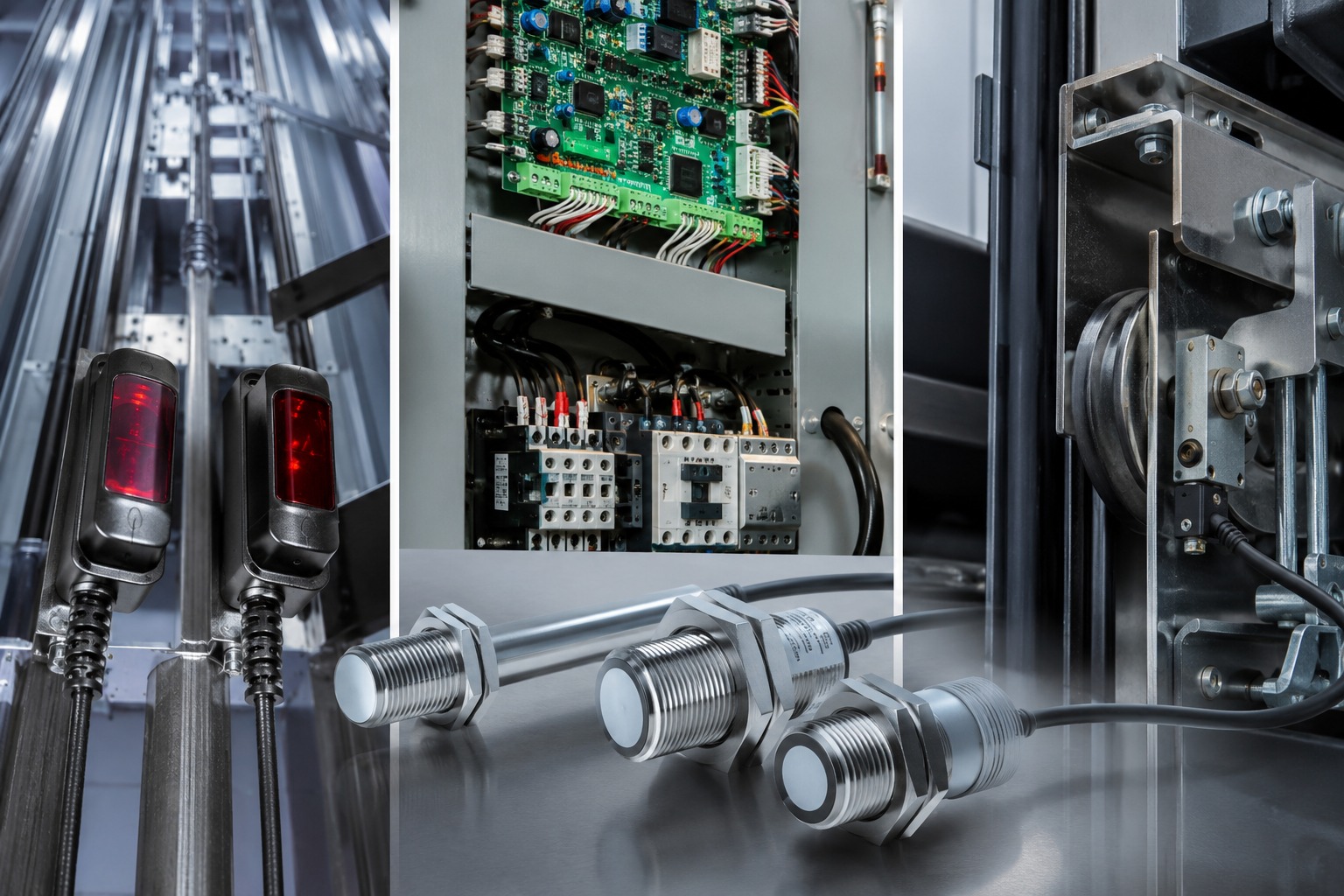
Elevator photoelectric switches and position detection sensors are small components with a big job. In a typical elevator system, they help the controller confirm car position, floor leveling, door zone status, and movement feedback. In the United States, where maintenance teams often work across mixed brands, older equipment, and modernization projects, selecting the right sensor can reduce callbacks, shorten downtime, and improve overall ride performance.
At a practical level, a photoelectric switch detects the presence, absence, interruption, or reflection of light. A position sensor tells the elevator control system where the car, door, or moving mechanism is at a given moment. Together, these devices support accurate stopping, reliable door logic, safe operation, and stable communication between field hardware and the main controller. Whether you manage elevators in New York high-rises, hospitals in Chicago, hotels in Orlando, warehouses near Houston, or residential towers around Los Angeles, proper sensor selection and installation directly affect maintenance outcomes.
For buyers in the United States, the most important issues are usually compatibility, mounting dimensions, operating voltage, cable and connector style, environmental resistance, and replacement timing. The right part is not just the one with the same label. It also needs to match sensing method, switching logic, response distance, alignment requirements, and the specific application in the lift system.
This guide explains what elevator photoelectric switches detect, where position sensors are used, how to choose sensor type and voltage, what to consider when replacing Hitachi elevator sensors, how to check mounting distance and alignment, how to troubleshoot common failures, and how preventive maintenance can help avoid shutdowns. It is written for elevator maintenance companies, modernization contractors, building owners, and parts distributors looking for practical and field-oriented information.
What Elevator Photoelectric Switches Detect
In elevator systems, photoelectric switches detect optical changes that indicate movement, position, obstruction, or confirmation of a target point. Depending on the design, the sensor may work through through-beam detection, retro-reflective detection, diffuse reflection, or specialized door zone sensing. In many applications, the switch is used to determine whether a vane, flag, bracket, target plate, or moving component has reached a defined position.
For example, a photoelectric switch may detect a leveling target when the car approaches a floor. In another application, it may confirm whether a door mechanism has reached fully open or fully closed position. On some systems, it can also be used alongside encoder feedback or magnetic sensing to provide redundant or auxiliary status information to the controller.
The detected object is not always a person or a large obstruction. In elevators, the target may be a small metal tab, a reflective marker, a flag on the car, a selector cam, a landing reference, or a moving door linkage point. That is why installation geometry matters so much. Even a reliable sensor will fail if the target is too small, misaligned, dirty, vibrating, or outside the effective sensing range.
In U.S. service environments, particularly in older office buildings in Boston, Philadelphia, and San Francisco, technicians frequently see issues caused by contamination, bracket shift, connector fatigue, or non-original replacements with slightly different optical windows. These details may seem minor, but they can create erratic door zones, poor releveling, missed floor signals, or intermittent faults.
| Detection Function | What the Sensor Sees | Typical Elevator Use | Common Mounting Location | Result Sent to Controller | Risk if Unstable |
|---|---|---|---|---|---|
| Target presence | Flag or vane enters beam | Floor approach or zone confirmation | Car top or hoistway side | Position reached | Misleveling or floor hunting |
| Beam interruption | Moving part breaks light path | Door mechanism status | Door operator assembly | Open/close transition | Door reopen or timeout |
| Reflective return | Light returns from reflector or marker | Reference point confirmation | Landing or car frame | Reference detected | Missed floor signal |
| Object absence | Expected target not seen | Safety logic or reset logic | Selector or control area | Position not valid | Nuisance shutdowns |
| Door zone presence | Zone vane within sensing area | Leveling and dispatch logic | Car side near landing zones | Car in zone | Door lock sequence errors |
| Travel feedback | Repeated passing targets | Motion confirmation | Guide rail or hoistway reference line | Movement tracked | Controller confusion |
The table above shows that photoelectric switches are not generic “on/off” devices in elevator use. Their exact detection purpose determines the correct sensor type, mounting position, and replacement criteria.
The market trend in the chart reflects a realistic increase in replacement demand across the United States. Growth is being driven by aging installed bases, modernization cycles, the need for compatible spare parts, and service pressure in dense urban markets such as New York, Miami, Seattle, Dallas, and Atlanta.
Position Detection Sensor Applications
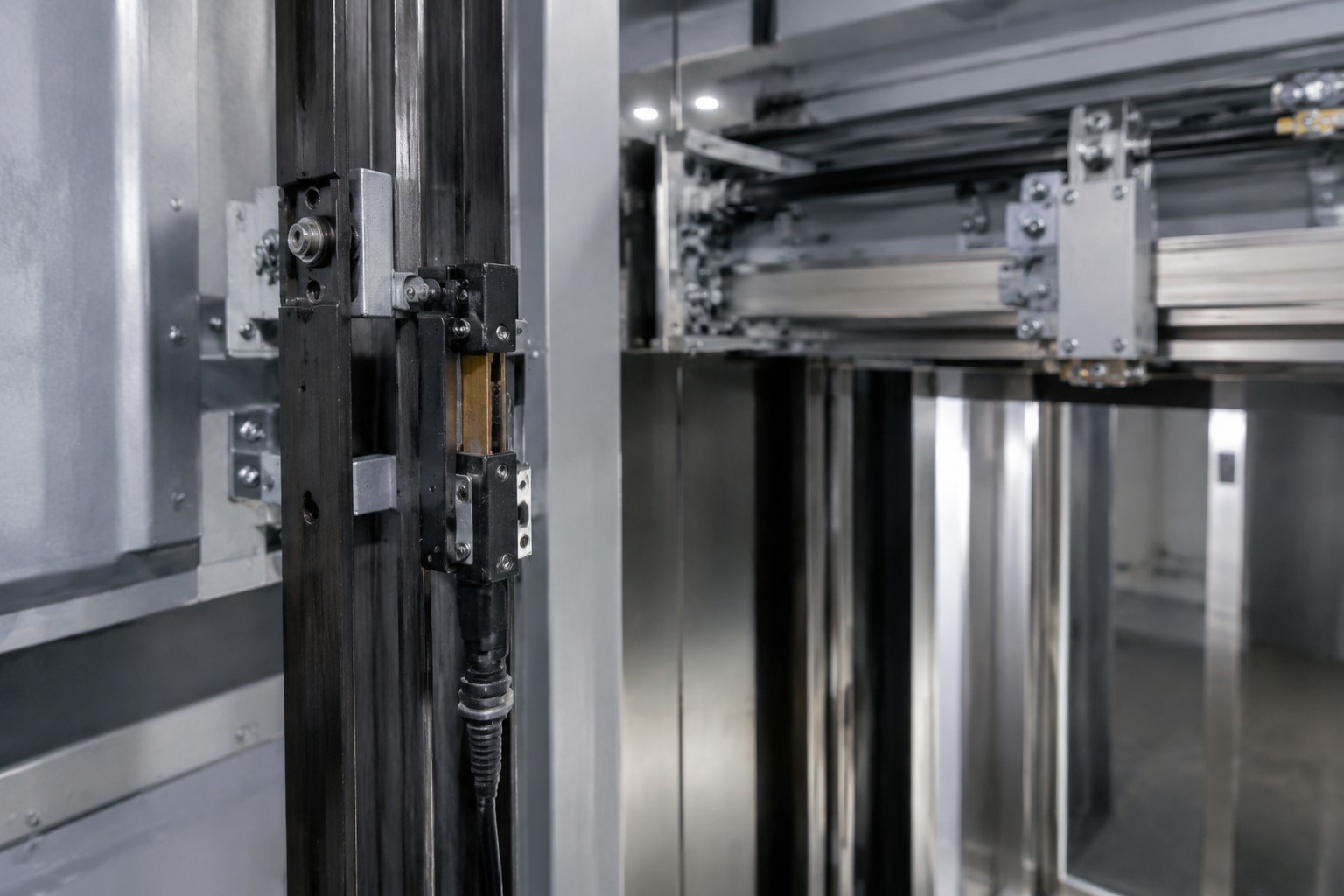
Position detection sensors are used wherever the elevator system needs confirmation of physical location or travel status. Their applications go beyond floor stopping. They can be found in car positioning systems, leveling circuits, door operators, landing interface systems, and machine room or controller-linked feedback loops. In many cases, the position sensor works together with control boards, inverters, door locks, encoders, and software logic to complete a reliable command chain.
One of the most important applications is leveling. When the elevator car arrives at a floor, the system must stop the car within a narrow height tolerance. A position detection sensor helps the controller identify when the car enters the floor zone and when it has reached the correct stopping point. This is especially important in hospitals, senior living facilities, and public buildings where step differences can create safety concerns.
Another key application is door control. Sensors can confirm fully open and fully closed door positions, monitor intermediate door travel, and help the controller decide whether to continue movement or hold the door cycle. On high-traffic elevators in airports, convention centers, or large residential buildings, stable door position feedback supports cycle consistency and reduces nuisance faults.
Position detection sensors are also used in modernization work. Many older elevators in U.S. cities still operate with partial upgrades, meaning new control systems may need to work with legacy mechanical arrangements. In these cases, careful sensor matching becomes essential because the replacement part must communicate reliably with both old field geometry and newer controller expectations.
| Application Area | Sensor Role | Typical Signal Purpose | Maintenance Importance | Common Failure Impact | Where Often Seen in U.S. Buildings |
|---|---|---|---|---|---|
| Car leveling | Detect floor zone or stop point | Leveling confirmation | High | Uneven floor landing | Hospitals, offices, condos |
| Door operator | Confirm open/close position | Door status feedback | High | Door timeout, repeated reopening | Hotels, retail, transit stations |
| Landing zone control | Verify zone entry | Safe door enable logic | High | Door lock sequence faults | Mid-rise residential towers |
| Travel reference | Track movement past targets | Motion confirmation | Medium | Position drift or fault codes | High-rise commercial towers |
| Modernized systems | Bridge old hardware to new control | Compatible location feedback | High | Intermittent integration errors | Retrofit projects nationwide |
| Special equipment lifts | Detect precise mechanism position | Special sequence confirmation | Medium | Operational interruption | Freight and service elevators |
The table illustrates how application context affects the sensor requirement. A door operator sensor may prioritize fast response and compact mounting, while a car leveling sensor may prioritize zone repeatability and resistance to vibration.
The bar chart shows why urban commercial and residential sectors dominate replacement demand. Dense service schedules, frequent door cycles, and long operating hours place heavy wear on sensing components.
How to Choose Sensor Type and Voltage
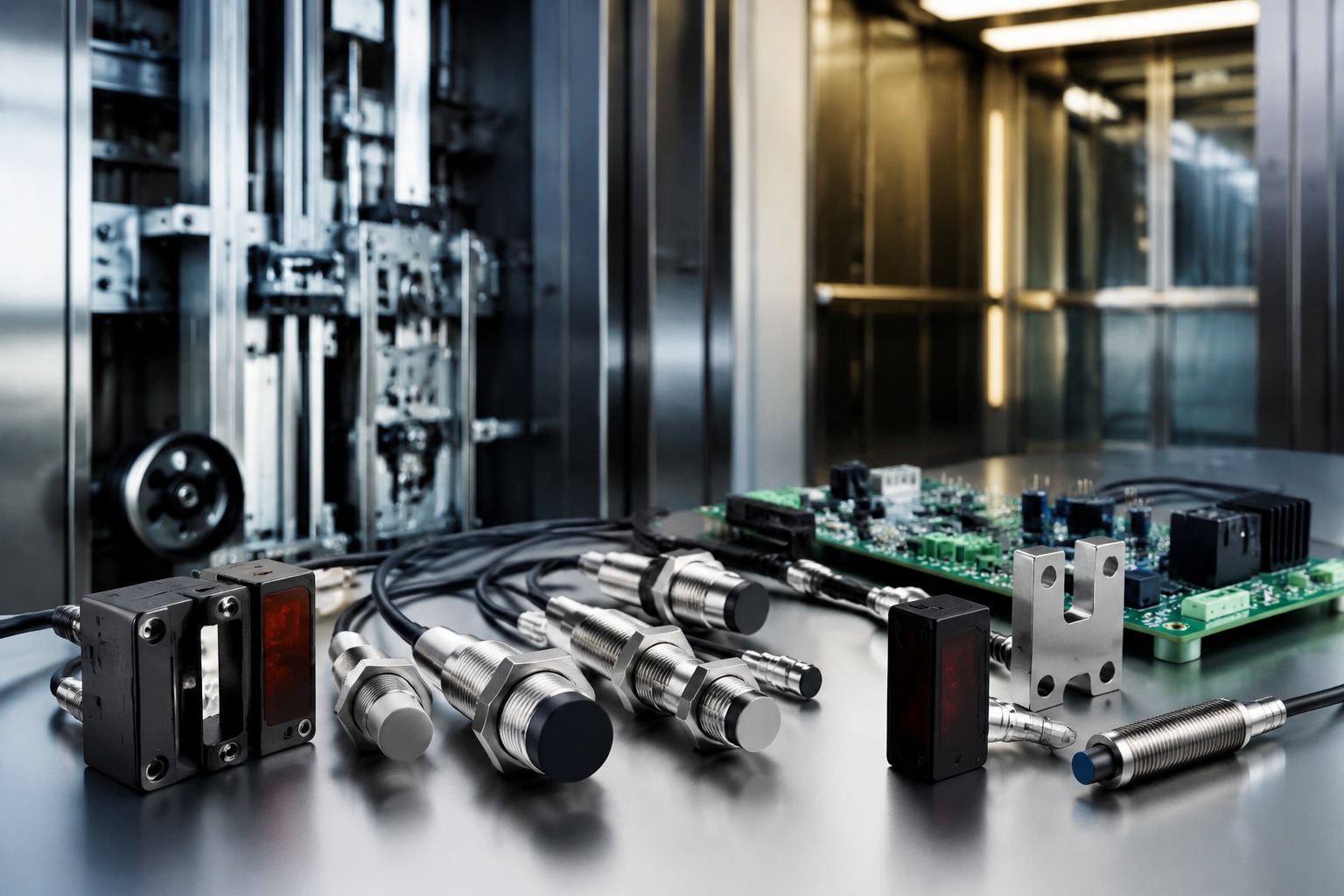
Choosing the correct elevator sensor starts with the application, not the appearance. A technician or buyer should confirm the original part number, operating voltage, sensing method, output type, cable arrangement, mounting dimensions, and target distance. If any of these factors are unclear, the safest approach is to compare the old unit, controller requirement, and field installation geometry together.
Voltage is one of the first checks. Many elevator sensors use DC control voltages such as 12V, 24V, or other specified input ranges, but the controller side may also impose output logic requirements such as NPN, PNP, normally open, or normally closed switching. Even if a sensor physically fits the bracket, the wrong electrical logic can cause permanent alarms or no detection at all.
Next is sensor type. Through-beam types are good for precise interruption detection when a transmitter and receiver can be mounted across from each other. Retro-reflective types can work well where a reflector is practical. Diffuse sensors may be easier to mount but are more sensitive to surface variation and ambient conditions. For elevator use, the correct choice depends on space, target consistency, contamination risk, and required repeatability.
Response distance is another major issue. Some failures happen because a replacement sensor has a broader or narrower detection field than the original. This can result in false signals when nearby hardware passes through the beam, or missed signals when the target only briefly enters the zone. In modernization work around ports like Long Beach, Newark, and Savannah, where imported parts may have multiple equivalents, exact distance and output matching are crucial.
Technicians should also consider environmental exposure. Machine-room-less systems, outdoor-adjacent lobbies, coastal humidity, and dust-heavy service elevators all create different demands. Buildings in Miami may need better moisture resistance, while facilities around Phoenix or inland logistics hubs may need improved dust tolerance.
| Selection Factor | Why It Matters | What to Verify | Common Buyer Mistake | Field Result | Recommendation |
|---|---|---|---|---|---|
| Operating voltage | Must match control circuit | Input range and tolerance | Assuming all are 24V | No output or unstable output | Check controller and old label |
| Output logic | Controller reads specific signal type | NPN/PNP, NO/NC | Ignoring switching logic | Constant fault indication | Confirm with wiring diagram |
| Sensing method | Affects installation and reliability | Through-beam, reflective, diffuse | Choosing only by housing size | Inconsistent detection | Match original detection principle |
| Detection distance | Controls target recognition window | Minimum and maximum range | Using “close enough” specs | Missed or false triggers | Measure actual bracket geometry |
| Connector and cable | Impacts installation speed | Pinout, length, shielding | Overlooking pin assignment | Wiring errors or rework | Compare connector photo and wiring |
| Mechanical dimensions | Must align with bracket and target | Body size, hole spacing, window position | Matching brand but not size | Alignment problems | Confirm dimensions before order |
| Environmental rating | Protects against dust and moisture | IP level, temperature range | Using indoor-only part widely | Short life in harsh sites | Choose for site conditions |
The table highlights the most common causes of wrong-part purchases. In practice, the safest procurement process is to collect a clear label photo, wiring photo, connector photo, bracket dimensions, and the elevator brand or subsystem details before ordering.
If you are comparing replacement options, a specialized elevator photoelectric switch for lift accessories should be reviewed not only by part name, but also by use position and circuit requirements. The same principle applies when sourcing a position detection sensor for Hitachi elevator systems or a model-specific GLS-326 leveling sensor replacement.
Hitachi Sensor Replacement Considerations
Hitachi elevator systems are widely used in many commercial and residential projects, and replacement work often requires more than simple brand matching. When replacing a Hitachi photoelectric switch or position sensor, maintenance teams should review model code, mounting style, electrical rating, connector type, target geometry, and the actual function inside the system. In many cases, an original-looking part from another application will not perform correctly if its optical characteristics differ.
A common challenge with Hitachi replacements is that the field-installed sensor may belong to an earlier series, a regional supply batch, or a modernization adaptation. Some buildings in the United States have original equipment mixed with later repairs, especially in major service markets like New York City, Los Angeles, and Washington, D.C. That means the label on the part may not tell the full story. Measuring the installed sensor and checking how it interacts with the target is often necessary.
Another issue is controller expectations. Hitachi systems may use very specific timing or logic behavior. A replacement sensor that switches slightly earlier or later than the original can create intermittent issues rather than immediate complete failure. This is why many experienced buyers prefer suppliers who can help verify model matching and application context before shipping.
From a sourcing perspective, dependable replacement support matters. Our role as a professional elevator parts supplier is not limited to selling individual components. In the technical matching stage, we help customers compare label data, application photos, and installation dimensions so the replacement sensor aligns with actual field requirements. This technical capability is especially useful for mixed-brand portfolios, legacy projects, and urgent maintenance situations where minimizing downtime is a priority.
| Hitachi Replacement Check | Why It Is Important | What to Compare | If Ignored | Best Practice | Priority Level |
|---|---|---|---|---|---|
| Part code confirmation | Prevents wrong family selection | Label, series, suffix | Incorrect substitute | Use clear part photos | High |
| Mounting footprint | Ensures bracket fit | Hole distance and body size | Cannot align sensor properly | Measure before purchase | High |
| Optical window position | Defines sensing geometry | Lens location and direction | Missed target detection | Compare front and side views | High |
| Electrical specification | Must match controller | Voltage and output type | Fault signal or no signal | Check wiring diagram | High |
| Cable and connector style | Affects plug-in compatibility | Pinout, cable exit angle | Field rewiring delay | Confirm connector photo | Medium |
| System function | Separates leveling from door use | Installed application | Part works incorrectly | Identify actual duty in system | High |
| Historical repairs | Older sites may have non-original parts | Past service records | Repeated mismatching | Review maintenance history | Medium |
The table shows that successful Hitachi replacement depends on both part identity and system role. For modernization contractors, this is particularly important when standardizing maintenance inventories across multiple buildings.
In terms of manufacturing capability, buyers usually benefit from suppliers that understand protective packaging, stable quality inspection, and component consistency. Sensors are precision parts; poor packaging or weak incoming inspection can lead to hidden shipping damage, connector deformation, or inconsistent replacement performance. Reliable sourcing is not just a logistics advantage; it directly affects installation success.
Mounting Distance and Alignment Checks
Even the correct sensor can fail if mounted incorrectly. Mounting distance and alignment are among the most overlooked causes of elevator sensor problems. Photoelectric switches rely on a specific relationship between sensor window, target, and movement path. If the target passes too far away, at the wrong angle, or with vibration that shifts its path, detection becomes inconsistent.
The first step is to inspect the bracket. Bent, loose, corroded, or re-drilled brackets can move the sensor out of its proper sensing window. In older U.S. buildings, it is common to find field modifications made during past emergency repairs. These changes may have worked temporarily with one sensor model but not with a precise replacement unit.
Next, check the target condition. A vane or reflective marker may be worn, dirty, cracked, or shifted. On door systems, hardware play can also change the final target position under load. If the sensor is adjusted only during a static test, it may still fail during normal operation because vibration and speed alter the actual sensing relationship.
Alignment should always be checked in real operating motion. Observe whether the target enters the center of the sensing field or only clips the edge. A narrow and consistent pass through the designed area is better than a wide but uncertain signal. If available, check controller diagnostics to see whether the signal state changes cleanly and repeatably.
| Inspection Item | What to Look For | Typical Problem | Impact on Operation | Correction Method | Recommended Tool |
|---|---|---|---|---|---|
| Bracket position | Secure and square mounting | Shifted or bent bracket | Inconsistent sensing point | Realign or replace bracket | Level, ruler |
| Sensor-to-target distance | Within rated operating range | Gap too large or too small | Missed or false detection | Adjust bracket spacing | Caliper, gauge |
| Target angle | Proper entry into sensing zone | Skewed vane or reflector | Partial beam capture | Straighten target path | Visual alignment tool |
| Vibration movement | Stable during travel | Oscillation at speed | Signal chatter | Tighten hardware, damp movement | Observation during run |
| Contamination | Clean lens and target surface | Dust, grease, residue | Weak optical return | Clean with approved method | Lint-free cloth |
| Cable strain | No pull on body or connector | Stressed cable routing | Intermittent signal loss | Re-route and secure cable | Ties, clips |
| Repeatability test | Stable signal across several runs | Works only occasionally | Callbacks and shutdowns | Run multiple cycles and monitor | Diagnostic display |
The table above is useful because it links visible mechanical conditions to system-level effects. In the field, many “sensor failures” are actually alignment or mounting failures.
The area chart reflects an important industry trend: U.S. customers are gradually moving from reactive sensor changes to planned maintenance and scheduled replacement programs. This is especially visible in portfolio-managed properties and modernization cycles.
Fault Symptoms and Troubleshooting
When a photoelectric switch or position sensor begins to fail, the symptoms are not always obvious. In some cases the elevator still runs, but performance becomes inconsistent. You may see occasional misleveling, door reopening, delayed door close, failure to recognize floor zone, intermittent service faults, or unexplained controller alarms. Understanding the symptom pattern helps determine whether the issue is electrical, optical, mechanical, or control-related.
A completely failed sensor often results in a persistent alarm or loss of a known function. An intermittent failure is harder to diagnose and may be caused by cable fatigue, vibration, thermal drift, contamination, or marginal alignment. For that reason, troubleshooting should include both static inspection and live operation checks.
Start with basic verification: power supply present, correct wiring, indicator status if available, clean optical surface, secure mounting, and visible target condition. Then move to functional testing by observing whether the output changes at the expected travel point. If the controller has diagnostics, compare the sensor state on the interface with the actual position of the target.
In the United States, service teams working under tight building access windows often benefit from systematic fault isolation. Instead of changing multiple parts, they confirm whether the problem follows the sensor, the cable, the bracket, or the controller input. This is especially important in premium downtown buildings where return visits can be costly and scheduling is limited.
| Symptom | Likely Cause | How to Check | Related Area | Immediate Action | Long-Term Fix |
|---|---|---|---|---|---|
| Car stops uneven with floor | Zone or leveling sensor instability | Observe signal at landing | Car positioning | Clean and realign sensor | Replace worn sensor or bracket |
| Door reopens unexpectedly | Door position feedback inconsistent | Check open/close sensor timing | Door operator | Inspect target and mounting | Replace faulty feedback sensor |
| Intermittent fault codes | Cable or connector issue | Move cable during test | Wiring harness | Secure connection | Replace cable or connector set |
| No detection at all | Wrong voltage or failed device | Measure input power | Electrical supply | Verify power and output | Install correct-spec sensor |
| False triggering near target | Distance or angle out of range | Measure sensing geometry | Mechanical alignment | Reposition sensor | Restore proper bracket layout |
| Works when cold, fails later | Thermal drift or aging component | Test during extended operation | Sensor internals | Monitor temperature effect | Replace aged sensor |
| Random service shutdowns | Mixed issues or poor substitute part | Compare installed model and logic | Replacement quality | Review specification match | Use verified compatible part |
This troubleshooting table is effective because it connects symptoms to likely root causes instead of treating every issue as a generic sensor failure. Fast diagnosis reduces downtime and unnecessary parts usage.
Preventive Sensor Maintenance
Preventive maintenance is the best way to extend sensor life and reduce emergency calls. Elevator sensors are exposed to vibration, dust, repeated movement, and in some locations humidity or temperature shifts. A simple inspection plan can identify contamination, loose brackets, cable wear, and alignment drift before the elevator goes out of service.
At minimum, maintenance teams should clean optical faces using approved non-abrasive materials, inspect brackets for movement, verify fastener tightness, check cable strain relief, and confirm that targets remain in the proper path. If the building has high traffic, preventive intervals should be shorter. High-use installations in Manhattan office towers, Las Vegas hotels, and major healthcare campuses often justify more frequent checks than lightly used low-rise properties.
Preventive replacement can also be worthwhile for aging fleets. If a building has recurring intermittent issues from older sensors, replacing the sensor during scheduled maintenance may be more cost-effective than repeated callbacks. This is particularly true where after-hours access or tenant disruption creates high service costs.
From a service capability perspective, buyers benefit from suppliers that respond quickly, confirm model matching carefully, and package parts well enough to reach jobsites in ready-to-install condition. Responsive service is not just about shipping speed. It also includes pre-sale verification, practical communication on compatibility, and support for reducing downtime in critical service situations.
Our service approach for U.S. customers focuses on reliable sourcing, careful model matching, stable quality checks, and protective packaging that helps prevent transit-related issues. This is especially useful for distributors moving inventory through hubs like Chicago, Dallas, and New Jersey, and for maintenance teams supporting time-sensitive repairs across multiple sites.
The comparison chart reflects what U.S. buyers usually value most in elevator sensor sourcing: getting the correct part the first time, with stable quality and support that reduces installation risk.
On the manufacturing side, consistency matters as much as price. Reliable production control, visual inspection, electrical verification, and secure packing help reduce mismatch claims and field problems. For maintenance companies and building owners, that translates into fewer repeat visits, lower labor waste, and stronger confidence when stocking critical spare parts.
FAQ About Elevator Photoelectric Switches
What is the difference between a photoelectric switch and a position sensor in an elevator?
A photoelectric switch detects an optical event, such as beam interruption or reflected light. A position sensor is a broader term describing a device used to confirm location or movement status. In many elevator applications, the photoelectric switch is serving as the position sensor.
Can I replace a sensor with a similar-looking model?
Not safely without checking the details. Voltage, output logic, sensing distance, mounting position, and connector type must match. Similar housing size does not guarantee compatibility.
Why does my elevator have intermittent leveling problems after sensor replacement?
The most common causes are misalignment, wrong sensing distance, different switching point behavior, or an output logic mismatch. The replacement part may fit physically but not behave like the original.
How often should elevator sensors be inspected?
Inspection frequency depends on traffic, environment, and equipment age. High-use elevators may need frequent visual and functional checks during routine maintenance visits, while low-use buildings can often follow standard preventive schedules.
What should I provide when requesting a replacement part?
Provide clear photos of the sensor label, installed position, connector, wiring, bracket dimensions, and the elevator brand or subsystem details. If available, include the controller fault code and site history.
Are Hitachi elevator sensor replacements difficult to source?
They can be straightforward when the application is clearly identified. The challenge usually comes from mixed historical repairs, legacy series, or incomplete field information. Careful model matching is the key factor.
Do sensors fail more often in certain environments?
Yes. Dust, humidity, vibration, and heavy cycling all shorten effective life. Coastal regions, high-traffic towers, and freight-service environments are especially demanding.
Should we stock spare sensors in the United States?
For building portfolios, hospitals, hotels, and critical-use properties, keeping common replacement sensors in stock can reduce downtime. This is especially helpful where access restrictions or urgent service expectations apply.
What trends will shape elevator sensors in 2026?
Three major trends are expected in 2026. First, smarter diagnostics will make sensor-related faults easier to trace through integrated controller feedback. Second, modernization demand will continue to drive compatible replacement parts for mixed-brand and aging systems. Third, sustainability and policy pressure will encourage longer-life components, reduced waste through better part matching, and more planned maintenance instead of emergency replacement. U.S. building owners are increasingly looking for parts strategies that support uptime, energy-conscious operation, and responsible lifecycle planning.
How can a supplier help beyond just selling the part?
A strong supplier helps verify application fit, reviews model matching, maintains stable inspection standards, and uses protective packaging. That support can reduce downtime, prevent wrong-part orders, and improve service efficiency across maintenance and modernization projects.
U.S. Buying Advice, Local Supply Reality, and Practical Selection Strategy
In the United States, elevator sensor buying decisions are shaped by logistics, labor cost, and downtime exposure. A cheap but incorrect sensor can become expensive once technician hours, return visits, and building disruption are considered. That is why maintenance companies and distributors often prioritize verified compatibility over headline unit price.
Local supply conditions also matter. Buyers in large metro markets like New York, Chicago, Houston, and Los Angeles often need fast turnaround, while regional contractors serving multiple states may prefer stable inventory planning. Distributors operating through major trade corridors such as the Port of Los Angeles, Port of Long Beach, Port of New York and New Jersey, Savannah, and Houston often evaluate not only price and lead time, but packaging reliability and repeat quality from shipment to shipment.
A practical buying strategy is to group sensors into three categories: emergency replacements, frequently used maintenance stock, and project-based modernization items. Emergency items should be sourced from partners with responsive service and high confidence in model matching. Frequently used stock should come from suppliers with stable quality inspection and packaging consistency. Project-based items require deeper technical review, especially if the site includes legacy equipment or mixed-brand upgrades.
For maintenance companies, technological capability on the supplier side is valuable when identifying compatible spare parts across control boards, door operator components, sensors, encoders, and supporting accessories. For modernization contractors, manufacturing capability and quality discipline matter because the same part may be installed across multiple units. For building owners and facility managers, service capability shows up in reduced downtime, better communication, and lower risk of repeat failures.
Ultimately, the best sensor decision is the one that fits the application correctly, installs smoothly, performs consistently, and supports safe elevator operation over time. Whether you are replacing a single leveling sensor in a mid-rise apartment building or planning sensor stock for a national portfolio, careful matching and preventive maintenance will deliver better results than reactive part swapping.