
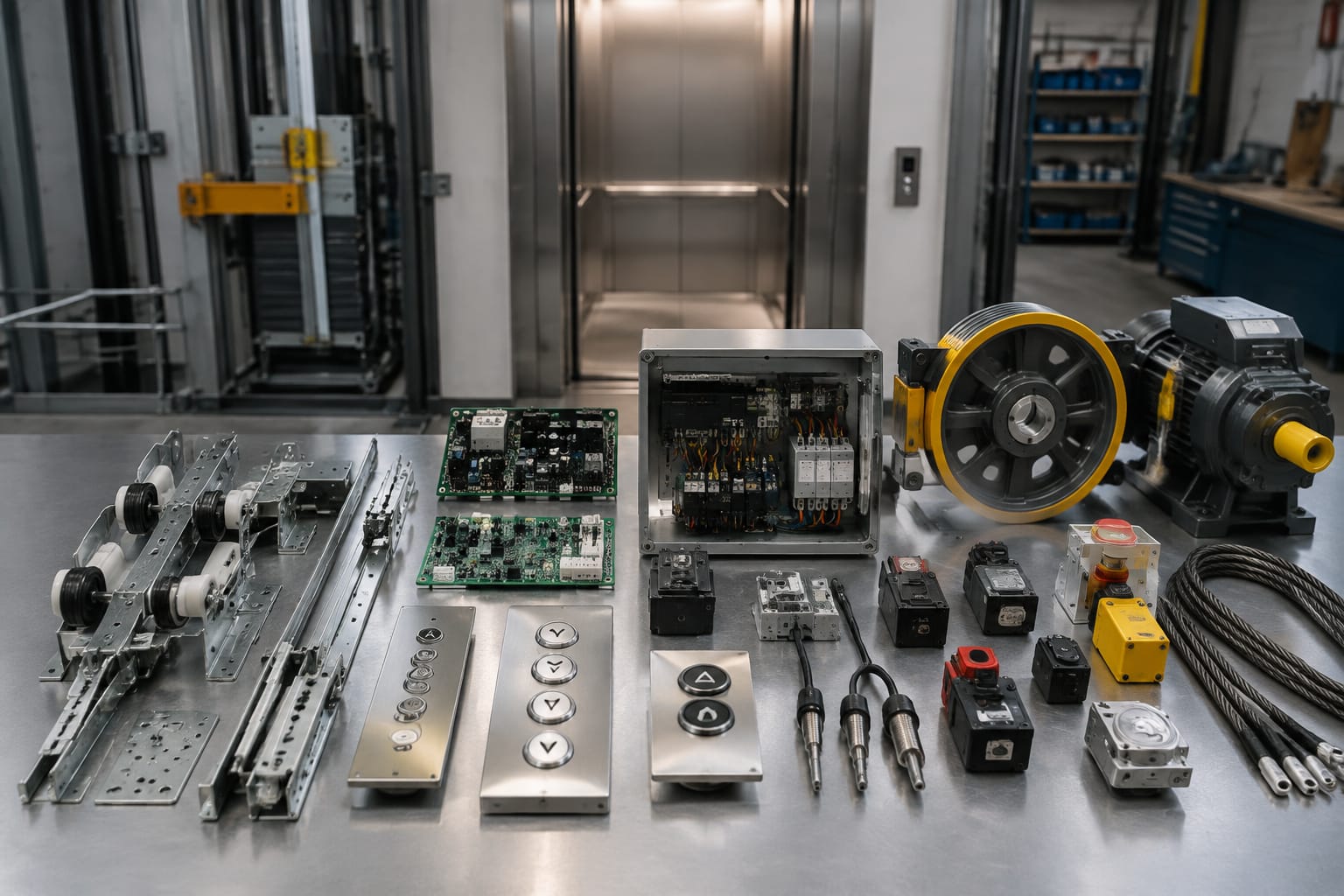
An elevator parts catalog groups replacement components by elevator subsystem, equipment brand, model, function, and technical specifications. To find the right part, begin with the subsystem and component type, then verify the manufacturer part number, electrical ratings, dimensions, connectors, software or firmware requirements, and applicable elevator model.
A visual match alone is not enough. Two parts may look identical while using different voltages, communication protocols, mounting patterns, or board revisions. The most reliable sourcing request combines clear nameplate and connector photos with the original part number, elevator details, measurements, and operating specifications.
How an elevator parts catalog is organized
Most elevator spare-parts catalogs organize products around major systems such as doors, fixtures, controls, traction equipment, safety devices, and emergency communication. A multi-brand catalog may add filters for manufacturer, elevator series, installation type, or component condition.
Catalog terminology is not completely standardized. For example, a door control board may be listed under door operators, electronic boards, or control components. Searching by both the part number and the component’s function can produce better results than relying on a single category.
A practical catalog entry should provide enough information to narrow the selection before technical confirmation:
| Catalog field | What it tells you | What to verify |
|---|---|---|
| Component name | General function and product category | That the name refers to the complete assembly rather than one subcomponent |
| Manufacturer or compatible brand | Equipment family associated with the part | Whether it is original, aftermarket, refurbished, or otherwise described |
| Part number | Primary identifier used for matching | Every letter, digit, space, suffix, and revision mark |
| Applicable model | Elevator or subsystem series | Exact controller, door operator, machine, or fixture model |
| Electrical rating | Required voltage, current, frequency, or signal type | Input and output ratings, not just supply voltage |
| Dimensions | Physical size of the component | Mounting-hole pattern, shaft size, clearances, and connector orientation |
| Interface | Plug, terminal, pinout, or communication connection | Connector keying, pin count, wiring sequence, and protocol |
| Revision information | Hardware or software generation | Whether revisions are interchangeable or require configuration changes |
| Included items | Scope of supply | Brackets, cables, plugs, hardware, covers, or accessories |
Before ordering, determine whether the catalog listing represents a direct replacement, a compatible substitute, or a component that requires adaptation. “Compatible with” does not automatically mean plug-and-play.
Door-system components
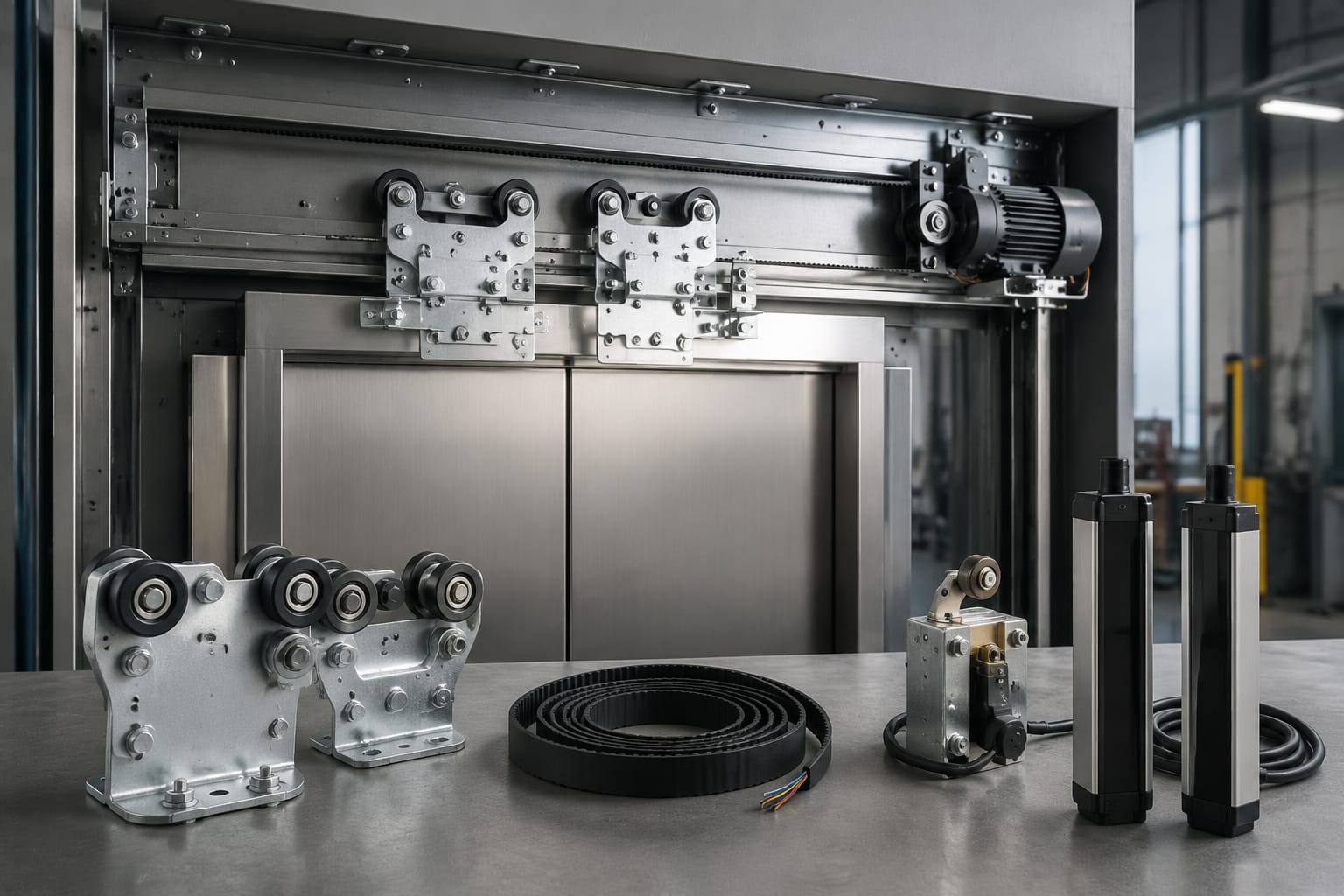
Elevator doors contain mechanical, electrical, and safety-related parts that operate as a coordinated system. Diagnosis should identify whether the problem is in the car-door operator, landing-door equipment, sensing circuit, mechanical linkage, or controller.
1. Door operator motors and control boards
The door operator motor supplies movement, while its control board regulates opening speed, closing speed, torque, position, and protective functions. Depending on the design, these may be separate products or parts of an integrated operator assembly.
For a motor, confirm:
- Manufacturer and complete motor model
- Rated voltage, current, power, and frequency
- AC, DC, brushless, or other motor type
- Shaft diameter, shaft shape, and rotation requirements
- Mounting dimensions and pulley or gearbox interface
- Encoder or feedback connection, if present
For a door control board, record the board number, revision, connector labels, supply voltage, operator model, and any parameter or software information shown on the labels. A Hitachi elevator door motor board illustrates the type of brand- and subsystem-specific listing that should be checked against the installed operator rather than selected by appearance.
Replacing a board without investigating binding doors, worn rollers, damaged wiring, or an overloaded motor can leave the underlying fault unresolved.
2. Door rollers, hangers, and guide components
Hanger rollers support and guide door panels along the track. Related mechanical parts include hanger assemblies, upthrust rollers, guide shoes, belts, pulleys, tracks, and linkage components.
Important matching details include:
- Roller diameter, width, profile, and material
- Bearing bore or mounting-stud size
- Hanger-plate dimensions and hole spacing
- Door configuration and panel arrangement
- Belt width, tooth profile, pitch, and length
- Left-hand or right-hand orientation, where applicable
Wear patterns can help identify system problems. Uneven roller wear, for example, may indicate misalignment or track damage. Installing a correctly sized roller will not correct a distorted hanger or improperly adjusted door panel.
3. Interlocks and door-sensing devices
Landing-door interlocks and car-door contacts verify that doors are closed and locked as required by the control system. Light curtains, photoelectric sensors, and mechanical safety edges detect obstructions at the entrance.
For an interlock, confirm the lock model, contact arrangement, mounting orientation, actuator design, handing, and connector or terminal layout. These are safety-related components, so substitutions should be evaluated against the elevator design, governing code, and requirements of the authority having jurisdiction.
For a light curtain, check:
- Number and length of transmitter and receiver elements
- Protected height and physical profile
- Supply voltage
- Output or communication type
- Cable lengths and connector styles
- Required controller or power-supply module
- Static or moving installation arrangement
A transmitter from one product series may not communicate correctly with a receiver or controller from another series, even when the housings are similar.
Buttons, panels, and displays
Fixtures are visible to passengers, but catalog matching involves more than choosing the same color and shape. Mechanical fit, illumination voltage, symbols, communication method, and accessibility features may all affect suitability.
4. Push buttons and key switches
Elevator push buttons include hall-call buttons, car-call buttons, door-control buttons, alarm buttons, and other function controls. Some are conventional switch assemblies; others connect to a serial fixture network.
Check the button’s:
- Cutout and face dimensions
- Mounting method and panel thickness
- Contact configuration
- Lamp or LED voltage
- Connector and pinout
- Legend, tactile marking, and illumination color
- Finish and bezel design
- Applicable fixture or elevator series
For replacement buttons in existing panels, measure the opening behind the faceplate. Matching only the visible diameter can result in a part that does not fit the mounting cutout.
5. Car and landing operating panels
Car operating panels and landing operating panels can be supplied as complete assemblies, faceplates, subpanels, or sets of individual devices. The catalog description should be checked carefully to determine what is included.
A complete-panel request generally requires panel dimensions, opening dimensions, floor count, button layout, display opening, service controls, finish, mounting method, and wiring interface. In the United States, applicable accessibility and elevator-code requirements should also be confirmed for the specific installation and jurisdiction.
Panel dimensions are often project-specific. Even equipment from the same manufacturer and elevator series may have been configured differently for a particular building.
6. Position indicators and display modules
Position indicators show floor location and may also display direction, service status, or other messages. Catalog categories can include dot-matrix displays, LCD modules, segmented displays, direction arrows, and complete indicator assemblies.
Confirm the display dimensions, viewing orientation, supply voltage, communication interface, connector, controller compatibility, character requirements, and mounting arrangement. Also identify whether the requested item is only the display, a display with its control board, or a complete fixture.
A physically matching display may remain blank or show incorrect information if its addressing, protocol, or software generation differs from the original.
Controllers, boards, and relays
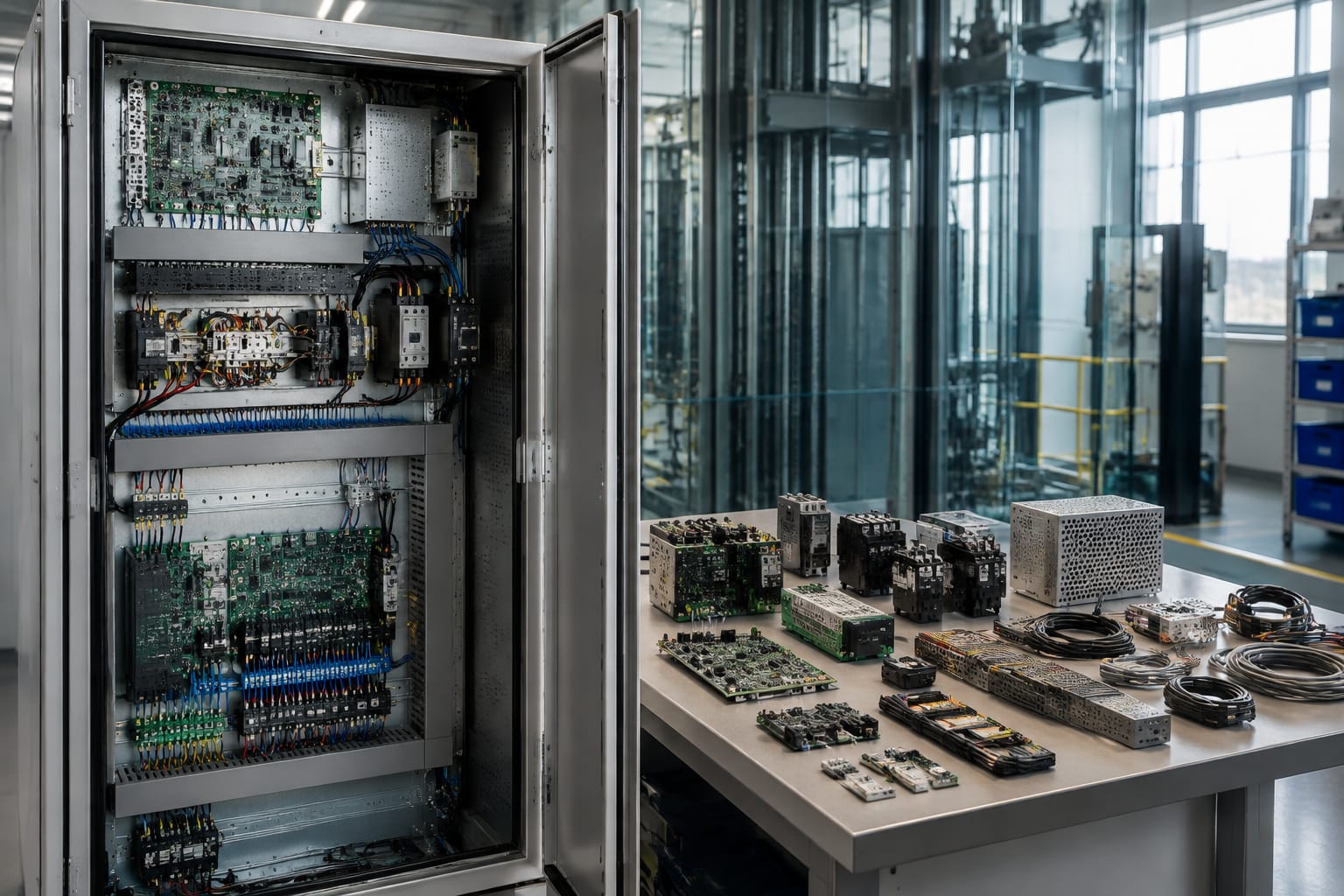
Control-system parts require especially careful identification. A general equipment model may narrow the search, but board revisions, programmed parameters, and connected devices can determine whether a replacement will operate correctly.
7. Main and auxiliary control boards
Control boards process calls, monitor safety circuits, command motion and doors, and communicate with fixtures or other modules. Their functions vary widely, from main controller boards to dedicated interface, input/output, power-supply, or communication boards.
Record all identifying marks, including:
- Assembly and printed-circuit-board numbers
- Revision letters or version numbers
- Equipment manufacturer and controller model
- Software, firmware, or programmable-device labels
- Supply and signal voltages
- Connector names and pin counts
- Installed daughterboards, memory devices, or option modules
- Diagnostic display or switch configuration
Do not assume that a newer revision automatically replaces an older one. Some revisions require updated firmware, transferred memory, parameter loading, wiring changes, or additional modules. Static-sensitive boards should also be handled and packaged with appropriate electrostatic-discharge precautions.
8. Relay boards and interface modules
Relay boards isolate or switch circuits for doors, brakes, signals, contactors, and auxiliary functions. Interface modules may translate signals between the controller and field devices.
The complete board number and revision are the starting points. Then compare relay coil voltage, contact ratings, connector layout, board power requirements, mounting points, and intended controller series. A Mitsubishi elevator relay board is an example of a catalog item for which the equipment family and board identity should be verified together.
Replacing only a failed relay may be possible in some maintenance contexts, but the cause of overheating or contact damage should be investigated. Excessive load, loose terminals, coil-voltage problems, or repeated switching can damage a replacement.
Traction and motion components
Traction equipment transfers motor torque into controlled car movement. Parts in this category can affect ride quality, leveling, speed feedback, and the mechanical integrity of the drive system.
9. Traction encoders
An encoder sends speed, direction, or position feedback to the elevator drive and controller. Encoder compatibility depends on both mechanical installation and electrical signal characteristics.
For an accurate match, confirm:
- Encoder manufacturer and full model number
- Incremental, absolute, sine/cosine, or other output type
- Resolution, such as pulses per revolution, where specified
- Supply voltage
- Output circuit and communication interface
- Solid-shaft, hollow-shaft, or through-shaft design
- Shaft or bore diameter
- Cable exit, cable length, connector, and pinout
- Mounting bracket and anti-rotation arrangement
A catalog listing for a traction encoder for elevator applications can help identify the relevant product category, but the original encoder label and drive requirements remain essential. An incorrect signal type or resolution can cause drive faults, poor leveling, or uncontrolled operating behavior during commissioning.
10. Traction sheaves, ropes, belts, and bearings
Motion components include traction sheaves, deflector sheaves, suspension ropes or coated belts, machine bearings, and related hardware. These parts are selected as elements of a complete suspension and drive arrangement.
For sheaves, document the outside diameter, number of grooves, groove profile, rope or belt size, bore, keyway, hub dimensions, and machine model. For ropes or belts, confirm the manufacturer’s identification, construction, dimensions, quantity, termination method, and system requirements.
These components should not be selected from nominal size alone. Groove condition, traction relationships, suspension-member compatibility, wear limits, and replacement practices must be evaluated by qualified elevator personnel under applicable requirements.
Sensors and safety devices
Sensors provide the controller with information about position, speed, load, limits, and equipment status. Safety devices may be part of monitored circuits that prevent operation under unsafe conditions.
11. Leveling, position, and limit sensors
Common catalog items include magnetic switches, proximity sensors, photoelectric sensors, vane readers, limit switches, load-weighing sensors, and floor-position devices.
Identification should cover:
- Sensor technology and sensing distance
- Normally open, normally closed, or electronic output
- Number of wires and wiring function
- Supply voltage
- Connector or terminal arrangement
- Body dimensions and mounting method
- Target, magnet, vane, or actuator type
- Environmental rating when specified by the manufacturer
Similar-looking proximity sensors can use different PNP, NPN, two-wire, or dry-contact outputs. Installing the wrong output type can prevent correct detection or damage an input circuit.
Governors, safety switches, buffers, brake-monitoring devices, and other protective equipment demand an even higher level of scrutiny. Confirm the exact approved configuration for the elevator and jurisdiction rather than treating these items as general-purpose replacements.
Communication and emergency parts
Communication components connect passengers, building personnel, monitoring services, and elevator control equipment. Emergency devices may also need to function during a loss of normal power.
12. Emergency phones, intercoms, alarms, and backup-power parts
This category may include emergency telephones, intercom stations, alarm buzzers, microphones, speakers, communication interface boards, batteries, chargers, and emergency-lighting modules.
For communication equipment, identify the existing connection method and building interface. Depending on the system, that could involve an analog line, cellular gateway, network connection, or proprietary communication link. Confirm power input, mounting dimensions, programming requirements, monitoring arrangements, and compatibility with existing station hardware.
For batteries, match the chemistry, nominal voltage, capacity, dimensions, terminal type, wiring arrangement, and charger requirements. Higher capacity is not automatically suitable if the charger, enclosure, or emergency circuit was designed for a different battery.
Emergency communication and backup systems are subject to installation-specific code and operational requirements. Confirm required functionality, testing, monitoring, and power-loss behavior with the responsible elevator professional and authority having jurisdiction.
How to identify an exact catalog match
A dependable match comes from combining identifiers, specifications, and installation evidence. Use the following process before issuing a purchase order.
-
Identify the subsystem and failed function. Determine whether the part belongs to the door operator, controller, fixture network, drive, safety circuit, or another system. Verify that the component itself is faulty rather than responding to an external mechanical or wiring problem.
-
Record the complete equipment information. Capture the elevator manufacturer, elevator model or series, controller model, door-operator model, machine or drive model, and any project or unit identifiers available in the equipment documentation.
-
Transcribe every part number exactly. Include prefixes, suffixes, spaces, dashes, revision letters, and secondary assembly numbers. A one-character difference can identify a different voltage, interface, or generation.
-
Photograph the installed part before removal. Take clear images of the front, back, labels, connectors, terminals, mounting points, and surrounding wiring. Wider photos provide context; close-ups preserve label details.
-
Measure critical dimensions. Use dimensions relevant to the part, such as overall size, hole spacing, shaft diameter, bore, panel cutout, cable length, or connector position. State whether measurements are in inches or millimeters.
-
Document electrical and communication details. Record voltage, current, frequency, output type, connector pin count, communication protocol, encoder resolution, and other marked specifications. Do not infer ratings from wire color or physical size.
-
Check revision and programming requirements. Ask whether firmware, parameters, memory, addressing, calibration, or commissioning is required. Determine whether configuration data can be transferred from the original part.
-
Define the required scope of supply. State whether you need a bare board, motor only, complete assembly, cable, bracket, connector, faceplate, or installation hardware. Catalog photos sometimes show accessories that are not included.
-
Confirm replacement status in writing. Before purchasing, verify whether the offered item is an exact part-number match, an authorized supersession, or a compatible alternative. For alternatives, document any wiring, mounting, software, or commissioning changes.
-
Review safety and jurisdictional requirements. Replacement work should be performed by qualified elevator personnel. Safety-related substitutions and modernization changes may require additional engineering review, inspection, or approval under the codes adopted by the local authority having jurisdiction.
Common sourcing mistakes include ordering from a front-view photo, omitting the revision suffix, confusing a board number with a complete assembly number, and assuming that all parts within one elevator brand are interchangeable. Another frequent error is failing to distinguish the elevator’s overall model from the model of the controller, door operator, drive, or machine.
A concise sourcing package should contain the requested quantity, full part number, revision, equipment models, technical ratings, dimensions, labeled photos, connector photos, and desired scope of supply. Kelevator supplies multi-brand elevator spare parts to contractors, importers, distributors, modernization companies, sourcing teams, and OEM buyers, but the same identification package is useful when comparing any qualified supplier.
Once the information is assembled, compare the catalog candidate line by line against the installed component. Resolve every mismatch in part number, revision, rating, interface, and dimensions before ordering or scheduling installation.