
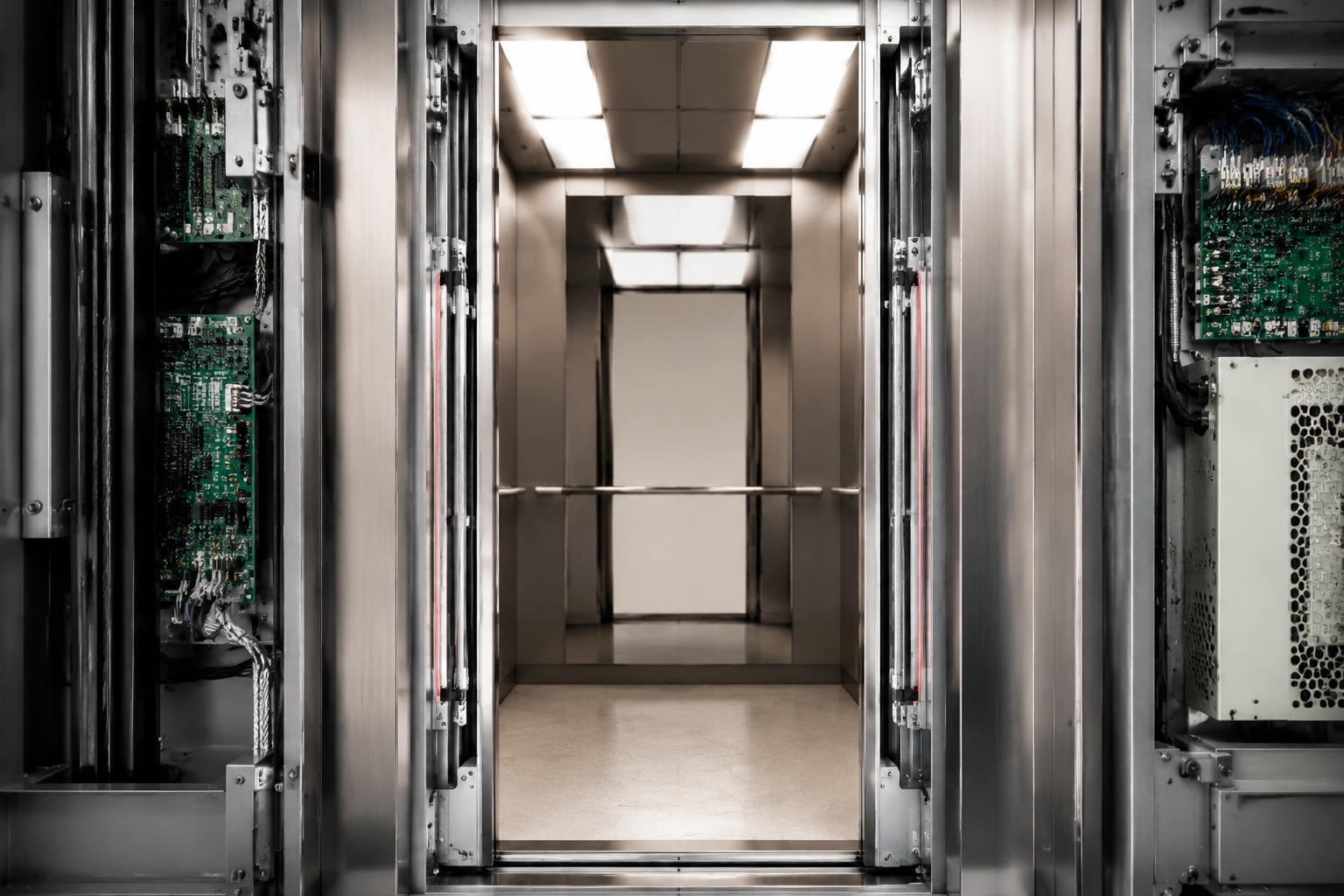
An elevator light curtain is a multi-beam door safety sensor that detects passengers, carts, and objects across the full doorway so the doors reopen before impact. In practical terms, it helps reduce nuisance door strikes, callbacks, passenger complaints, and wear on door operator components. For building owners, maintenance firms, and modernization contractors across the United States, upgrading from older two-point or three-point door sensors to a full-height infrared light curtain is often one of the fastest ways to improve passenger protection and reduce door impact faults.
In high-traffic properties such as hospitals in Chicago, office towers in New York, residential buildings in Miami, and logistics facilities near Los Angeles and Houston, door reopening performance matters every day. People move with strollers, delivery carts, wheelchairs, luggage, and pallets. A narrow sensor zone can miss these obstacles. A properly matched light curtain provides a denser protective screen across the entrance, improving traffic flow and reducing avoidable service interruptions.
This guide explains what elevator light curtains do, how to identify common failure symptoms, how to select beam coverage and model type, what to know about E GMS replacement work, and how to check wiring and controller compatibility before installation. It also covers post-installation testing, upgrade timing, market trends through 2026, and frequently asked questions from the United States elevator parts market.
For buyers sourcing replacement units, compatibility matters more than appearance. Connector style, power input, mounting dimensions, controller logic, response time, and beam count all affect whether a replacement will perform correctly. If you are reviewing parts for a service route or modernization package, you can compare options such as E GMS elevator light curtain replacements and other elevator door light curtain assemblies while confirming the exact door operator and controller interface.
What an elevator light curtain does
An elevator light curtain creates an invisible grid of infrared beams between a transmitter and receiver mounted on opposite sides of the door entrance. When a passenger or object interrupts one or more beams, the curtain sends a reopen signal so the doors stop closing and reverse. Unlike a basic photo eye that monitors only one or two points, a light curtain protects a much larger portion of the opening from near sill level to near header level.
This broad coverage is valuable in mixed-use properties. A child鈥檚 hand, the corner of a rolling bag, the footrest of a wheelchair, or the edge of a food service cart may not break a single-point sensor at the right time. A multi-beam curtain improves detection consistency. It also helps lower the chance of intermittent impact events that may not trigger a shutdown but do create complaints, accelerated door wear, and potential liability.
Most modern systems work with a dedicated control board or interface module. Some are simple open-collector outputs; others depend on brand-specific timing or door operator logic. In the field, the light curtain is often blamed whenever doors nudge, hesitate, or reopen unexpectedly, but the root cause may also involve dirty lenses, loose alignment, cable damage in the traveling door loop, weak door operator performance, controller input issues, or power supply instability.
| Function | How It Helps | Common Use Case | Benefit to Building | Maintenance Impact | Upgrade Priority |
|---|---|---|---|---|---|
| Passenger detection | Detects people across the doorway | Office lobby traffic | Reduces door contact events | Fewer callbacks for door strikes | High |
| Cart and luggage sensing | Covers low and mid doorway areas | Hotels and airports | Smoother traffic movement | Less door edge damage | High |
| Wheelchair and stroller protection | Improves detection of partial obstructions | Residential and healthcare | Better accessibility experience | More consistent reopen response | High |
| Door reopening signal | Commands the operator to reverse closing | Busy rush-hour periods | Reduces nuisance impacts | Supports safer operation | High |
| False impact reduction | Prevents light contact from becoming a complaint | Retail and mixed-use sites | Better tenant satisfaction | Lower complaint handling time | Medium |
| Modernization support | Fits safety upgrades on older equipment | Aging mid-rise buildings | Extends useful service life | Improves parts availability | Medium |
The table above shows why light curtains are often included in modernization scopes even when the rest of the entrance remains unchanged. They are relatively compact components, but they influence everyday safety perception more than many hidden control parts.
Common light curtain failure symptoms
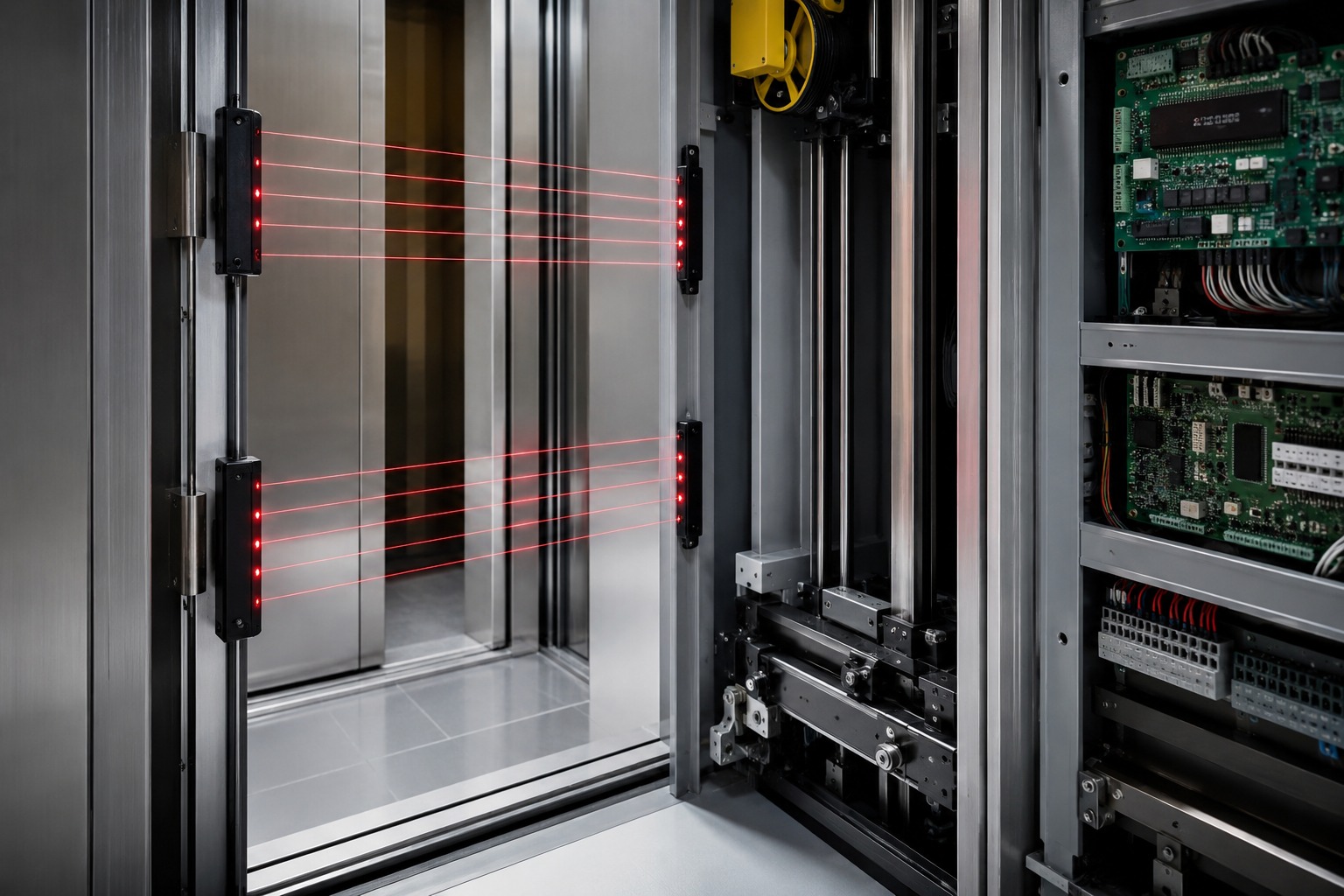
The most common symptoms are inconsistent door reopening, doors that close normally but occasionally hit a passenger or object, random reopening when no one is present, door nudging too often, and repeated door faults after wet weather, cleaning, or heavy vibration. Technicians in cities with temperature swings such as Boston, Denver, and Minneapolis may also see seasonal issues related to condensation, brittle wiring, or aging plastic retainers.
Failure symptoms usually appear in patterns. If the doors fail to reopen only at the lower part of the opening, damaged low beams or lens contamination near the sill may be involved. If the issue is intermittent during movement, look at cable flexing where the door loop travels. If the sensor LEDs indicate normal beam activity but the controller does not react, the problem may be in the output wiring, interface board, or logic polarity rather than the curtain itself.
Older installations near coastal environments like Newark, Long Beach, Savannah, or Seattle can develop corrosion at connectors or terminals due to humidity and airborne contaminants. In parking structures and service elevators, impact damage from carts, mops, or freight handling is also common. In these environments, rugged mounting and careful cable routing matter as much as the sensor specification.
| Symptom | Likely Cause | Where to Check First | Urgency | Temporary Risk | Recommended Action |
|---|---|---|---|---|---|
| Doors close on passengers occasionally | Beam loss or poor coverage | Lens, alignment, beam status LEDs | Critical | Safety complaints and impact risk | Inspect and replace if needed |
| Doors reopen with no obstruction | Electrical noise or misalignment | Cable shielding, mounting, board input | High | Traffic delay and nuisance callbacks | Stabilize wiring and verify output |
| Frequent nudging mode | Sensor not communicating reliably | Power supply and controller interface | High | Reduced user confidence | Check voltage and logic compatibility |
| Only upper or lower zone detects | Partial beam failure | Emitter/receiver strips | High | Missed object detection | Replace damaged side or full set |
| No LED indication | No power or failed board | Input voltage and connectors | Critical | No active protection | Isolate power issue or replace unit |
| Intermittent faults during door travel | Broken flex cable | Traveling cable loop | High | Unpredictable operation | Repair harness and secure routing |
This symptom table is useful because it separates visible behavior from actual root cause. Many 鈥渂ad sensor鈥?reports turn out to be installation, power, or controller issues. Good troubleshooting saves time, prevents wrong-part orders, and reduces return handling.
How to choose beam coverage and model type
Choosing the right elevator light curtain starts with beam coverage, physical dimensions, and control compatibility. In the United States, the right choice depends on traffic profile, entrance width, door operator type, and whether the site is a straight replacement or a broader modernization. A luxury residential tower in San Francisco may prioritize smooth passenger experience, while a hospital in Atlanta may prioritize dense coverage for stretchers and wheelchairs.
Beam count is often a key selection point. Higher beam density generally improves detection across the opening, especially for small or irregularly shaped objects. However, more beams do not automatically guarantee better results if the unit does not match the controller logic, mounting space, or power input. For some routes, a robust standard model with stable compatibility performs better than a premium model installed with an adapter that introduces delay or noise.
Model type also includes one-piece kits, separated strips with external controller, and brand-specific replacement assemblies. When replacing an existing device, compare the following: overall strip height, width, mounting hole pattern, cable exit direction, connector type, supply voltage, output type, and whether the door operator expects normally open, normally closed, relay, transistor, or coded communication behavior.
| Selection Factor | Standard Building | High-Traffic Building | Hospital / Accessibility Focus | Freight / Service Use | Why It Matters |
|---|---|---|---|---|---|
| Beam density | Moderate | High | High | Moderate to high | Improves doorway coverage |
| Mounting profile | Standard slim strip | Slim, impact-resistant | Slim with stable alignment | Heavy-duty preferred | Fits door edge space and protects hardware |
| Output logic | Simple relay/transistor | Fast and stable interface | Reliable reopen response | Noise-resistant preferred | Must match controller input |
| Cable durability | Normal flex use | Frequent cycle rated | Reliable for continuous use | Extra flex protection | Reduces intermittent failures |
| Environmental resistance | Basic indoor | Dust and cleaning tolerance | Strong consistency | Impact and dirt resistance | Extends service life |
| Replacement strategy | Exact match if possible | Upgrade if callbacks persist | Choose better coverage | Choose rugged design | Balances downtime and cost |
The table above helps buyers decide based on use conditions rather than price alone. In many cases, the best-value option is the model that avoids repeated adjustments and service calls over the next several years.
The chart above reflects a realistic upward trend in door safety upgrade demand. Growth is supported by aging equipment in major metro areas, more modernization activity, rising passenger expectations, and a stronger focus on reducing avoidable impact complaints.
E GMS light curtain replacement notes
E GMS light curtain replacement projects usually require more than just matching the visible strip shape. You should verify the original part label, the door operator model, the signal method, and whether the system uses an external controller or integrated interface. In older buildings, previous service companies may have installed adapters, non-original brackets, or custom wiring changes, so a simple visual match can be misleading.
When replacing an E GMS style unit, inspect both sides of the doorway. Check if the transmitter and receiver pair are both original, whether one side was changed earlier, and whether beam interruption LEDs behave consistently from top to bottom. If one side is damaged from impact, replacing both sides can be more reliable than mixing a new strip with an older strip that has reduced sensitivity or aged cabling.
It is also wise to compare mounting depth. Some entrances have limited clearance with door vanes, hangers, or fascia edges. A strip that is slightly thicker may still fit in catalog terms but can become vulnerable to rub points during operation. For that reason, careful model matching is essential. Our team typically supports customers by confirming label data, photos, connector details, and dimensions before shipment, which helps reduce mismatches and return delays.
For buyers reviewing replacement options, a practical starting point is the E GMS light curtain product page. If the site uses a related but different assembly, another option may be a broader elevator light curtain replacement unit after compatibility checks are complete.
| E GMS Replacement Checkpoint | What to Verify | Common Field Issue | Best Practice | Downtime Impact | Result if Ignored |
|---|---|---|---|---|---|
| Part label | Model code and revision | Wrong generation ordered | Use label photo and serial detail | Medium | Fit or logic mismatch |
| Strip dimensions | Height, width, depth | Interference with moving door parts | Measure installed unit | High | Premature damage |
| Connector type | Pin count and keying | Cannot connect directly | Confirm harness photo | High | Installation delay |
| Controller method | Integrated or external board | No reopen response | Map system wiring first | Critical | Nonfunctional protection |
| Door operator brand | Original entrance setup | Timing differences | Check operator manual and field notes | Medium | False faults or nuisance reopen |
| Bracket condition | Straightness and mounting integrity | Alignment loss after impact | Replace damaged hardware | Medium | Intermittent beam gaps |
This replacement table matters because most ordering mistakes come from skipped field verification. A good supplier can help with cross-checking, but accurate site information remains the foundation of a successful order.
Wiring and controller compatibility checks
Before installing any replacement light curtain, confirm the electrical basics. Check input voltage range, polarity, current draw, output type, and the door controller input expectation. Some systems accept a simple dry contact. Others expect transistor output or a specific state change under beam interruption. A curtain that powers up and shows LEDs can still fail in operation if the board logic does not match the operator鈥檚 reopen circuit.
In modernization work around Dallas, Phoenix, and Philadelphia, it is common to encounter mixed equipment generations. The car door operator may be newer than the controller, or the sensor may have been retrofitted years earlier with an adapter board. In those cases, technicians should document the full signal path: power source, interface board, controller input terminal, and any jumper or DIP switch settings related to door protection.
Noise immunity also matters. Variable frequency drives, aging grounds, and poorly routed harnesses can create intermittent behavior that looks like a failing sensor. Keep low-voltage sensor wiring separate from high-noise power runs where possible, secure flex loops, and inspect terminal blocks for oxidation or weak clamping. A replacement part alone will not solve a wiring quality problem.
| Compatibility Item | What to Confirm | Typical Acceptable Condition | Risk If Wrong | Field Check Method | Decision |
|---|---|---|---|---|---|
| Supply voltage | Input range on sensor and board | Stable within rated value | No power or damaged electronics | Measure under operation | Must match |
| Polarity | Positive and negative orientation | Correct terminal placement | Unit will not run | Trace wiring and labels | Must match |
| Output type | Relay, transistor, NPN, PNP, or custom | Compatible with controller input | No reopen signal | Review manual and test signal | Must match |
| Controller logic | NO/NC or active high/low | Door responds correctly to beam break | Reverse behavior or no action | Simulate interruption | Must match |
| Cable length and routing | Proper strain relief and flex movement | No pinch or over-bend | Intermittent faults | Cycle doors repeatedly | Recommended |
| Grounding and noise control | Stable reference and clean routing | No false triggering | Random reopen or fault | Inspect VFD proximity and harness path | Recommended |
This table gives buyers and technicians a checklist that prevents the most expensive mistake: ordering the correct shape but the wrong signal behavior. For distributors and service contractors, compatibility verification before shipping reduces project risk and improves first-time installation success.
This bar chart shows where demand tends to be strongest. Hospitals and office towers usually lead due to continuous traffic, accessibility expectations, and the cost of nuisance door issues. Warehouses and service environments also rank high because impact exposure and rough usage shorten sensor life.
Testing after installation
After installation, testing should go beyond a basic 鈥渄oor reopens once鈥?check. Test multiple heights and positions across the entrance. Use a hand, a box edge, a cart corner, and low-level obstructions near the sill. Cycle the doors repeatedly with normal speed and under peak traffic simulation if possible. Watch for delayed reopen response, missed lower-zone detection, and intermittent operation during full travel.
In major properties around Washington, DC, Las Vegas, and Orlando, a good commissioning routine can prevent early callback costs. Building staff quickly notice if doors reopen too often or not enough. The ideal result is stable protection without nuisance reversing. Confirm also that the signal clears properly after the obstruction is removed and that no fault remains latched unless the controller is designed that way.
If the installation is part of a modernization package, document the final settings, wiring points, and replacement part numbers for future service teams. This is especially important in portfolios with multiple sites and multiple service providers. Good records reduce future troubleshooting time and help ensure the same replacement can be sourced again when needed.
| Test Step | Procedure | Expected Result | Common Failure Sign | Why It Matters | Record Needed |
|---|---|---|---|---|---|
| Power-up check | Confirm LEDs and startup state | Normal indication | No status light | Verifies base operation | Voltage reading |
| Center doorway test | Interrupt beams at mid-height | Doors reopen immediately | Delay or no reaction | Checks main reopen logic | Pass/fail |
| Lower zone test | Interrupt near sill level | Reliable detection | Missed cart or bag profile | Important for accessibility and luggage | Pass/fail |
| Upper zone test | Interrupt near upper section | Reliable detection | Partial beam loss | Confirms full-height coverage | Pass/fail |
| Repeated cycle test | Run 20 to 50 cycles | Stable performance | Intermittent fault under movement | Finds cable and alignment issues | Cycle count |
| Controller response review | Observe normal service after test | No nuisance faults | Unexpected nudging or reopen | Confirms system integration | Final settings note |
The testing table above is valuable because elevator door safety performance is dynamic. A part may appear fine when the car is stationary and fail only after repeated movement or with a low-profile obstruction. Structured testing catches those issues early.
When to upgrade old door sensors
You should consider upgrading old door sensors when the system relies on a limited photo eye, when passengers report door contact, when callbacks increase, when replacement parts become hard to source, or when a broader entrance modernization is already planned. Buildings in older urban cores such as Cleveland, St. Louis, Baltimore, and Detroit often have entrances where the operator still runs but the detection technology no longer meets current user expectations.
Upgrading makes particular sense in facilities with high baggage, mobility devices, patient transport, grocery carts, or tenant delivery traffic. It can also be a practical risk-management step for building owners who want to reduce incidents without replacing the entire entrance. While a light curtain is not a cure for mechanical door issues, it is often one of the most visible safety improvements available at a manageable project cost.
From a lifecycle perspective, upgrading becomes more attractive when the old sensor causes repeated labor costs. If a route technician has to clean, realign, or bypass the unit several times per year, the total maintenance cost may already exceed the value of a properly matched replacement. This is especially relevant in portfolio management across large metro regions where every callback affects route efficiency.
The area chart reflects a clear market transition: older point sensors are gradually being replaced by full-height doorway detection, especially in modernization cycles. This trend is expected to continue through 2026 as labor efficiency, tenant expectations, and safety planning become more important.
FAQ about elevator light curtains
Do all light curtains fit all elevators?
No. Physical fit, power input, connector style, and controller logic must all be checked. A visually similar strip may still be electrically incompatible.
How many beams are enough?
There is no single answer for every job. Moderate beam density may be acceptable for standard low-rise traffic, but higher density is usually preferred in hospitals, hotels, airports, and premium residential buildings where luggage, wheelchairs, and irregular traffic profiles are common.
Should I replace one side or both sides?
If one side is physically damaged but the other side is old, replacing both sides often improves reliability and alignment. Mixed-age pairs can work, but they may not deliver the same long-term stability.
Can a light curtain solve all door problems?
No. It improves detection, but worn hangers, weak door motors, bad rollers, dirty tracks, and controller faults can still cause poor door performance. A good technician should evaluate the entire door system.
How long does installation take?
It depends on access, matching accuracy, and whether rewiring or adapter work is needed. A true direct replacement is much faster than a retrofit requiring bracket changes and controller interface adjustments.
What should distributors and maintenance firms ask before ordering?
Request photos of the installed unit, part labels, connector close-ups, dimensions, controller details, and door operator brand. This reduces mismatch risk and shortens lead-time uncertainty.
Is it worth upgrading during modernization even if the old sensor still works?
Often yes. If the building is already taking the entrance out of service, that is an efficient time to improve doorway protection and standardize future replacement parts.
The comparison chart highlights the supplier attributes that matter most in elevator spare parts sourcing. For maintenance companies and modernization contractors, technical matching and careful inspection are usually more valuable than low price alone because the true cost of a mismatch is downtime.
United States market, applications, and buying advice
The United States elevator replacement market is shaped by a mix of dense urban modernization and ongoing service demand in secondary cities. New York, Chicago, Los Angeles, Houston, Atlanta, and San Francisco continue to drive high-volume parts demand, while ports and logistics corridors such as Newark, Savannah, Long Beach, and the Dallas-Fort Worth distribution hub create strong need for durable door protection in freight and mixed-use buildings.
Applications span residential towers, healthcare systems, universities, hotels, retail centers, transit buildings, industrial campuses, and municipal facilities. In each segment, the reason to upgrade is slightly different. Residential properties focus on tenant experience and complaint reduction. Hospitals prioritize safe patient movement. Hotels need smooth luggage traffic. Industrial sites require rugged hardware that tolerates dust, impacts, and frequent cart movement.
Buying advice is simple: start with exact field data, not assumptions. Confirm the old part, the entrance setup, and the interface logic. Ask whether the site needs direct replacement or performance improvement. Consider future serviceability, not just immediate price. If the property owner manages multiple buildings, standardizing compatible light curtain models across similar equipment can save labor and simplify stocking.
Our capabilities for elevator light curtain supply
Technological capabilities: We support model identification for elevator spare parts by checking labels, connector types, dimensions, and application details across many common lift brands and related systems. For buyers dealing with mixed fleets, this helps narrow compatibility risk before shipment. We focus on practical matching for control boards, inverter parts, door operator components, sensors, and replacement light curtains so maintenance teams can restore safe operation faster.
Manufacturing capabilities: Our sourcing and quality process emphasizes stable component selection, careful inspection, and protective packaging suitable for domestic and international transport. For delicate items such as elevator light curtain strips, encoders, buttons, and electronic boards, packaging quality matters because impact or connector damage during transit can create unnecessary downtime at the jobsite. We aim for consistent part condition and dependable replacement readiness.
Service capabilities: We work with maintenance companies, distributors, building owners, and modernization contractors by responding quickly to model inquiries and helping verify replacement options before ordering. This service approach is especially useful in the United States market where labor cost, downtime pressure, and job scheduling are high. Clear communication, careful model matching, and responsive follow-up help customers reduce repeat visits and keep elevator systems operating safely.
2026 trends: technology, policy, and sustainability
Looking ahead to 2026, several trends will shape elevator light curtain demand in the United States. First, modernization activity will continue as aging entrances remain in service longer than originally expected. Building owners want targeted upgrades that improve safety and passenger experience without full system replacement. Door sensors are an efficient part of that plan.
Second, policy and risk management will push more owners toward reliable doorway detection. While local code interpretation and project scope vary by jurisdiction, the broader direction is clear: fewer avoidable door strikes, better accessibility support, and stronger documentation of maintenance performance. In competitive real estate markets, safety perception and service quality affect tenant retention.
Third, sustainability is becoming more relevant. Extending the useful life of elevator entrances through selective component upgrades can reduce waste compared with full replacement. When a building can keep a functioning operator, controller, and mechanical entrance in service by changing worn sensors and related door parts, it often lowers material consumption and project disruption. Packaging efficiency, stable quality, and lower return rates also contribute to a more sustainable supply chain.
Finally, technology will continue to improve integration. Expect more demand for durable, low-maintenance sensor assemblies with better noise immunity, easier retrofitting, and more predictable interface behavior across mixed equipment generations. For service firms managing routes across multiple cities, standardized, reliable replacement choices will matter even more than new features alone.
Case examples from real-world applications
In a mid-rise residential property in Jersey City, repeated complaints involved doors touching grocery carts and strollers during evening traffic. The building had an older narrow-beam sensor. After replacement with a properly matched light curtain and post-installation cycle testing, complaints dropped and route callbacks related to door impact were reduced.
At a medical office building in Phoenix, the issue was not the sensor strip itself but a failing flex cable that broke contact during movement. The symptom looked like a bad light curtain because detection was inconsistent. Once the cable route and wiring were corrected, the system returned to normal service without additional controller replacement.
In a hotel near Orlando鈥檚 convention traffic zone, luggage carts repeatedly struck the mounted strips because of limited clearance and bent brackets from previous impacts. The final solution involved replacing the strips, correcting bracket alignment, and documenting the exact mounting dimensions to prevent future mismatch. This example shows why field-fit details matter as much as the part number.
These cases reflect the core lesson of elevator doorway safety upgrades: the best result comes from proper diagnosis, accurate model matching, and disciplined testing after installation.