
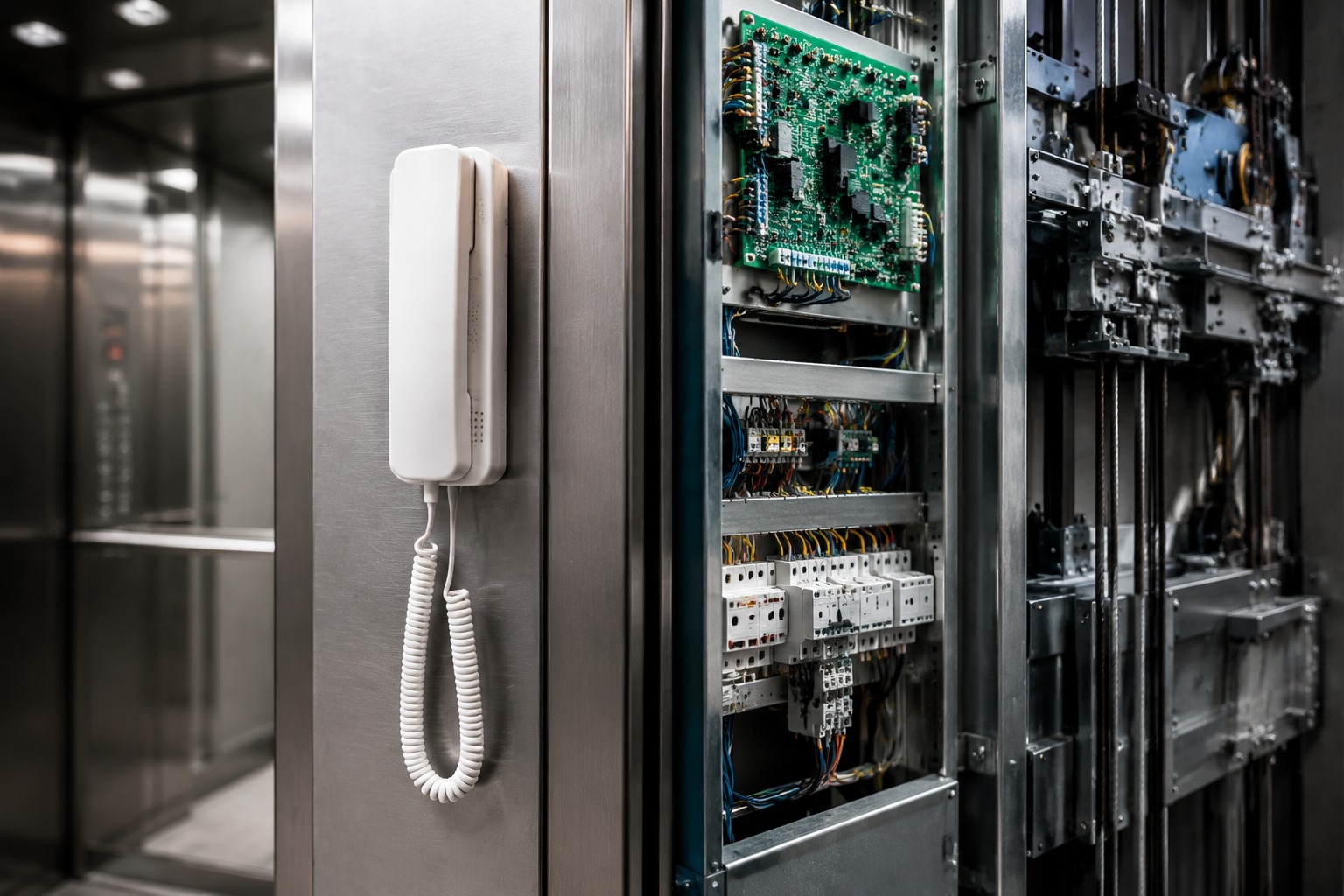
Elevator intercom phones are a life-safety communication link, not just a convenience feature. In the United States, they help trapped passengers contact building staff, monitoring stations, or emergency responders, and they support daily compliance, modernization, and maintenance work across offices, hotels, hospitals, apartments, airports, and industrial buildings. When an intercom fails, the elevator may still move, but passenger confidence, emergency response readiness, and inspection performance can all suffer quickly.
For building owners and elevator maintenance companies, the practical question is usually not whether an intercom matters, but how to source the right replacement quickly. That means confirming the equipment brand, checking whether the part is a car intercom, handset, terminal, or complete phone assembly, matching voltage and wiring, testing audio quality, and deciding whether repair or replacement makes better financial sense. In older installations in New York City, Chicago, Los Angeles, Houston, Miami, Seattle, Atlanta, and Boston, these details often determine whether downtime lasts hours or days.
The U.S. market also has a wide mix of legacy and modern systems. A mid-rise residential tower in Newark may still use older analog elevator communication hardware, while a modernization project near the Port of Long Beach may require updated intercom parts that fit an existing car operating panel without changing the whole communication architecture. Because of that, careful model matching matters more than generic assumptions.
As a professional elevator parts supplier serving maintenance companies, distributors, building owners, and modernization contractors, we focus on reliable sourcing, exact model verification, stable quality inspection, protective packaging, and responsive service for replacement parts used in passenger elevators and lift systems. That includes intercom phones, intercom terminals, and related accessories for brands such as Hitachi and other major manufacturers used throughout the United States.
If you are reviewing options now, it may help to compare a Hitachi elevator intercom phone for direct handset replacement, a Hitachi intercom system phone for broader communication assemblies, a Hitachi intercom terminal for control-side connection needs, or a Hitachi car intercom in 24V or 6V when voltage-specific car communication hardware is required.
Why elevator intercoms are important
Elevator intercoms are important because they create the first line of communication during entrapments, power events, door faults, and other service interruptions. In a passenger elevator, riders may have no visibility into what happened and no technical understanding of whether the issue is minor or serious. A working intercom gives clear reassurance, allows two-way instructions, and shortens response confusion. In commercial towers, healthcare facilities, and residential high-rises, that alone can reduce panic and liability exposure.
They also support code compliance and inspection readiness. While specific requirements vary by jurisdiction and by the age and type of the installation, elevator communication devices are commonly reviewed as part of safety expectations. In the United States, building managers in cities with dense vertical transportation networks, such as New York City and San Francisco, are especially aware that communication failures can trigger urgent repair calls, resident complaints, and failed inspections.
From an operations viewpoint, intercoms protect service continuity. A phone that crackles, disconnects, or fails to ring can delay rescue coordination. In hotels and hospitals, that delay affects customer satisfaction and care workflows. In logistics and industrial sites around Dallas, Memphis, and the Port of Savannah, it can interrupt shift movement and create avoidable downtime.
The value of an elevator intercom can be understood across several functions:
| Function | Why It Matters | Typical U.S. Building Example | Risk if It Fails |
|---|---|---|---|
| Emergency communication | Connects trapped passengers to help | Apartment towers in Chicago | Panic, delayed rescue, complaints |
| Inspection readiness | Supports safety expectations and documentation | Office buildings in Manhattan | Failed inspection follow-up |
| Operational continuity | Helps staff triage events quickly | Hospitals in Houston | Longer downtime |
| Passenger confidence | Provides reassurance during faults | Hotels in Orlando | Negative guest experience |
| Modernization compatibility | Lets older systems remain serviceable | Retrofits in Boston | Unplanned full-system replacement |
| Liability reduction | Documents that communication was available | Mixed-use towers in Los Angeles | Higher legal and reputational exposure |
The U.S. replacement and modernization market for elevator communication devices continues to grow as aging building stock remains in service. This trend is especially visible in the Northeast and Midwest, where many elevators have long service lives and where parts availability can determine the speed of repairs.
The chart above reflects a realistic upward replacement trend driven by modernization, higher service expectations, and the need to keep older elevators operational without replacing every connected subsystem at once.
Car intercom and intercom terminal differences
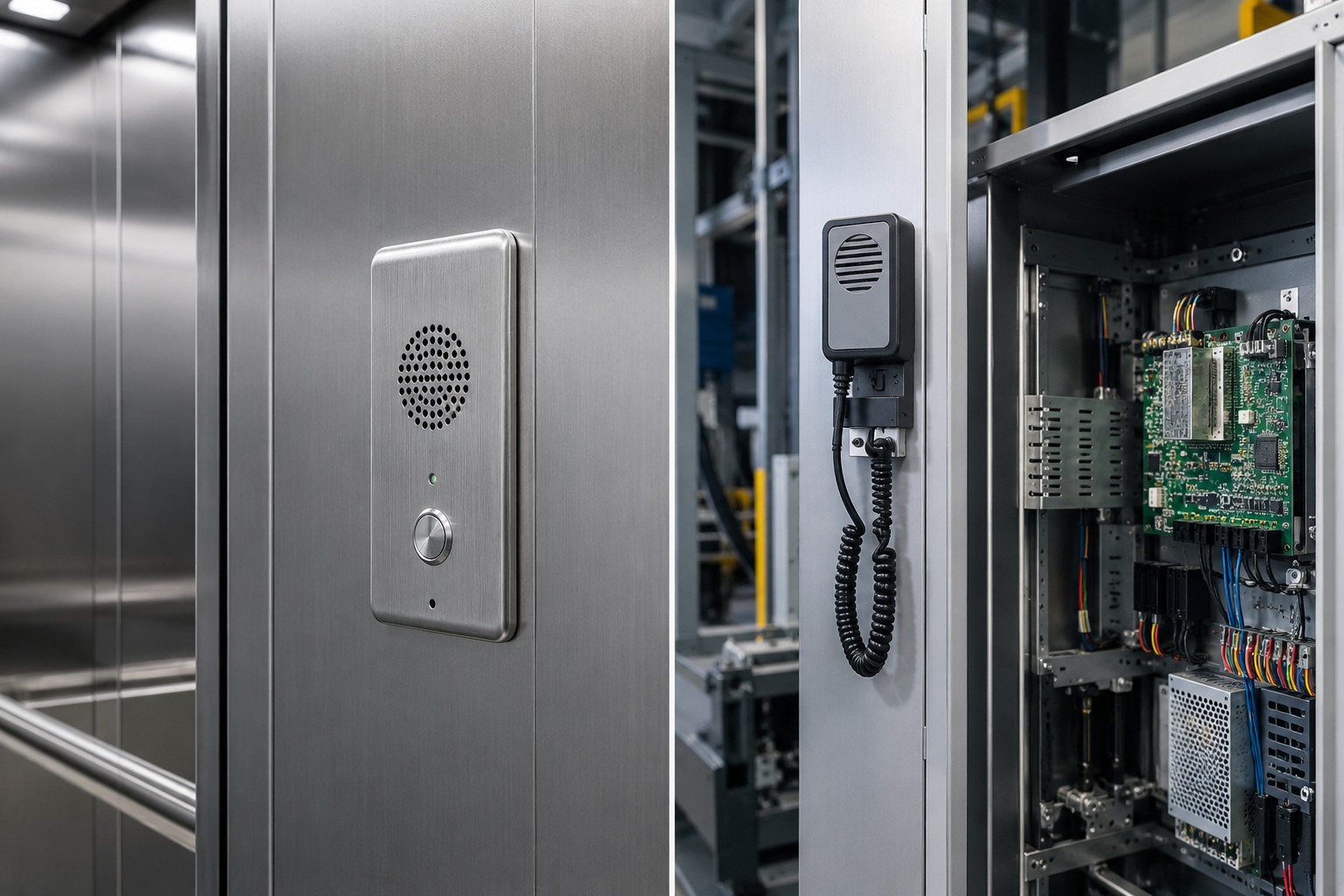
One of the most common sourcing mistakes is assuming that every elevator communication part is interchangeable. In practice, a car intercom and an intercom terminal perform different roles. The car intercom is usually the device or assembly located in the elevator car that enables passenger communication. The intercom terminal is often the connection or interface component used within the broader system architecture, typically relating to signal routing, wiring, or system-side communication management.
In service calls, technicians often know that “the elevator phone is bad,” but the exact failed item may be the handset, speaker unit, wiring harness, terminal board, or a connected intercom module. That is why photos, model numbers, connector details, and voltage readings are so useful before ordering.
Below is a practical comparison for buyers in the United States.
| Item | Main Location | Primary Role | Common Failure Symptom |
|---|---|---|---|
| Car intercom | Inside elevator car | Passenger voice communication | No audio or weak audio in car |
| Intercom phone handset | COP or dedicated panel area | Direct talk/listen function | Dead handset, broken cord, no pickup |
| Intercom terminal | Control cabinet or communication interface area | Signal and wiring interface | No call routing or intermittent connection |
| System phone assembly | Linked car and machine room points | Integrated communication management | Call failure across multiple points |
| Speaker or microphone module | Car panel or faceplate | Audio input/output | Feedback, low volume, muffled speech |
| Wiring harness/connector | Between modules | Electrical continuity | Intermittent operation during movement |
For buying decisions, the distinction matters because a building may not need a full communication assembly if only one field component has failed. Replacing the wrong item increases cost and delays. A maintenance company in Philadelphia may lose a day waiting on a second shipment if the original order was based on a generic description instead of connector, mounting, and voltage confirmation.
Demand also varies by industry. Hospitals may prioritize complete tested assemblies to minimize site labor, while residential maintenance teams may prefer individual replacement parts for cost control.
This industry view shows why stock planning differs across regions. Residential-heavy markets such as Miami and Phoenix often see frequent service calls tied to older in-car communication devices, while healthcare and transit sites demand more documented testing and more predictable spare part sourcing.
Hitachi intercom phone sourcing notes
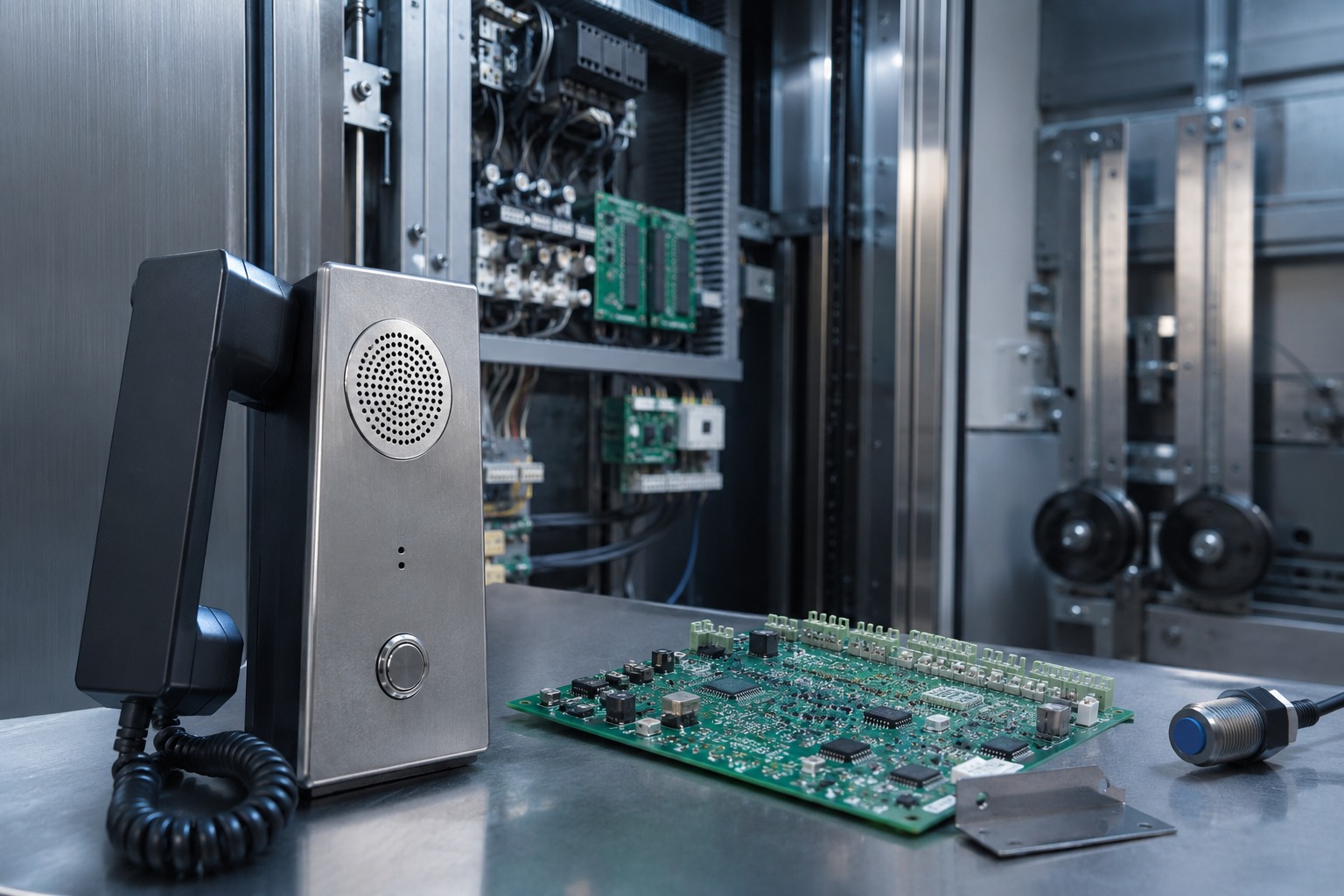
When sourcing Hitachi elevator intercom phones or related communication components, the safest approach is to verify the exact application first. Hitachi elevator systems used in the United States may vary by generation, modernization history, and local retrofit work. A part that appears visually similar may differ in connector layout, operating voltage, mounting dimensions, or compatibility with the existing communication path.
For that reason, experienced buyers typically collect several data points before placing an order:
| Verification Point | What to Check | Why It Prevents Errors | Preferred Evidence |
|---|---|---|---|
| Brand and system model | Hitachi model details on plate or documentation | Confirms platform family | Clear nameplate photo |
| Part number | Label on phone, terminal, or board | Improves exact matching | Close-up label image |
| Voltage rating | 6V, 24V, or other specified value | Avoids electrical mismatch | Printed marking or meter reading |
| Connector type | Pin count, harness style, socket shape | Ensures physical connection | Front and rear photos |
| Mounting dimensions | Panel cutout, screw spacing, depth | Prevents fitment issues | Measured dimensions |
| Failure description | No ring, no talk, noise, intermittent cutout | Helps identify whether phone or terminal failed | Technician notes or test video |
In many cases, sourcing notes also need to account for whether the product is for a direct repair or a modernization project. A direct repair usually aims to preserve the original system architecture. A modernization project may allow adaptation if the installer is already changing related wiring, panel hardware, or communication routing.
For buyers handling repeated U.S. service calls, it is smart to create a simple internal record with car number, building location, equipment brand, old part number, and approved substitute history. That approach helps multi-site contractors working in New Jersey, Washington, D.C., Charlotte, and Detroit reduce repeat diagnostics. It also helps distributors serving customers near freight gateways such as the Port of Newark, Port of Houston, and Los Angeles basin plan inventory more effectively.
Our technological capabilities are built around accurate identification and compatibility review. For intercom-related parts, we support model matching through photos, labels, dimensions, and application notes so maintenance teams can reduce guesswork before shipment. Our manufacturing capabilities focus on stable quality inspection, component verification, and protective packaging designed to reduce transit damage on small but sensitive elevator communication parts. Our service capabilities emphasize responsive communication, practical replacement guidance, and shipment support for urgent downtime situations across the United States.
Buyers looking for a complete communication replacement can review a Hitachi intercom system phone option when broader assembly matching is needed, while projects requiring control-side interface confirmation may benefit from checking a compatible intercom terminal for Hitachi elevators.
Voltage and wiring compatibility
Voltage and wiring compatibility are among the most important checks before ordering any elevator intercom part. Many field issues that look like product defects are actually mismatch problems. A phone may power on weakly, produce distorted audio, or fail completely if the installed system voltage does not match the replacement component. The same is true when a connector fits loosely, pin assignments differ, or polarity is reversed.
Common buyer questions include whether 6V and 24V car intercoms can be interchanged, whether an older analog handset can connect to a newer control-side terminal, and whether a replacement requires a wiring modification. The answer depends on the exact equipment design, but the short rule is simple: never assume visual similarity means electrical compatibility.
| Compatibility Item | What to Verify | Field Risk if Ignored | Recommended Action |
|---|---|---|---|
| Voltage level | Rated input value | No power or damaged unit | Match label and meter reading |
| Polarity | Positive/negative orientation | Dead or unstable operation | Check wiring diagram before install |
| Connector pinout | Pin count and function | Partial function or no call path | Compare old and new harness layouts |
| Wire condition | Corrosion, breaks, loose crimps | Intermittent audio loss | Inspect and re-terminate if needed |
| Shielding/grounding | Noise suppression path | Hum, buzz, interference | Confirm grounding integrity |
| Panel fit and cable strain | Physical routing and slack | Failure after repeated car movement | Secure harness and avoid pinch points |
In older U.S. buildings, especially those that have seen partial upgrades over many years, mixed wiring practices are not uncommon. A building in Cleveland may have one elevator with original communication wiring and another with modifications from a prior modernization contractor. For that reason, technicians should test at the car and system side rather than relying only on archive drawings.
The market is also gradually shifting from basic legacy communication components toward more integrated, service-friendly replacements that support cleaner diagnostics and easier part traceability.
This trend matters for 2026 planning. Buyers increasingly want parts that are easier to verify, easier to install correctly, and easier to support with remote documentation. Policy trends toward better emergency communication reliability, along with sustainability goals that favor targeted replacement over unnecessary whole-system disposal, are reinforcing this shift.
Audio testing and call quality checks
Once the correct part is identified and installed, audio testing is essential. A successful replacement is not just a unit that powers on. It must provide clear, stable, two-way communication under normal operating conditions. Testing should include call initiation, answer reliability, speaker volume, microphone pickup, background noise behavior, and performance while the car is moving.
In the United States, audio quality complaints often arise in older high-rise environments where electrical noise, worn harnesses, or corroded contacts affect speech clarity. For example, a downtown tower in Seattle may experience interference from aged cabling, while a coastal property in Tampa may face contact oxidation from humidity. In both cases, the problem may not be the intercom body itself.
A practical testing routine can help technicians isolate the source faster.
| Test Step | Procedure | Pass Condition | Likely Problem if Failed |
|---|---|---|---|
| Power confirmation | Measure voltage at input | Stable rated supply | Power source or wiring issue |
| Call initiation | Press help or activate intercom | Call starts immediately | Button, terminal, or routing fault |
| Inbound audio | Listen from car speaker/handset | Clear speech, no heavy noise | Speaker, amplifier, or grounding issue |
| Outbound audio | Speak from car to receiving point | Voice received clearly | Microphone or connector fault |
| Car motion test | Repeat during travel | No cutout or crackle | Harness strain or intermittent contact |
| Extended hold test | Maintain conversation for several minutes | Stable connection throughout | Heat, power fluctuation, or board instability |
When documenting a repair for building management, it helps to note the test conditions clearly: landing position, car movement state, receiving location, measured voltage, and any environmental noise observed. This is particularly useful for large portfolios managed across multiple metropolitan areas, where a standardized service record can improve consistency between sites.
Comparison shopping should also focus on total fit, not only price. A supplier that provides better part verification, protective packaging, and fast response can reduce repeat labor costs substantially.
The comparison above reflects what many U.S. maintenance teams already know from experience: the lowest-priced part is not always the lowest-cost solution if poor matching leads to a second truck roll or another week of downtime.
When to replace old intercom parts
Old intercom parts should be replaced when they become unreliable, unsupported, physically damaged, or incompatible with current service needs. Age alone is not always the deciding factor, but repeated faults, poor call quality, visible wear, or obsolete configuration usually indicate that replacement is the smarter choice.
For building owners, the key issue is service risk. If the intercom fails only once every few months, some teams try to keep repairing it. But if the same elevator repeatedly generates communication complaints, or if rescue call clarity is poor, replacement usually becomes more economical than continued patchwork. This is especially true in busy properties where downtime disrupts tenant operations.
Common replacement triggers include:
| Condition | Typical Sign | Operational Impact | Recommended Response |
|---|---|---|---|
| Intermittent audio | Calls cut in and out | Unreliable emergency communication | Inspect wiring and replace failed unit |
| Physical damage | Cracked handset, broken cord, loose faceplate | Reduced usability and safety confidence | Replace damaged hardware promptly |
| Corrosion or contamination | Rust, residue, oxidized contacts | Noise, poor connection, short life | Replace and inspect environment |
| Obsolete part status | No stable source or repeatable stock | Longer future downtime | Plan proactive replacement |
| Voltage mismatch after upgrades | Newer control side but older car phone | Erratic or failed communication | Re-match full communication path |
| Repeated service calls | Same issue returns multiple times | Higher labor and tenant disruption | Replace instead of repeated repair |
Case studies in the U.S. often show that proactive replacement pays off. In one residential property portfolio in northern New Jersey, a contractor replaced recurring failed in-car communication units during planned service windows instead of waiting for each elevator to fail separately. That reduced emergency callbacks and improved resident satisfaction. In a mixed-use building near downtown Atlanta, replacing a weak handset and aging terminal during a scheduled modernization phase avoided future rework after tenant occupancy increased.
For industries such as healthcare, senior living, hospitality, and Class A office buildings, planned replacement is often easier to justify because communication quality has a direct effect on occupant confidence and service reputation. Buildings with heavy traffic, coastal humidity, or high vibration should be especially careful about leaving marginal intercom parts in service too long.
Maintenance tips for building managers
Building managers do not need to diagnose every intercom failure personally, but they do benefit from having a structured maintenance process. Good habits reduce emergency calls, improve documentation, and help service providers solve issues faster. The goal is not just to keep an intercom present, but to keep it clearly functional and easy to support.
A simple preventive routine should include regular communication tests, visual inspections, complaint tracking, and part records. Many U.S. property teams already perform monthly elevator reviews; adding intercom verification to that checklist is a practical step, especially for multifamily and commercial buildings with high passenger use.
| Maintenance Task | Suggested Frequency | What to Document | Benefit |
|---|---|---|---|
| Call function test | Monthly | Date, time, receiving point, result | Early detection of silent failures |
| Audio clarity check | Monthly | Volume, noise level, speech quality | Finds weak but not yet dead units |
| Visual panel inspection | Monthly | Damage, loose hardware, contamination | Prevents physical deterioration |
| Wiring and connector review | Quarterly or during service | Wear, strain, corrosion | Reduces intermittent faults |
| Part inventory review | Quarterly | Critical spares on hand | Shortens downtime |
| Replacement planning | Annually | Age, failure history, budget timing | Avoids rushed emergency buying |
For larger portfolios, it also helps to classify elevators by risk level. A low-rise office elevator with low usage may need only standard testing, while a 24-hour hospital elevator should have stricter communication verification and faster replacement thresholds. Managers near major logistics hubs such as Memphis, Kansas City, and Inland Empire markets can sometimes improve response times by coordinating spare parts strategy with local maintenance partners and regional shipping schedules.
Our manufacturing capabilities support that preventive mindset by emphasizing quality inspection and packaging that protects electrical contacts, housings, and connectors during transit. Our service capabilities help maintenance teams confirm applications quickly and arrange suitable replacement options when downtime is urgent. Our technological capabilities support accurate model matching across intercom phones, terminals, and related elevator components so buyers can align old and new parts with fewer installation surprises.
Another smart tip is to treat intercom parts as part of a broader elevator reliability plan. If a property is already replacing buttons, COP components, door operator items, or control-related accessories, it may be cost-effective to review communication parts at the same time. Coordinated purchasing often lowers labor duplication and improves overall elevator performance planning.
Looking toward 2026, building managers should expect three major trends. First, more modernization projects will favor communication parts with clearer compatibility records and easier testing. Second, policy and inspection attention will continue to emphasize dependable emergency communication. Third, sustainability goals will encourage selective replacement of failed components rather than wasteful full-system changeouts, provided compatibility and safety can be maintained. Buyers that keep accurate asset records will be in the best position to benefit from these trends.
FAQ about elevator intercom phones
What is the difference between an elevator intercom phone and an intercom terminal?
An elevator intercom phone is usually the passenger-facing communication device or handset used in or near the car operating panel. An intercom terminal is generally a system-side interface or connection component that helps route or manage the communication path. They are related but not the same part.
Can I replace a 6V unit with a 24V unit?
Not unless the system is specifically designed for that change. Voltage mismatch can cause immediate failure or unstable performance. Always verify the rated voltage and wiring before ordering or installing.
What information should I send when requesting a quote?
Provide the equipment brand, model if available, old part number, clear photos of the front and back, connector details, voltage marking, mounting dimensions, and a brief failure description. This makes application matching faster and more accurate.
How do I know whether the problem is the phone or the wiring?
Start with voltage measurement, continuity checks, and a controlled audio test. If the power supply is stable but calls fail intermittently, the issue may be wiring, a connector, or the terminal side. If the unit is physically damaged or completely nonresponsive under correct power, the phone itself may be the failed component.
Are older Hitachi elevator intercom parts still available?
Availability depends on the specific model and production history. Many older applications can still be supported through careful sourcing and model matching, but exact verification is important because visually similar parts may not be compatible.
Should building owners keep spare intercom parts?
Yes, especially for high-traffic properties, remote sites, hospitals, hotels, and buildings with known legacy equipment. A small stock of approved communication parts can reduce downtime significantly.
How often should elevator intercoms be tested?
A monthly basic function and audio check is a practical minimum for many buildings, with additional review during scheduled elevator maintenance visits. Higher-risk sites may adopt stricter intervals.
What industries most often replace elevator intercom phones?
Residential high-rises, office towers, healthcare facilities, hotels, airports, transit hubs, universities, and industrial buildings all generate regular replacement demand. The need is highest where passenger volume and uptime expectations are high.
Why do some intercoms work when the car is still but fail during travel?
That often points to harness strain, loose connectors, vibration-sensitive contacts, or cable routing problems rather than a simple static power issue. Motion testing is important during diagnosis.
What should I prioritize when choosing a supplier in the United States market?
Prioritize accurate model matching, compatibility review, quality inspection, protective packaging, responsive communication, and dependable sourcing. Those factors usually have more impact on total repair cost than unit price alone.
In summary, elevator intercom phones play a critical role in passenger safety, emergency readiness, and day-to-day building operations throughout the United States. Whether you are replacing a single car intercom, confirming a Hitachi intercom terminal, checking voltage and wiring compatibility, or planning proactive upgrades for older buildings, the best results come from exact identification, careful testing, and reliable sourcing support. For maintenance teams, distributors, and building owners, that approach reduces downtime, protects occupants, and keeps elevator systems easier to maintain over the long term.