
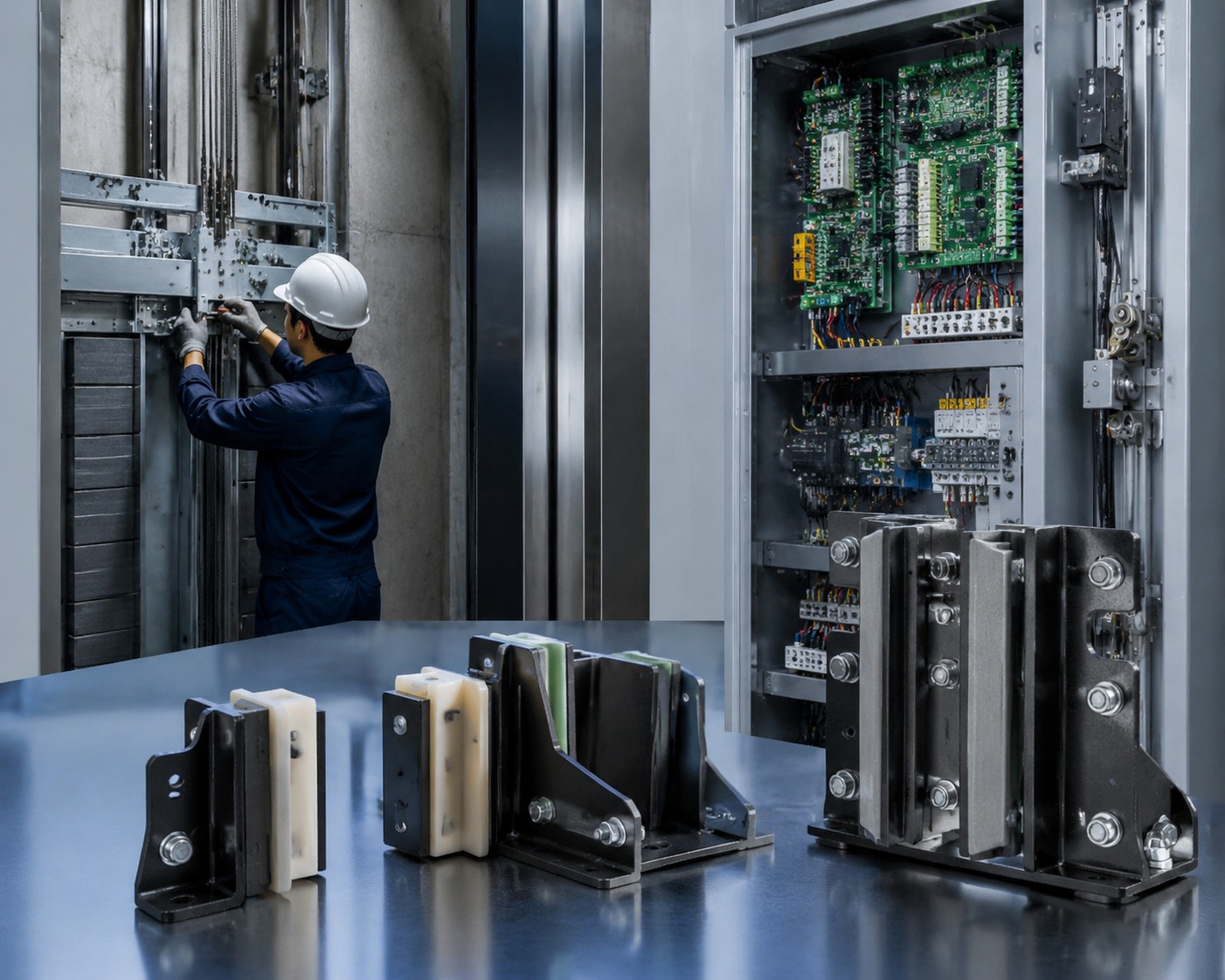
Elevator guide shoes and guide shoe liners are small parts with a big job: they keep the car and counterweight tracking smoothly along the rails, reduce vibration and noise, and help limit long-term rail wear. For building owners, elevator maintenance companies, distributors, and modernization contractors in the United States, choosing the right guide shoe lining can improve ride comfort, reduce callbacks, and support safer daily operation.
In practical terms, a guide shoe assembly sits between the moving elevator components and the steel guide rails. The liner, sometimes called the insert or slide, is the wear surface. When it is correctly sized and made from the right material, it cushions movement, controls side play, and helps the elevator travel with less chatter. When it is worn, cracked, glazed, loose, or poorly matched, riders may notice scraping sounds, rough starts, side-to-side vibration, or inconsistent travel quality.
The United States market has wide variation in elevator age, brand mix, climate exposure, and usage intensity. A high-rise office tower in Manhattan, a hospital in Houston, a logistics hub near the Port of Los Angeles, a hotel in Orlando, and a residential modernization project in Chicago may all use different rail dimensions, car loads, speeds, and maintenance schedules. That is why buying guide shoe liners should never be based on appearance alone. Exact dimensions, rail profile, application position, load pattern, and OEM compatibility all matter.
For buyers comparing options, the core checklist is straightforward: identify whether the part is for the car main rail or the counterweight, confirm the liner dimensions and groove profile, verify the material grade, inspect wear patterns, and review alignment conditions before replacement. In many cases, replacing only the liner is effective. In others, rail condition, shoe body wear, spring pressure, mounting looseness, or lubrication issues must also be addressed to avoid premature failure.
Across major U.S. service centers such as New York, Miami, Dallas, Seattle, Atlanta, and Southern California, elevator contractors are also looking for dependable supply support. Fast model matching, stable quality inspection, protective packaging, and responsive after-sales communication can reduce downtime, especially when a maintenance crew needs a compatible replacement part quickly. That is particularly important for modernization work, public buildings, healthcare facilities, airports, transit-connected towers, and mixed-use developments where elevator uptime directly affects building operations.
The chart above reflects the steady growth pattern seen in the U.S. replacement market. Demand is supported by aging installed elevators, increased modernization activity, labor pressure on maintenance teams, and stronger expectations for ride quality in Class A office, hospitality, healthcare, and multifamily properties. By 2026, buyers are expected to place even more emphasis on compatibility verification, sustainable material choices, and predictive maintenance planning.
What elevator guide shoes do
Elevator guide shoes maintain the controlled relationship between the moving elevator car or counterweight and the fixed guide rails. They are not just support pieces. They are functional alignment components that absorb minor irregularities, reduce metal-to-metal contact, and help distribute side loads during travel. In sliding guide shoe designs, the liner is the sacrificial contact part, which means it is intended to wear gradually instead of allowing more expensive components, especially the rail or the complete shoe body, to wear first.
In everyday operation, guide shoes help with several ride-quality outcomes that matter in the field. First, they reduce vibration transmitted from rail joints, bracket locations, and minor alignment deviations. Second, they lower noise generated by sliding contact and lateral movement. Third, they stabilize the car under changing passenger loads. Fourth, they help protect the guide rail surface from unnecessary scoring when the elevator is properly aligned and maintained.
| Guide shoe function | What it controls | Impact on ride quality | Failure risk if ignored | Typical field symptom | Replacement priority |
|---|---|---|---|---|---|
| Rail guidance | Car or counterweight path | Smoother vertical travel | Tracking instability | Side rubbing noise | High |
| Vibration reduction | Lateral movement | Less cabin shake | Passenger discomfort | Shudder at speed | High |
| Noise control | Sliding contact sound | Quieter operation | Escalating friction noise | Scraping or squeal | Medium to high |
| Rail protection | Contact surface wear | Longer rail life | Rail scoring | Visible rail marks | High |
| Load stability | Response to imbalance | Better comfort under changing loads | Uneven wear | Cab sway when full | Medium |
| Component isolation | Wear concentrated in liner | Lower lifecycle cost | Damage to shoe body | Loose fit and chatter | High |
This table shows why the liner is often treated as a routine wear part in U.S. preventive maintenance programs. Replacing a liner at the right time is generally far less costly than allowing abnormal wear to transfer into rails, brackets, or the full guide shoe assembly.
Product types in this segment include complete sliding guide shoe assemblies, counterweight guide shoe liners, car main rail liners, and model-specific components for major brands. Buyers who need replacement options can compare complete sliding guide shoe assemblies when the housing or mounting section is also worn, not only the insert.
Main rail and counterweight guide shoe differences
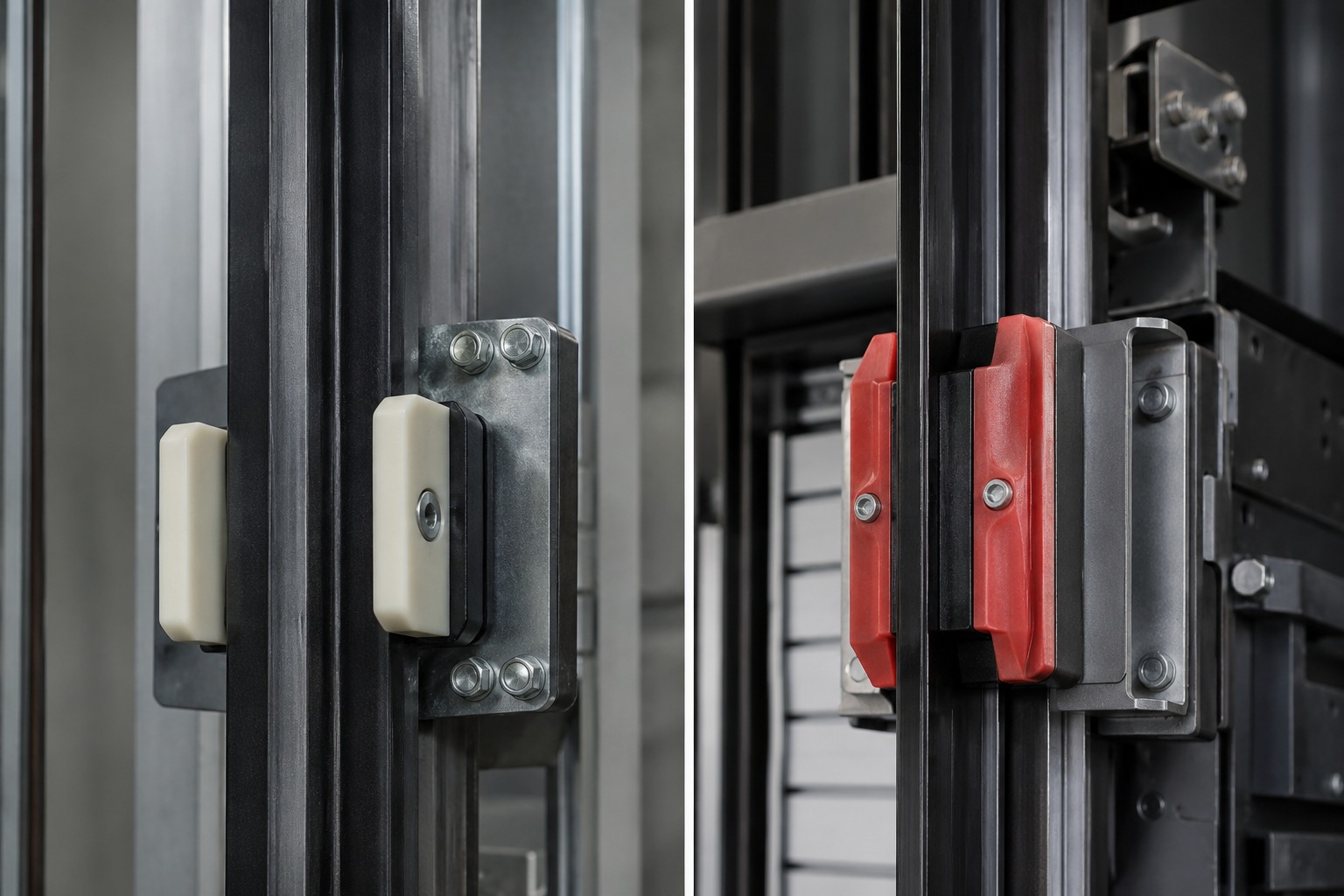
The main rail guide shoe for the elevator car and the counterweight guide shoe may look similar, but they are not interchangeable by default. They operate under different load conditions, geometry, and movement behavior. The car main rail shoe supports the passenger or freight car, where ride comfort is critical. The counterweight guide shoe manages the balancing mass, where motion stability matters just as much, but loading behavior differs.
In most U.S. installations, the car guide shoe is more directly associated with the passenger experience. If the car liner wears unevenly, passengers may feel vibration or hear rail chatter more quickly. Counterweight liners can also create significant issues, especially in taller buildings or higher-speed applications, where imbalance or poor rail interaction can transmit noise through the hoistway structure.
| Comparison point | Car main rail guide shoe | Counterweight guide shoe | Why it matters | Common buying mistake | Field note |
|---|---|---|---|---|---|
| Primary role | Guides elevator car | Guides counterweight | Different load dynamics | Assuming same part fits both | Always verify application position |
| Ride comfort effect | Directly felt by riders | Indirect but significant | Car shoes affect comfort first | Focusing only on counterweight | Check passenger complaints |
| Wear pattern | Can vary by loading cycles | Can vary by tension and balance | Wear diagnosis differs | Ignoring opposite side wear | Inspect both sides together |
| Replacement urgency | Often higher | Also important | Comfort and safety depend on both | Replacing only one set | Review complete hoistway condition |
| Stocking strategy | High rotation in service inventory | Needed for full maintenance readiness | Balanced spare planning | Understocking counterweight parts | Useful for modernization projects |
| Typical sourcing check | Rail size, liner dimensions, brand match | Rail size, liner dimensions, position match | Prevents wrong shipment | Ordering by photo only | Use drawings or measured samples |
The key takeaway is that a maintenance team should inspect both the car main rail and counterweight side together. If one liner shows abnormal edge wear, there may be a rail alignment issue, loading imbalance, or shoe pressure problem elsewhere in the system. For buildings planning a preventative replacement program, it is often more efficient to review car and counterweight components as a set rather than as separate emergency purchases.
When sourcing by application type, buyers often search for dedicated counterweight guide shoe liners or car main rail sliding guide shoe liners to avoid mixing positions. This is especially useful for service contractors maintaining diverse building portfolios across regional markets such as the Northeast corridor, Texas metro areas, and West Coast high-rise clusters.
The bar chart illustrates where liner replacement demand is especially active. High-rise residential and office buildings usually generate strong volume because of frequent use cycles and ride-comfort expectations. Hospitals rank high because elevator availability affects patient movement and equipment transport. Airport and hospitality applications also value quieter, smoother travel, which makes guide shoe condition a practical maintenance concern.
How to choose guide shoe liner size and material
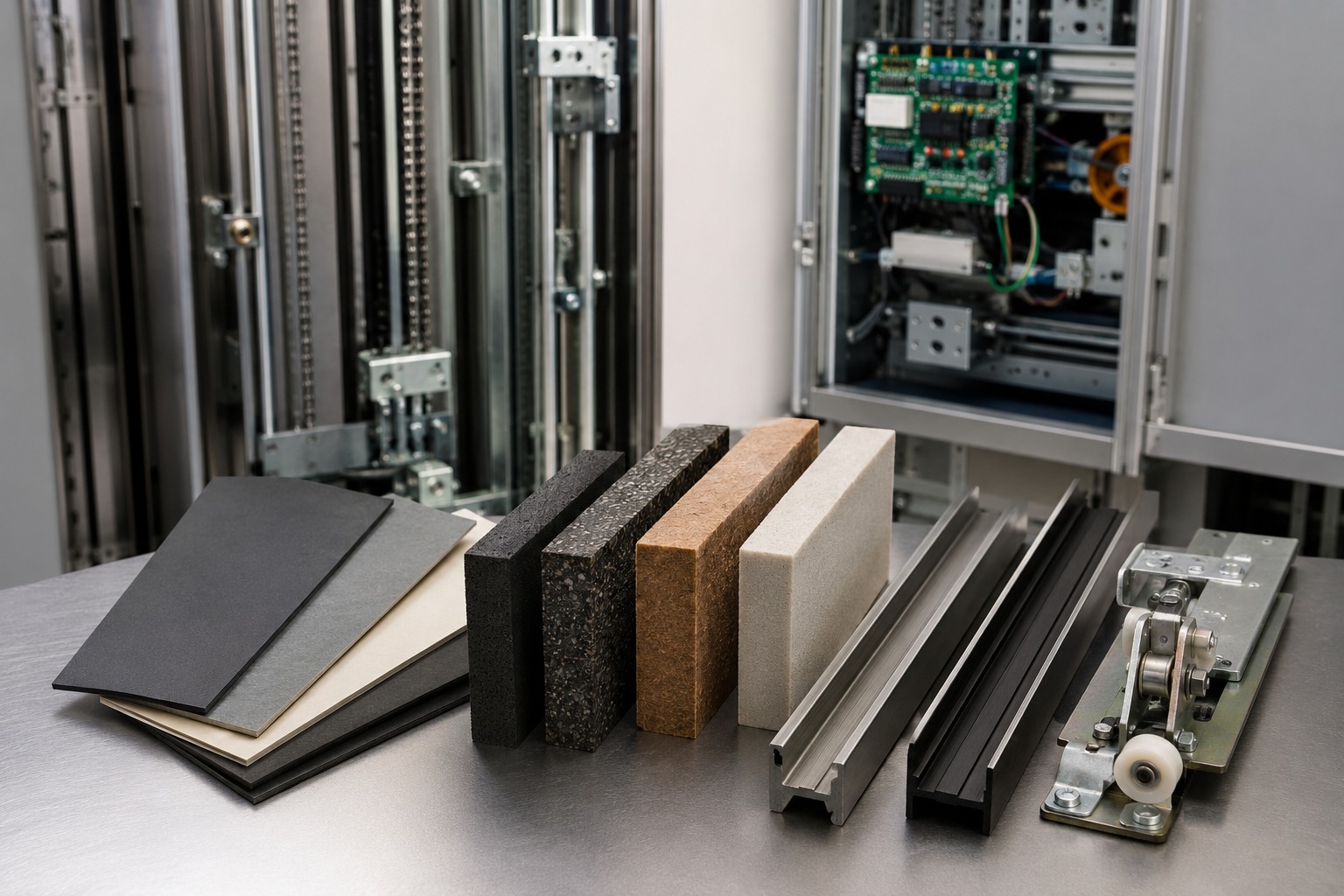
Choosing the correct guide shoe lining starts with precise dimensional matching. The most common errors in the U.S. parts market are ordering by brand name only, relying on a rough visual comparison, or overlooking rail width and groove profile details. A liner that is close in size but not exact can create excess play, concentrated edge loading, accelerated wear, and avoidable noise.
Dimension checks should include overall length, width, thickness, groove opening, groove depth, mounting method, and rail contact geometry. Some buyers also confirm hardness or material grade when the application involves unusual speed, heavy usage, or local environmental factors such as temperature swings, dust, or moisture. In coastal markets near Long Beach, Newark, Savannah, or Houston, contamination control and protective packaging during storage can be particularly important.
| Selection factor | What to verify | Why it matters | Typical source of error | Best practice | Buying result |
|---|---|---|---|---|---|
| Overall dimensions | Length, width, thickness | Ensures physical fit | Using estimated measurements | Measure removed sample carefully | Lower mismatch risk |
| Groove profile | Rail contact shape | Maintains proper guidance | Ignoring profile details | Compare with rail and old liner | Smoother travel |
| Application position | Car or counterweight | Prevents wrong part use | Single SKU assumption | Confirm assembly location | Correct functional match |
| Material type | Wear and friction properties | Affects noise and life | Choosing lowest cost only | Match duty cycle and rail condition | Better lifecycle value |
| Brand compatibility | OEM or equivalent model reference | Supports installation accuracy | Ordering generic without review | Cross-check part data | Fewer returns |
| Operating environment | Usage intensity, dust, humidity | Influences wear rate | Ignoring site conditions | Consider building type and traffic | More durable selection |
Material selection is equally important. The right liner material should balance low friction, controlled wear, stable geometry, and compatibility with the rail surface and operating conditions. Harder is not always better. A material that is too hard may increase rail wear or noise in a slightly imperfect system. A material that is too soft may wear rapidly in a busy transit-adjacent tower or a hospital freight application.
For many maintenance buyers, the most practical route is to work with a supplier that can assist with model matching from dimensions, photos, old samples, and equipment data. This is where technological capability matters. A supplier with organized part databases, dimensional verification procedures, and compatibility review can reduce the time service teams spend sorting uncertain replacements. In real purchasing workflows, that means faster quoting, fewer shipping corrections, and less downtime for customers across cities like Phoenix, Boston, Denver, and San Francisco.
Where model-specific replacement is required, some buyers look for a measured size such as the 88x20mm guide shoe lining for MCA Hitachi applications. Size-based sourcing is useful, but final confirmation should still include application position and compatibility details before installation.
Signs that guide shoe liners are worn
Guide shoe liner wear does not always announce itself with a complete failure. More often, the warning signs appear gradually. Elevator technicians may hear increased rubbing sound during travel, especially near rail joints or during acceleration. Building managers may receive complaints about a rougher ride. Inspection may reveal uneven wear on one edge, polishing or glazing of the contact surface, chips, cracks, thinning, looseness in the shoe, or unusual rail marks.
Uneven wear is one of the most important clues. It can mean the liner itself has reached the end of service life, but it can also indicate that the real problem lies elsewhere: rail misalignment, poor adjustment, loose mounting hardware, contamination, or an issue with the guide shoe body. Replacing the liner without diagnosing the cause may solve symptoms only temporarily.
| Wear sign | Likely cause | Operational effect | Inspection method | Recommended action | Urgency |
|---|---|---|---|---|---|
| Uneven edge wear | Misalignment or side loading | Vibration and noise | Visual check and rail review | Replace liner and check alignment | High |
| Cracks or chips | Aging, impact, poor material match | Reduced contact stability | Close visual inspection | Replace promptly | High |
| Glazing or polishing | Heat and friction buildup | Possible squeal or slipping feel | Surface condition check | Review pressure and rail condition | Medium |
| Excessive thinning | Normal wear or harsh duty cycle | Loss of proper guidance | Measure remaining thickness | Replace before shoe body contact | High |
| Loose fit in shoe body | Wear, deformation, poor installation | Chatter and instability | Physical movement test | Check housing and fasteners | High |
| Rail scoring marks | Damaged liner or contamination | Accelerated system wear | Inspect rail surface | Investigate root cause immediately | Critical |
This table is useful during maintenance planning because it separates visible liner symptoms from likely system causes. For U.S. building owners managing multiple properties, this distinction helps prevent repeated spending on liners when the actual problem is rail condition, adjustment, or shoe assembly wear.
Industries with heavy use often see wear faster than low-rise residential buildings. Examples include healthcare campuses, university buildings, airport hotels, municipal buildings, logistics facilities with service lifts, and mixed-use towers where elevator cycles run continuously from early morning through late evening. In these environments, proactive inspection intervals are more effective than waiting for passenger complaints.
Hitachi guide shoe replacement notes
Hitachi elevator systems are widely recognized in many international and U.S.-connected building portfolios, especially where modernization, imported components, or mixed-brand maintenance support is involved. When replacing Hitachi guide shoe liners, the main rule is simple: match by exact model data and dimensions, not by assumption. Even when two parts appear similar, the rail interface, thickness, or mounting detail can vary enough to affect travel quality.
For Hitachi-related purchases, technicians commonly verify the old part code, assembly location, measured dimensions, and any equipment plate information available from the site. If a sample is badly worn, comparing both the used part and the shoe housing can help avoid incorrect size readings. It is also good practice to inspect the rail face and the mating surfaces in the guide shoe before installing a new liner.
Manufacturing capability matters here. Buyers prefer parts from suppliers that maintain consistent dimensional control, stable raw material selection, and careful quality inspection before shipment. Protective packaging is also important because liner edges can be damaged in transport if packed poorly, especially when goods move through busy U.S. freight networks connected to ports and inland hubs such as Los Angeles, Oakland, Seattle, Houston, Memphis, and New Jersey distribution centers.
| Hitachi replacement checkpoint | What to confirm | Reason | Common risk | Recommended source data | Outcome |
|---|---|---|---|---|---|
| Part identification | Original code or equivalent reference | Supports accuracy | Ordering by appearance only | Old label, service record | Better compatibility |
| Measured dimensions | Length, width, thickness, groove | Ensures proper fit | Using worn dimension alone | Sample plus housing check | Lower return risk |
| Application side | Car or counterweight | Avoids wrong placement | Mixed inventory labeling | Site inspection notes | Correct installation |
| Rail condition | Surface marks or misalignment | Prevents repeat wear | Replacing liner only | Visual rail inspection | Longer service life |
| Assembly condition | Shoe body, fasteners, springs | Supports liner performance | Ignoring worn support parts | Full assembly check | Stable travel quality |
| Packaging and traceability | Protected packing and clear labeling | Reduces shipping damage | Mixed parts on arrival | Supplier QC records | Faster field handling |
In real projects, these steps help contractors manage modernization schedules and urgent replacement jobs more smoothly. A well-organized supply partner can assist with technical cross-checking, photo review, and batch preparation, which is especially valuable when a service company is supporting multiple properties across states or coordinating with field teams from different branches.
Installation and alignment checks
Even the best liner will not perform well if installation and alignment are poor. Before fitting a new guide shoe lining, technicians should clean the guide shoe area, inspect the rail surface, confirm mounting hardware condition, and verify that there is no distortion in the shoe body. The liner should seat correctly without twisting, rocking, or excess force that can damage the material during installation.
After installation, alignment checks are critical. A fresh liner may initially seem to reduce noise, but if the rail alignment is off or spring pressure is uneven, wear can return quickly. Good practice includes checking clearances, ensuring uniform contact, reviewing rail joints and brackets, and confirming that the car and counterweight track smoothly through the full run. On higher-rise jobs in markets like New York, Chicago, and Seattle, where travel distance magnifies alignment errors, this step is especially important.
| Installation checkpoint | What to inspect | Why it matters | Problem if skipped | Field recommendation | Expected benefit |
|---|---|---|---|---|---|
| Seat fit | Liner sits flush in shoe body | Prevents movement | Chatter and premature wear | Test fit before final securing | Stable contact |
| Rail cleanliness | Dust, residue, scoring | Protects new liner | Abrasive wear | Clean and inspect surface | Longer liner life |
| Fastener condition | Bolts, clips, holders | Maintains assembly integrity | Loosening in service | Replace damaged hardware | Reduced callbacks |
| Clearance check | Correct contact and movement range | Controls friction and play | Binding or excessive looseness | Verify to equipment spec | Better ride quality |
| Rail alignment | Vertical and lateral consistency | Prevents uneven wear | Edge loading | Inspect full travel path | Balanced liner wear |
| Test run review | Noise, vibration, temperature | Confirms successful replacement | Hidden issues remain | Monitor after installation | Reliable return to service |
The explanation behind this checklist is simple: guide shoe liner replacement should be treated as a system task, not a single-part swap. Elevator performance depends on how the liner, shoe body, rail, and alignment all work together. That is why experienced maintenance teams document condition before and after the replacement and compare wear patterns across both sides.
The area chart highlights a growing trend in the United States: buyers are moving from reactive liner replacement toward planned, data-based maintenance. As labor availability tightens and building operators focus more on uptime, the value of condition tracking and scheduled replacement becomes clearer.
Maintenance tips for smoother elevator travel
Smoother elevator travel does not depend on liners alone, but guide shoe liner condition is one of the most controllable factors in routine service. Maintenance teams can improve ride quality by establishing inspection intervals based on building usage, not just calendar dates. A hospital, airport hotel, or downtown residential tower may need more frequent checks than a low-traffic suburban office building.
Useful maintenance habits include listening for new sound patterns, checking for uneven wear during scheduled visits, reviewing rail cleanliness, monitoring fasteners and mounting condition, and replacing liners before severe thinning transfers wear to the metal components. It is also wise to compare wear on the car and counterweight sides to spot alignment or balance issues early.
Service capability plays a major role here. Buyers in the U.S. often prefer suppliers that respond quickly to model questions, help confirm compatibility from photos or dimensions, and package parts so field technicians can identify them immediately upon arrival. Responsive communication is especially important when contractors are supporting shutdown-sensitive environments such as hospitals, senior living facilities, transit-linked properties, and office towers with strict tenant service requirements.
Applications where smooth travel matters most include passenger elevators in premium residential buildings, hotel guest elevators, healthcare lifts, public sector buildings, and office towers where occupant experience directly affects tenant satisfaction. Freight and service elevators also benefit from proper guide shoe maintenance because stable rail guidance can reduce noise, component shock, and wear across the full installation.
A practical maintenance plan often includes these steps: record measured wear during each inspection, stock the most common liner sizes for your portfolio, pair liner replacement with rail and shoe body inspection, review high-traffic units more frequently, and work with suppliers that can support mixed-brand fleets. This is especially useful for independent maintenance companies managing regional routes across cities such as Atlanta, Charlotte, Detroit, Philadelphia, and Minneapolis.
2026 trends in elevator guide shoe liners for the United States
Looking toward 2026, the U.S. market for elevator guide shoe liners is being shaped by three forces: modernization, policy and compliance pressure, and sustainability. First, modernization activity remains strong because many installed elevators in commercial and multifamily buildings are aging. As owners upgrade controllers, drives, and door systems, they are also paying more attention to ride quality components such as guide shoes and liners.
Second, policy expectations around building safety, maintenance documentation, and uptime are encouraging more structured replacement planning. While exact code requirements vary by jurisdiction, the overall direction is clear: better records, more predictable maintenance, and stronger accountability for system condition. This favors suppliers that can support traceability and consistent product identification.
Third, sustainability is becoming more relevant. Buyers increasingly consider lifecycle cost, reduced waste from repeat replacements, and material stability over time. Liners that deliver consistent wear behavior and reduce unnecessary rail damage can support a more efficient maintenance cycle. In addition, smarter inventory planning helps avoid excess freight and duplicate orders, which matters for contractors balancing cost and environmental goals.
Technology is also improving part selection. Digital model matching, photo-based confirmation, and more organized cross-reference systems reduce the chance of ordering errors. For firms servicing nationwide portfolios, this improves coordination between procurement teams, branch offices, and field technicians. That kind of technical support capability is becoming a competitive advantage in the replacement parts market.
Local sourcing, supplier comparison, and our approach
In the United States, local availability matters, but local stock alone is not enough. A nearby supplier that ships the wrong liner can create more downtime than a well-organized supplier with accurate matching and dependable logistics. Buyers therefore compare suppliers on four main points: technical accuracy, manufacturing consistency, service responsiveness, and shipping protection.
For example, a contractor serving downtown Los Angeles may need fast delivery because elevator downtime affects office tenants immediately. A distributor in New Jersey may focus on stable packaging and traceability because parts are redistributed across multiple service branches. A modernization team in Miami may need help matching mixed-brand equipment in older buildings. In each case, the best supplier is the one that combines product availability with accurate support.
The comparison chart shows what buyers often prioritize most. Technical matching and dimensional consistency rank at the top because the cost of a wrong part is usually greater than the cost difference between suppliers. In this product category, procurement success depends on getting the fit right the first time.
Our approach is built around three practical capabilities that matter to the market. On the technology side, we support careful model matching and compatibility review to help maintenance companies and distributors identify the right replacement part faster. On the manufacturing side, we emphasize stable quality inspection, consistent sourcing standards, and protective packaging so liners arrive in usable condition and with clearer identification. On the service side, we focus on responsive communication that helps customers reduce downtime and source compatible elevator spare parts for real field needs rather than generic catalog assumptions.
That combination is valuable for customers serving diverse applications, from residential towers and hotels to hospitals, office buildings, public facilities, and modernization projects. In a replacement market where small dimensional differences can affect ride quality, practical support is just as important as inventory.
FAQ about guide shoe lining
How often should elevator guide shoe liners be replaced?
There is no single schedule for every building. Replacement depends on travel cycles, rail condition, load patterns, speed, alignment, and maintenance quality. High-traffic U.S. buildings usually need more frequent inspection and earlier replacement than low-use properties.
Can I replace only the liner and keep the existing guide shoe body?
Yes, if the shoe body, fasteners, springs, and mounting areas are still in good condition. If the housing is worn or loose, replacing only the liner may not solve the problem for long.
What happens if the wrong liner size is installed?
A wrong size can cause poor fit, excessive clearance, binding, abnormal noise, rapid wear, and even rail damage. Accurate dimensional verification is essential before ordering and before installation.
Are main rail liners and counterweight liners the same?
Not automatically. Some systems use different parts for the car main rail and the counterweight. Always confirm the application position and dimensions rather than assuming interchangeability.
Do worn liners always mean the rail is bad?
No. Liners are designed to wear over time. However, uneven or unusually fast wear can indicate rail alignment issues, contamination, poor adjustment, or a problem with the guide shoe assembly.
Why is ride noise increasing even after liner replacement?
Possible causes include rail scoring, misalignment, incorrect material selection, loose hardware, worn guide shoe bodies, or installation issues. A successful replacement should include a broader inspection, not just a part swap.
What information should I send when asking for a quote?
The best package includes brand, model, application position, old part number if available, measured dimensions, photos of the old part and shoe body, and any site notes about rail size or unusual wear.
What should U.S. buyers prioritize in 2026?
Prioritize exact compatibility, reliable dimensional quality, documented sourcing, responsive service, and maintenance planning that supports lifecycle cost and smoother travel performance.
In summary, elevator guide shoe liners are a critical wear component that directly affects vibration, noise, rail protection, and overall travel smoothness. For buyers in the United States, the best results come from matching the correct car or counterweight application, verifying liner size and material, checking for root causes of wear, and working with a supplier that can support technical accuracy, stable quality, and responsive service. That approach helps maintenance teams reduce downtime, protect ride quality, and keep elevator systems operating safely across a wide range of building types and local markets.