
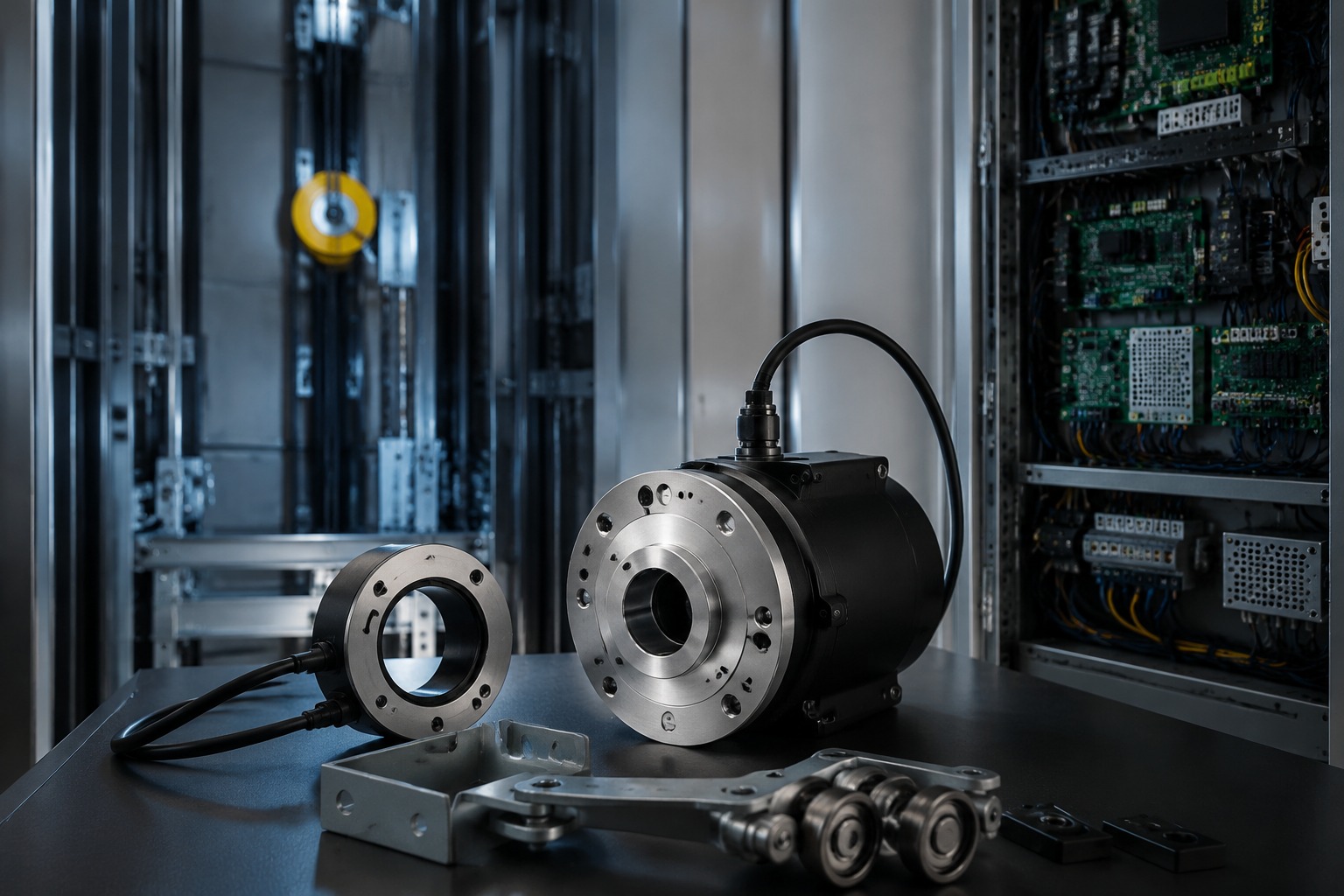
Elevator encoders are small components with a major safety role. In a traction elevator, the encoder sends position and speed feedback to the drive and control system so the machine can accelerate, decelerate, level accurately, and maintain stable traction control. When an encoder is selected correctly and installed properly, passengers notice smooth starts, quieter travel, and precise floor stopping. When the encoder signal is wrong, unstable, or missing, the result can be rough rides, leveling errors, nuisance shutdowns, or speed feedback faults that take the elevator out of service.
For maintenance companies, modernization contractors, distributors, and building owners across the United States, buying the correct elevator encoder is rarely just about price. The real priority is reducing downtime. A hospital in Chicago, a residential tower in Miami, a hotel in Las Vegas, or an office building in New York may all need different encoder specifications depending on motor type, drive compatibility, shaft dimensions, pulse output, environmental conditions, and OEM configuration. Fast and accurate model matching is especially important when urgent repair jobs cannot wait for trial-and-error ordering.
This guide explains how to choose an elevator encoder for accurate speed feedback, with special attention to replacement work in the United States market. It covers common failure symptoms, pulse output matching, shaft type checks, Hitachi UAX selection notes, installation alignment, post-replacement testing, emergency stocking strategies, and practical buying advice for service teams working in major logistics hubs such as Los Angeles, Houston, Savannah, Newark, and Seattle.
In the field, many buyers also need a dependable source for compatible replacement parts beyond encoders alone. That is why experienced suppliers often support broader sourcing for controllers, inverter parts, door operator assemblies, sensors, intercom components, light curtains, guide shoes, power supplies, buttons, and related lift accessories used in brands such as Hitachi, Toshiba, KONE, and Mitsubishi. A supplier that understands model matching can often shorten diagnostic time and help avoid return trips caused by ordering errors.
How Elevator Encoders Enable Safe Traction Control and Smooth Leveling
The direct answer is simple: an elevator encoder measures rotational movement and converts it into electrical feedback that the elevator controller or inverter can interpret. In most traction systems, the encoder is mounted on the motor shaft, machine shaft, or another rotating point connected to the drive system. By reading the pulse signals, the controller knows how fast the machine is moving, in which direction, and how position changes over time.
This feedback is essential for closed-loop control. Without accurate speed feedback, the drive cannot regulate acceleration or deceleration precisely. That affects ride comfort and, more importantly, leveling accuracy at the landing. In modern elevator operation, even small feedback errors can create noticeable stopping offsets, door zone issues, or repeated corrective movement after the car reaches the floor.
Encoders may output incremental pulses, differential signals, phase channels such as A and B, an index pulse Z, or other formats depending on the design. The replacement unit must match the original system requirements, not just look physically similar. A mismatch in pulse count or output type may cause unstable operation even when the connector appears to fit.
In the United States, elevator uptime is a major operational issue in commercial properties, transit-connected towers, mixed-use developments, university campuses, and healthcare facilities. Building managers in Boston, Dallas, Atlanta, and San Francisco often focus on parts availability because one disabled elevator can quickly create accessibility problems, tenant complaints, and compliance concerns. That is why encoder selection should be treated as both a technical and operational decision.
| Function | What the encoder provides | Impact on elevator operation | Risk if signal is wrong |
|---|---|---|---|
| Speed feedback | Real-time pulse rate linked to rotation speed | Smooth acceleration and deceleration | Jerking, overcorrection, trips |
| Direction detection | Phase relationship between channels | Correct travel logic up or down | Direction faults, control confusion |
| Position reference | Accumulated pulse count and index reference | Improved leveling and travel accuracy | Stopping offset, landing mismatch |
| Closed-loop regulation | Feedback for inverter or VVVF drive | Stable traction control | Hunting, unstable speed, shutdown |
| Safety monitoring | Verification of expected movement | Fault detection and protective logic | Nuisance faults or unsafe operation |
| Ride quality support | Consistent motion data | Reduced vibration and smoother starts | Passenger discomfort, complaints |
The table above shows why the encoder matters beyond one isolated signal. It is part of the larger control loop that determines how confidently the elevator machine responds during every trip.
Common Signs of Elevator Encoder Failure
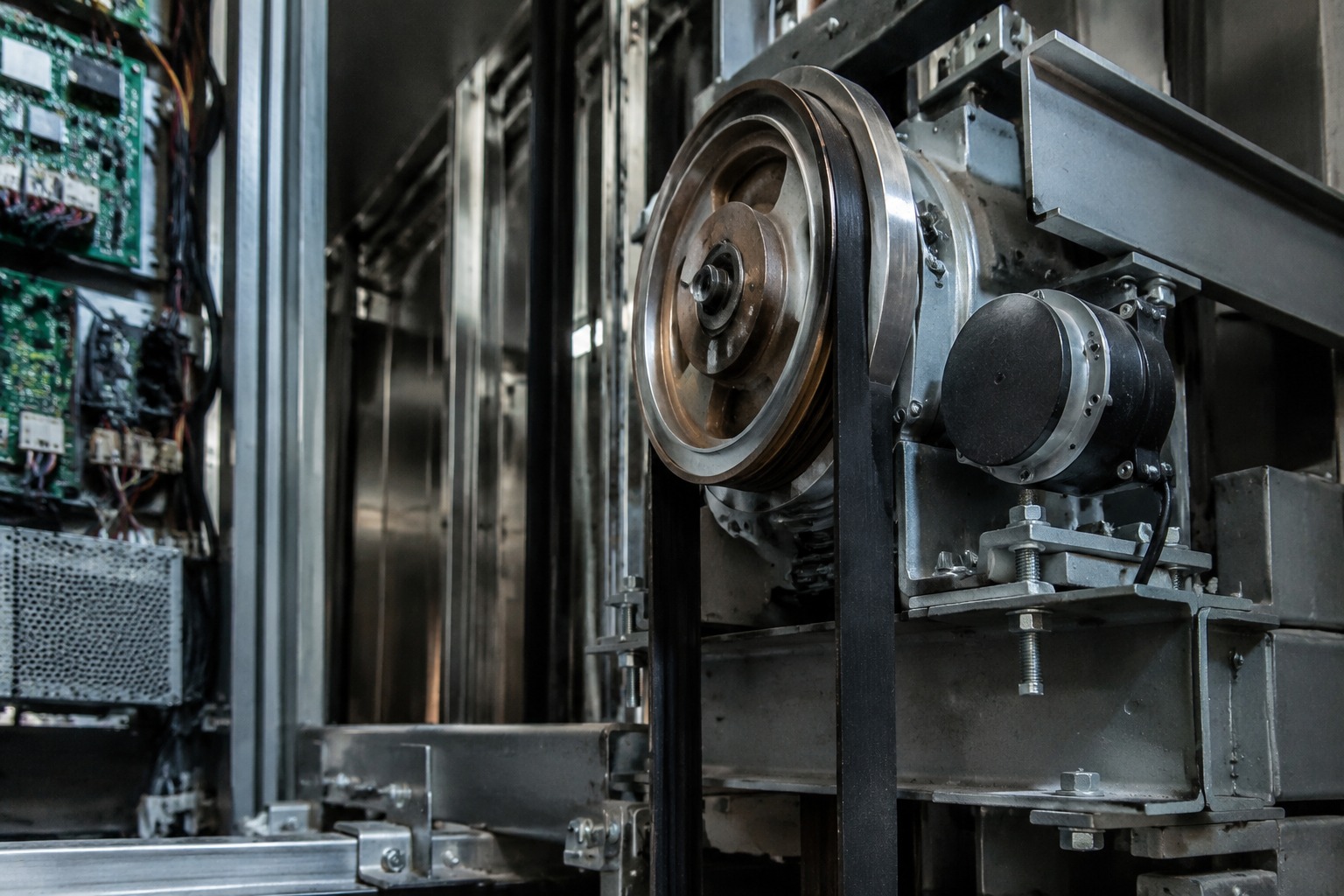
Encoder failure can be sudden, but in many cases it develops gradually. A building may first notice inconsistent leveling at a few floors, occasional inverter alarms, or rough deceleration before the elevator finally goes out of service. Because encoder symptoms can overlap with problems in cables, connectors, brakes, drives, or motor bearings, good troubleshooting should separate the feedback device from the rest of the system.
Typical symptoms include floor leveling errors, car re-leveling more often than usual, intermittent speed feedback faults, abnormal start-and-stop behavior, reduced travel smoothness, overspeed-related nuisance trips, and unstable operation after a machine-room temperature change. Some issues only appear during high traffic periods, which is why office towers in downtown districts such as Manhattan, Chicago Loop, or downtown Los Angeles may report faults during peak commuting hours but not during low-load testing.
Moisture, oil contamination, vibration, bearing wear, cable damage, misalignment, and electrical noise can all affect encoder performance. In coastal areas like Miami, Houston, and ports around Newark and Long Beach, humidity and corrosion deserve added attention. In colder regions such as Minneapolis or Buffalo, condensation and seasonal thermal cycling can also influence connector reliability.
| Observed symptom | Possible encoder-related cause | Other causes to rule out | Field priority |
|---|---|---|---|
| Rough ride during acceleration | Weak or unstable pulse output | Drive tuning, motor issue | High |
| Leveling offset at landing | Incorrect pulse count or signal loss | Door zone sensors, brake drag | High |
| Intermittent speed feedback fault | Damaged cable or loose connector | Control board input issue | High |
| Sudden shutdown after startup | No signal, wrong output type | Parameter error, inverter fault | Critical |
| Direction confusion or rollback | A/B phase error or miswiring | Drive logic, brake timing | Critical |
| Frequent call-backs after replacement | Mechanical misalignment | Loose mount, shaft slippage | High |
The table highlights a key buying principle: never replace an encoder based only on a general fault code. The better approach is to confirm whether the signal quality, pulse format, and mounting conditions match the original design. This saves both labor time and freight cost.
The market trend above reflects a realistic rise in replacement demand driven by modernization cycles, aging installed bases, and the need for faster service parts support in the United States.
Matching Pulse Output, Signal Format, and Shaft Type
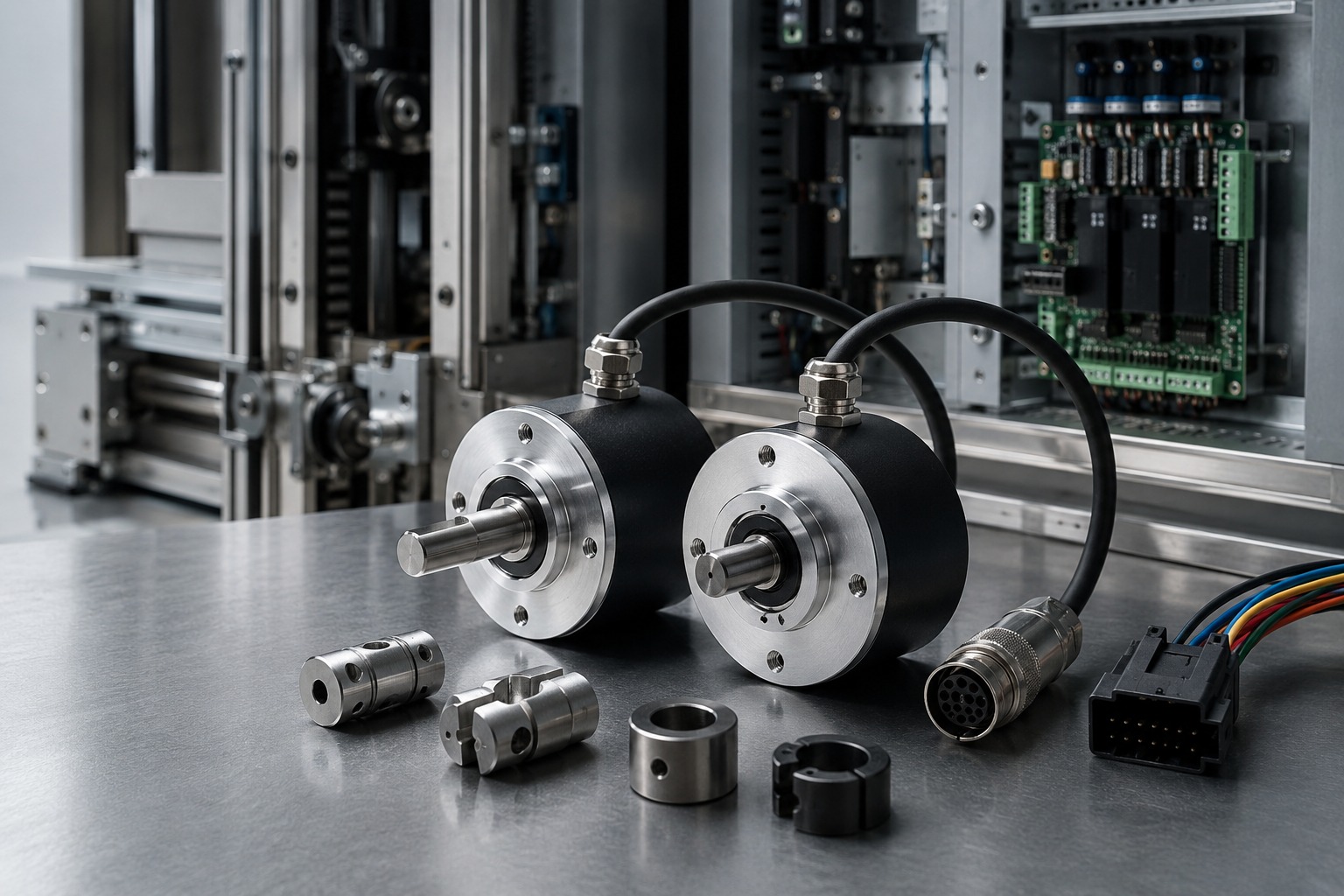
One of the most common ordering mistakes is choosing an encoder by appearance only. Two units may share a similar body size yet differ in pulse output, line driver configuration, voltage, connector pinout, shaft diameter, hollow shaft style, or mounting flange. Even a small mismatch can prevent the elevator from running properly.
Start with electrical compatibility. Confirm the pulse count per revolution, output channels, differential or open collector signal style, supply voltage, and connector arrangement. Then move to mechanical compatibility: shaft diameter, solid or hollow shaft, keyway or clamp style, overall length, mounting face, and axial or radial cable exit. Finally, verify the application context, including elevator brand, drive model, machine model, and original part marking.
For example, a modernization contractor in Phoenix replacing a failed traction machine encoder may have enough cabinet information to identify the drive family but still need photographs of the original nameplate, shaft measurement, connector image, and cable length to avoid a mismatch. In urgent jobs, that extra documentation can reduce return delays and help a supplier recommend the closest compatible replacement.
| Specification | What to verify | Why it matters | Mismatch result |
|---|---|---|---|
| Pulse output | PPR or equivalent resolution | Drive calculates speed from pulses | Wrong speed reading |
| Signal type | Differential, push-pull, open collector | Controller input compatibility | Noisy or unreadable signal |
| Channels | A, B, Z and complements if required | Direction and reference accuracy | Direction fault or poor homing |
| Voltage | 5V, 12V, 24V or specified range | Correct powering of the encoder | Failure to start or damage risk |
| Shaft type | Solid, hollow, diameter, keyway | Proper mechanical fit | Slippage or no installation fit |
| Mounting style | Flange, bracket, bolt pattern | Alignment and stability | Runout, vibration, shortened life |
| Connector and cable | Pin count, plug form, shielding | Fast field installation | Miswiring or signal interruption |
The most effective buying advice is to collect four things before ordering: clear photos, full part number, shaft measurements, and fault details. When available, include the elevator brand, drive model, and jobsite location. A supplier serving the United States can often compare these details with prior replacement records for similar equipment in regions such as Southern California, the Gulf Coast, or the Northeast corridor.
Selection Notes for Hitachi UAX Elevator Encoders
Hitachi UAX encoder selection often requires careful cross-checking because multiple similar-looking units may exist across service generations. Buyers should avoid assuming that a visually similar encoder will work as a direct substitute. The safer approach is to confirm the exact original code, machine application, pulse characteristics, and connector style.
When sourcing a Hitachi UAX replacement, check whether the encoder is used on a specific traction machine or drive family, whether the cable is included, and whether the shaft and mounting arrangement match the original assembly. This is particularly important for modernization work where some machines have mixed histories, replaced controllers, or undocumented field modifications.
If you are comparing options, a product page such as Hitachi UAX elevator encoder replacement can help you confirm general application direction, but final matching should still rely on original part data and installation details. For other compatible options used in broader elevator spare parts sourcing, buyers may also review elevator encoder spare parts solutions, replacement encoder configurations for lift systems, or additional elevator speed feedback encoder models when identifying alternatives.
In the United States market, Hitachi-related replacement needs often arise in buildings with long operating histories where documentation quality varies. A service team in Seattle or Philadelphia may only have a worn label and a maintenance photo from years ago. In such cases, a supplier with strong technical matching capability can reduce guesswork by checking dimensions, connector patterns, and application history before shipment.
| Checkpoint | What to collect | Why it helps | Order risk if missing |
|---|---|---|---|
| Original code | Nameplate or label photo | Best starting point for matching | High risk of wrong model |
| Machine application | Motor or traction machine reference | Confirms application family | Potential electrical mismatch |
| Pulse specification | PPR and channel format | Required for speed feedback | Unstable operation |
| Shaft dimensions | Diameter, length, hollow or solid | Ensures mechanical fit | No-install situation |
| Connector style | Pin count and cable exit | Prevents wiring confusion | Installation delay |
| Mounting arrangement | Flange, bracket, bolt spacing | Supports alignment | Runout and vibration issues |
The explanation behind this checklist is straightforward: the more exact the pre-order information, the lower the risk of downtime. That matters most in urgent repairs where a return shipment could add several days to a critical outage.
Installation Alignment, Shielding, and Cable Inspection
Even the correct replacement encoder can fail quickly if installation quality is poor. Mechanical alignment is one of the most overlooked causes of repeat trouble. If the shaft coupling is stressed, the hollow shaft is clamped unevenly, or the bracket introduces side load, signal quality may degrade and bearing life may shorten.
Before energizing the elevator, confirm that the encoder is mounted squarely, that fasteners are torqued correctly, and that the rotating interface does not wobble. Check for cable strain, sharp bends, contact with moving parts, and insufficient shielding. The encoder cable should be routed away from high-noise power wiring where possible, especially in machine rooms with inverter drives and dense cable trays.
In older buildings undergoing phased modernization, installers sometimes work with limited space or reused routing paths. That is common in city centers such as New York, Washington, DC, or San Francisco where equipment rooms may be crowded. In those environments, cable integrity is just as important as the encoder body itself.
| Inspection item | What to look for | Acceptance target | Problem if ignored |
|---|---|---|---|
| Mounting alignment | Encoder sits square to shaft axis | No visible offset or tilt | Signal instability, wear |
| Fastener security | Brackets and clamps fully tightened | Stable during vibration | Movement and intermittent faults |
| Shaft engagement | Correct insertion depth and coupling | No slippage | Incorrect speed feedback |
| Cable condition | No cuts, crushing, oil soak | Intact insulation and shield | Noise and signal loss |
| Connector seating | Fully locked and clean contacts | Firm connection | Intermittent faults |
| Routing and shielding | Separated from power lines where possible | Minimal EMI exposure | Erratic pulse readings |
This installation checklist is useful not only for field technicians but also for purchasing teams who want to reduce repeat failures. A part that is technically correct still needs proper mounting and clean signal transmission to perform reliably.
Testing Speed Feedback After Encoder Replacement
After installing a replacement encoder, testing should confirm both basic signal presence and real operating stability. The first step is static verification: power supply voltage, connector continuity, proper pinout, and correct phase relationship if applicable. Then move to dynamic testing during controlled operation.
During test runs, look for clean startup, smooth acceleration, stable rated speed, controlled deceleration, accurate landing, and absence of encoder- or speed-related drive alarms. If the system allows diagnostic monitoring, compare actual speed feedback with expected travel behavior. Watch for pulse dropouts, direction inconsistency, or fluctuations under load.
In busy U.S. facilities such as airports, medical centers, convention hotels, and residential high-rises, post-replacement testing should include multiple trip cycles at different loads and different floors. A replacement that passes one no-load run may still reveal noise or alignment problems during repeated service cycles.
The industry demand chart illustrates where urgent replacement activity is often concentrated. Residential towers and office buildings tend to drive high volume, while hospitals and transit-linked properties place especially high value on uptime and rapid parts sourcing.
A practical test sequence may include inspection mode operation, low-speed run, full-speed run, repeated floor-to-floor travel, leveling verification at several landings, and review of fault logs after cycling. If the elevator uses a modern inverter, confirm that speed loop behavior is normal and that no encoder signal quality alarm is stored after the test period.
Why Stocking Encoders Supports Urgent Elevator Repair
Stocking strategy matters because encoder failures are often time-sensitive. When an elevator in a high-occupancy building is out of service, every lost hour can create inconvenience, complaints, and in some cases code or accessibility issues. For service companies in the United States, keeping common encoder models available can be a major competitive advantage.
Not every company needs to stock every model. A better approach is to classify demand by installed base, brand concentration, regional building type, and freight access. For example, a contractor serving dense urban routes in New Jersey and New York may prioritize fast-moving replacements for residential towers and older commercial installations. A company covering Texas, Louisiana, and Gulf Coast ports may focus on harsh-environment packaging and expedited shipment options through Houston logistics channels.
Distributors and service firms often use three inventory levels: van stock for emergency calls, branch stock for common models, and central warehouse stock for broader compatibility coverage. Ports and logistics centers such as Long Beach, Savannah, Newark, and Memphis can influence lead times, so supplier location and packaging quality also matter.
The area chart shows a broader trend: more U.S. buyers are moving from reactive purchasing to preventive stocking, especially as modernization projects increase and building owners seek lower downtime exposure.
Buying Advice for the United States Elevator Parts Market
In the United States, elevator parts buyers usually compare options based on five factors: matching accuracy, quality consistency, documentation support, packaging protection, and response time. Price remains important, but low pricing without model verification can raise the total service cost if the wrong encoder arrives at the jobsite.
The best buying process begins with technical review. Confirm part number, application, electrical data, shaft style, connector, and cable details. Ask whether the supplier can help verify the replacement from jobsite photos. Then evaluate quality control practices: incoming inspection, dimension checks, connector verification, signal consistency checks, and shipping protection against transit damage.
For companies serving multi-site clients across states such as California, Florida, Texas, Illinois, and New York, supplier responsiveness is critical. A replacement part may need to move overnight to a building where service interruption affects tenants or residents immediately. Buyers should ask about stock status, packing method, return handling, and whether the supplier can support urgent cross-checking when the original label is incomplete.
From a market perspective, the United States continues to see solid demand for replacement encoders because many elevators remain in service well beyond initial installation cycles. Modernization activity in urban cores, hospitality refresh programs, healthcare campus upgrades, and residential high-rise maintenance all contribute to demand. By 2026, more buyers are expected to require not only part availability but also cleaner data support, traceability, and sustainability-minded packaging.
This comparison chart reflects how many professional buyers evaluate suppliers in practice. Technical support and model matching often rank as high as inventory and dispatch speed because a fast shipment is only useful when the part is correct.
Applications, Industries, and Practical Case Examples
Elevator encoders are used across nearly every traction elevator environment, but replacement priorities vary by industry. Hospitals need dependable leveling and minimal downtime for patient movement. Hotels value quiet ride quality and quick restoration to preserve guest experience. Residential towers need reliable daily performance and reduced callback frequency. Office buildings prioritize uptime during peak hours. Universities and public buildings often operate aging systems that depend on careful parts matching.
A practical case example is a residential high-rise in Jersey City where repeated leveling complaints occurred after a prior non-matched replacement. The issue was not the drive itself, but an encoder with a similar housing and incorrect output characteristics. After confirming the correct signal format and shaft size, the replacement stabilized landing accuracy and reduced service calls.
Another example is a hospital service elevator in Dallas where intermittent encoder faults were ultimately traced to cable shielding damage near a machine-room routing bend. The encoder body was still functional, but the repair required cable correction and connector replacement. This case shows why thorough diagnosis prevents unnecessary parts changes.
In a hotel modernization project in Orlando, the contractor chose to stock several common encoder types in advance because freight delays during peak season would have affected reopening timelines. Preplanned stocking reduced schedule risk and supported faster commissioning.
Local Supplier Expectations in Major U.S. Trade Corridors
Buyers often prefer suppliers that understand logistics across major U.S. trade corridors. For example, customers in Los Angeles and Long Beach may prioritize rapid west coast fulfillment. Companies near Houston may focus on Gulf Coast routing and weather-resilient packaging. Projects around Savannah and Atlanta can benefit from strong southeastern transport access, while Newark and New York often require fast delivery into dense urban service areas.
Local expectation is not only about physical proximity. It also includes communication speed, accurate documentation, and practical familiarity with elevator maintenance realities. A capable supplier should be able to discuss encoder pulse output, shaft style, connector details, and application fit without forcing the customer into repeated guesswork.
For urgent repair situations, the strongest suppliers usually provide quick quotation response, careful label verification, protected packaging, and direct confirmation of replacement details before dispatch. In the elevator field, a few hours saved during parts identification can be as important as a few hours saved in freight.
Our Technical, Manufacturing, and Service Strengths for Encoder Supply
On the technical side, we support careful model matching for elevator encoders and related lift spare parts by reviewing part numbers, jobsite photos, shaft details, and connector configurations before shipment. This helps maintenance companies, distributors, building owners, and modernization contractors reduce ordering risk when replacing speed feedback components used in traction control systems. Because encoders often interact closely with controllers, inverter parts, and machine assemblies, technical review is especially important when original documentation is incomplete.
From a manufacturing and quality perspective, we emphasize stable sourcing, inspection consistency, and protective packaging. For encoder supply, that means attention to visible labeling, connector accuracy, dimensional checks, and packing methods designed to reduce transit damage during domestic or international shipment. Buyers handling mixed brand portfolios often need more than one component at the same time, so we also support broader sourcing across elevator control boards, frequency converter parts, door operator components, door locks, light curtains, guide shoes, oil cups, sensors, power supplies, buttons, COP panels, intercom parts, and other lift accessories.
From a service perspective, our goal is responsive communication and practical support for urgent repair. That includes helping customers narrow down compatible replacement options, organizing protective packing for time-sensitive orders, and assisting with repeat procurement for common maintenance demand. For U.S. customers facing tight downtime windows in cities such as New York, Miami, Chicago, Los Angeles, and Houston, fast identification and consistent follow-through are often as important as the part itself.
2026 Trends: Technology, Policy, and Sustainability
Looking toward 2026, elevator encoder purchasing in the United States will be influenced by three major trends. The first is technology integration. More modernization projects will rely on cleaner digital diagnostics, better drive monitoring, and stronger documentation of replacement parts. Buyers will expect faster confirmation of signal type, compatibility, and installation requirements.
The second trend is policy and compliance pressure around uptime, accessibility, and building performance. While encoder selection remains a technical purchase, its impact touches broader service expectations in multifamily, healthcare, hospitality, and public-access buildings. More owners will prefer preventive replacement and stocking strategies to limit extended outages.
The third trend is sustainability. Building operators increasingly care about extending the usable life of elevator systems through targeted component replacement instead of complete system disposal. Reliable encoders support efficient modernization by restoring control accuracy without unnecessary replacement of larger assemblies. At the supply level, stronger packaging efficiency, reduced damage in transit, and more predictable inventory planning can also contribute to lower waste.
Frequently Asked Questions About Elevator Encoders
What does an elevator encoder do?
It provides speed and motion feedback to the elevator drive or controller, supporting traction control, leveling accuracy, and smooth ride performance.
What are the most common symptoms of encoder failure?
Frequent symptoms include leveling errors, jerky travel, intermittent speed feedback alarms, shutdowns during startup, and unstable deceleration.
Can I replace an encoder with a similar-looking model?
No. Appearance alone is not enough. You must match pulse output, signal type, voltage, shaft style, mounting details, and connector configuration.
Why is shaft type important?
A wrong shaft diameter, hollow shaft size, or mounting arrangement can make installation impossible or cause slippage and misalignment after installation.
How do I verify a Hitachi UAX encoder?
Collect the original label, shaft measurements, machine application details, pulse information, and connector photos. These details improve matching accuracy.
Should I replace the cable too?
If the cable shows shielding damage, crushed insulation, oil contamination, or unreliable connectors, inspect or replace it. Signal cable issues often mimic encoder failure.
How do I test an encoder after replacement?
Check supply voltage, continuity, pinout, signal presence, and then run controlled elevator tests for startup, full-speed travel, leveling, and repeated cycles under load.
Is it worth stocking encoders for urgent repair?
Yes, especially if your service portfolio includes common brands or high-rise properties where downtime creates major tenant or resident impact.
What information should I send when requesting a quote?
Send the part number, clear photos of the nameplate and connector, shaft dimensions, elevator brand, application details, and any fault description.
Why do some encoder problems appear only intermittently?
Because heat, vibration, moisture, cable movement, and electrical noise can weaken signals in ways that only show up under certain operating conditions.
Choosing the right elevator encoder in the United States market means combining field diagnostics with careful sourcing. When pulse output, shaft type, mounting style, and cable condition are all verified, the replacement is more likely to restore stable speed feedback on the first attempt. For maintenance teams and building operators, that translates directly into safer operation, smoother leveling, and less downtime.