
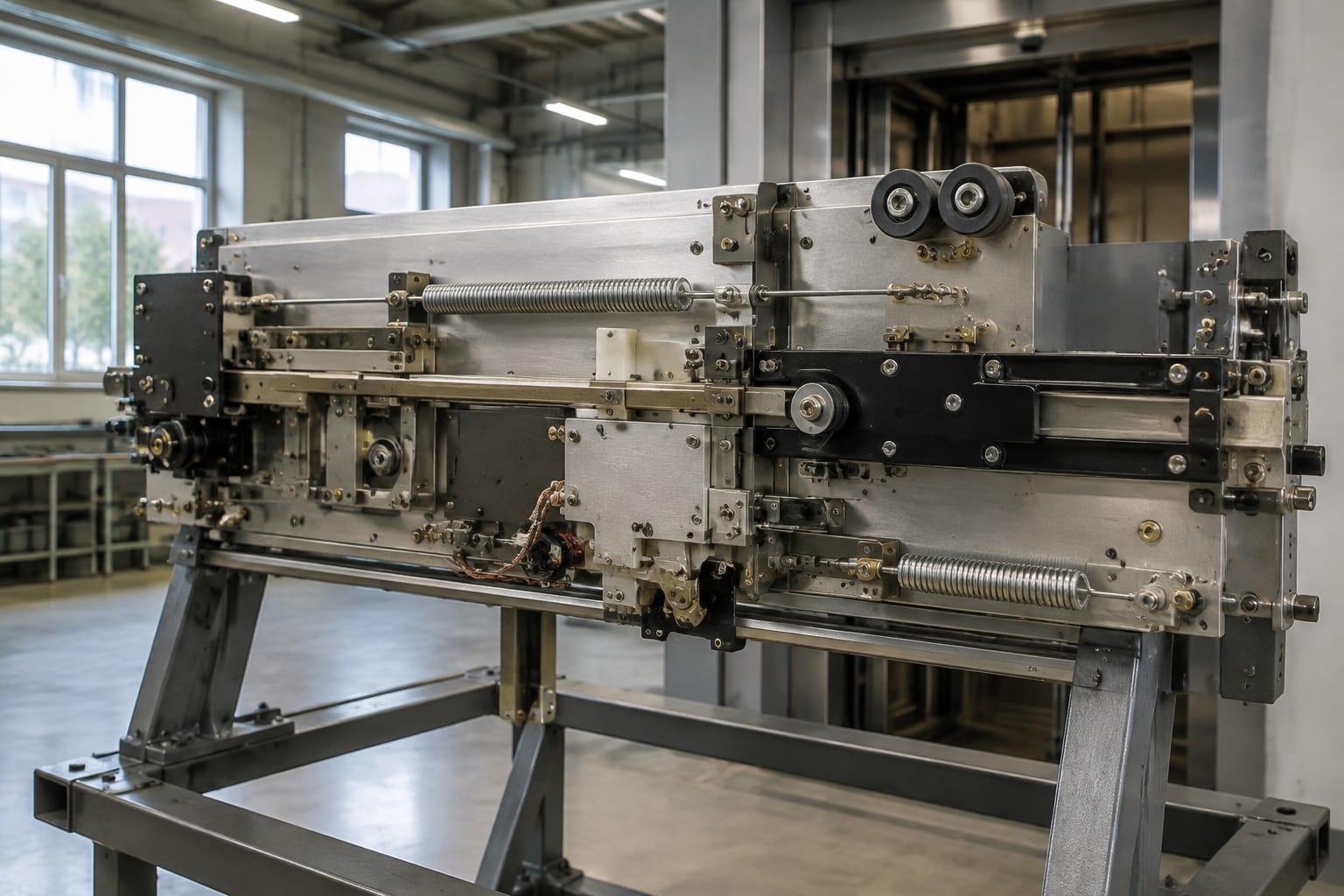
An elevator door stopper is not always one named part. In U.S. elevator maintenance work, the term can describe any component that limits door travel, cushions the final movement, or keeps a car or hoistway door panel from overtraveling. Depending on the door system, that may be a stop block, rubber bumper, spring, roller, buffer, hanger assembly, or an adjustment built into the operator or track.
The correct remedy starts with identifying what is actually stopping the door and why its motion has changed. A door that bangs at full open, rebounds before closing, stops short, or fails to close may have a worn stopper, but it may also have misalignment, damaged rollers, a loose track, incorrect clearances, or an operator issue. Door work should be performed by qualified elevator personnel using the manufacturer’s instructions and the applicable code and site safety procedures.
What buyers mean by elevator door stopper
“Elevator door stopper” is a useful sourcing term, but it is too broad to identify a replacement component by itself. Buyers commonly use it for one of several functions:
- Opening stop: Limits the panel’s travel at the fully open position.
- Closing stop or buffer: Cushions contact near the closed position or prevents hard metal-to-metal impact.
- Spring stop: Uses spring force to absorb motion or return a movable device to its intended position.
- Track or hanger stop: Prevents a hanger, roller, or panel from traveling beyond its designed path.
- Door operator limit component: Works with an operator adjustment or limit system to stop powered movement.
- Interlock-related stop: Restricts the position of a hoistway-door mechanism or related hardware. This is not interchangeable with a general door bumper.
The same term may refer to parts at the car door, hoistway landing door, door operator, sill, header, hanger track, or locking equipment. Before ordering, identify the door system and the part’s physical location. A photograph of the installed component alongside measurements and the equipment identification is more useful than a generic request for a “door stopper.”
For example, a spring that supports or restrains landing-door hardware may be described as a stopper even though its primary function is tension or return force. When the replacement is genuinely a spring component, compare the original against a 600 mm elevator hall-door spring only after confirming its length, end configuration, wire size, and application.
Springs, buffers, and travel limits
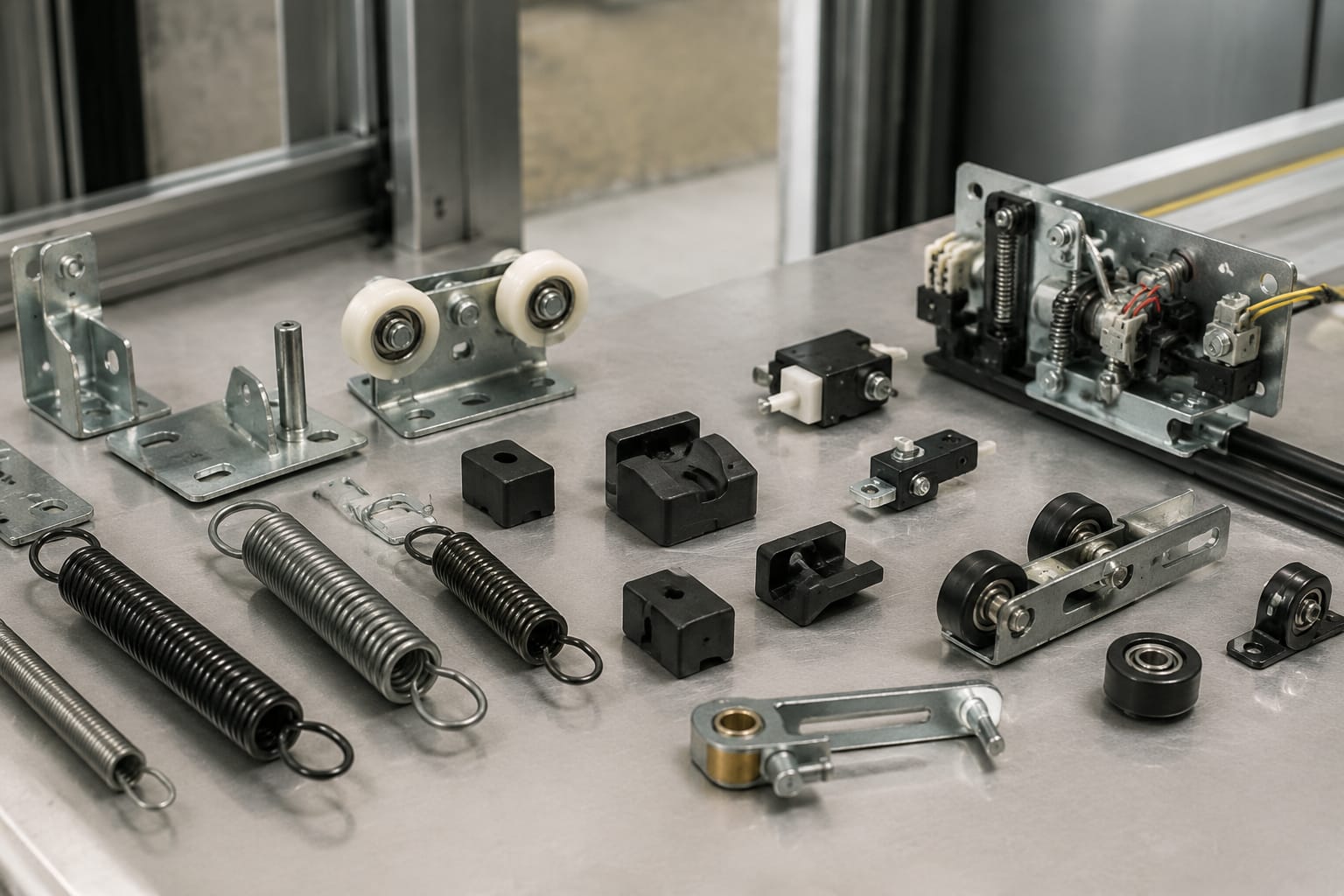
Stopping systems generally fall into three categories: elastic components that absorb energy, fixed components that physically limit travel, and adjustable systems that tell or allow the operator to stop at a defined position.
Springs
Springs can control, cushion, or return door-related parts. Extension springs, compression springs, torsion springs, and flat springs are all used in elevator equipment, but they are not substitutes for one another.
A spring-related fault may show up as inconsistent closing force, incomplete latching, excessive impact, or a component that does not return to its resting position. A stretched extension spring, cracked hook, corroded coil, or altered free length changes how the mechanism behaves.
Do not select a spring by overall length alone. Confirm:
- Free length and installed length
- Outside diameter and wire diameter
- Coil count and winding direction where applicable
- Hook, loop, eye, or mounting-end style
- Material condition and surface finish
- Required working load or spring rate when known
- Door manufacturer, operator model, and exact installed position
A small spring can be safety-critical because it affects how locking, coupling, or closing hardware returns to position. For general door-spring sourcing, compare the original details to a relevant elevator door spring component rather than treating springs of similar appearance as compatible.
Buffers and bumpers
Rubber, polyurethane, or elastomer bumpers reduce impact at the end of travel. They may be mounted to a header, panel, track, door operator, or stop bracket. Over time, they can harden, crack, flatten, detach, or leave residue on surrounding surfaces.
A damaged bumper often produces a sharp bang even when the door otherwise travels correctly. Replacing it may restore quieter motion, but only after checking whether the panel is reaching the correct stop position. A new bumper installed against a misadjusted stop can conceal, rather than solve, the underlying problem.
Fixed stops and adjustable travel limits
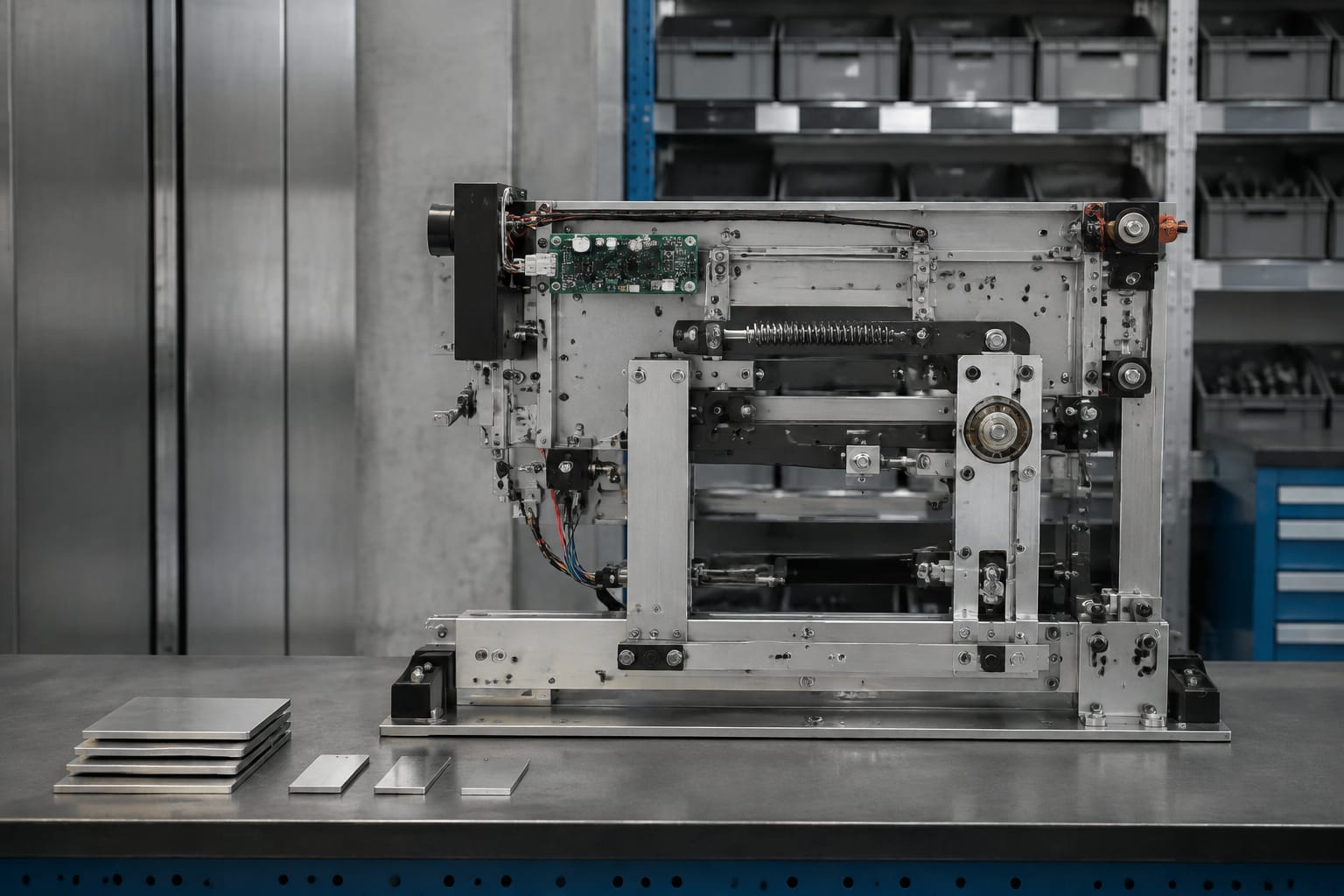
A fixed stop is usually a bracket, block, screw, or plate that physically prevents continued movement. An adjustable stop lets a technician set the final position within the manufacturer’s allowable range.
Powered door systems can also use electronic, mechanical, or encoder-based limits. These should be adjusted only according to the applicable door operator documentation. Moving a limit to compensate for a dragging panel, worn roller, or bent hanger can create new problems, including poor reopening behavior, door reversal, incomplete closure, or impact at the jamb.
Related rollers and hanging components
A stopper can only work correctly when the door panel is supported and guided correctly. Door rollers, hangers, tracks, gibs, pickup assemblies, clutch components, and bottom guides all influence the panel’s final position and impact.
The relationship is straightforward: if a roller is worn or a hanger is loose, the panel can shift vertically or laterally. That change may cause a stopper to strike off-center, miss its mating surface, contact too early, or hit too hard. In that condition, replacing the stopper alone is unlikely to provide a durable repair.
| Component | Primary role | How wear can affect stopping |
|---|---|---|
| Hanger roller | Supports panel travel on the track | Flat spots or bearing wear can cause rough travel and inconsistent final position |
| Hanger assembly | Carries and positions the door panel | Loose or bent hardware can shift the panel into the stop |
| Track/header | Provides the rolling path | Damage or contamination can prevent smooth travel to the limit |
| Bottom guide or gib | Keeps the panel aligned at the sill | Wear can allow side play and off-center contact |
| Bumper or buffer | Cushions end-of-travel contact | Hardening or loss causes impact and noise |
| Stop bracket or block | Limits travel mechanically | Bending, looseness, or misplacement changes the stopping point |
| Door knife or coupling hardware | Coordinates car and hoistway door operation | Incorrect engagement can mimic a closing or stopping fault |
Door knife springs deserve particular care because they relate to a specific coupling design, not just a general door-stop function. Where the installed component matches the manufacturer and dimensions, a Mitsubishi-style 119 x 17 mm elevator door knife spring illustrates the kind of exact dimensional comparison needed before purchasing.
Symptoms of poor stopping or closing
Door symptoms help narrow the inspection, but one symptom can have multiple causes. Start by observing whether the problem occurs at full open, near closed, during coupling, or throughout the travel path.
Common symptoms include:
- A loud impact when the door reaches full open or full closed
- Door panels that rebound after contacting a stop
- One panel stopping before the other
- A panel that travels past its normal open position
- Slow movement near the end of travel
- Repeated reopening or failure to complete the closing cycle
- Scraping, clicking, rattling, or rolling noise
- Uneven panel gaps or visible side-to-side movement
- A stopper, bumper, or bracket showing fresh contact marks
- A door that operates differently from floor to floor
A hard stop at full open points first toward the open stop, bumper, hanger rollers, track condition, or operator travel setting. A problem just before closure can involve closing limits, door clutch engagement, gibs, sill debris, panel alignment, or interlock-related hardware.
Do not assume the most visible damaged part is the cause. A bumper may be torn because the stop bracket moved. A bracket may be bent because the panel was allowed to swing due to worn guides. Inspect the complete mechanical path before ordering parts.
Inspect alignment and mechanical wear
A structured mechanical inspection reduces incorrect replacements and repeat service calls. Lockout, car position, access procedures, and inspection methods must follow the equipment manufacturer’s requirements and applicable safety rules.
Begin with a visual inspection while the doors are stationary. Look for cracked rubber, missing fasteners, loose set screws, bent brackets, corrosion, unusual polished contact areas, and debris in the track or sill. Then inspect the related moving parts for play and damage.
Check the panel and track relationship
Verify that the panel hangs squarely and follows the track without obvious binding. Excessive vertical movement, lateral play, or a roller that does not rotate smoothly can change where the panel meets its stop.
Look for:
- Roller tread damage, flat spots, or seized bearings
- Loose hanger fasteners or damaged adjustment hardware
- Bent or contaminated hanger tracks
- Worn, missing, or incorrectly fitted bottom guides
- Bent door panels or damaged panel reinforcement
- Uneven clearances at the jamb, sill, and meeting edges
- Stop brackets that are loose, bent, or shifted from their original position
Use witness marks carefully
Contact marks are valuable evidence. A clean, recent strike mark on one side of a bumper or stop may indicate misalignment. A bumper compressed unevenly suggests the panel is not approaching squarely. However, old marks do not prove a current setting is correct, so compare them with movement observations and the manufacturer’s intended arrangement.
Separate mechanical and control causes
A door that stops inconsistently may have a mechanical issue, a door-operator adjustment issue, or both. Mechanical checks should generally come first. If the panel cannot move freely by its designed mechanical path, changing operator force, timing, or limits may mask the issue while increasing stress on components.
Measure the original component
Accurate identification prevents the common error of purchasing a part that looks right but cannot mount, travel, or withstand the required load. Remove and measure components only when it is appropriate and safe to do so.
For a stopper, bumper, or fixed stop, record:
- Overall length, width, thickness, and diameter where relevant.
- Hole count, hole diameter, slot dimensions, and center-to-center spacing.
- Mounting orientation and the direction of panel contact.
- Material type: rubber, polymer, steel, aluminum, composite, or spring steel.
- Shape of the contact face: flat, rounded, stepped, grooved, or angled.
- Bracket thickness, fastener type, and clearance around the part.
- Part numbers, cast markings, labels, and manufacturer identification.
- Photos from installed and removed positions, including a scale reference.
For springs, add the free length, coil body length, wire diameter, outside diameter, number of active coils if practical, and both end forms. For rollers, record wheel diameter, width, bore size, bearing arrangement, axle or stud dimensions, and mounting style.
Also capture the elevator door manufacturer, operator model, door type, panel arrangement, and site equipment identification. A component can share the same dimensions as another part while using a different material hardness, spring force, mounting offset, or operational function.
Adjustment versus replacement
Adjustment is appropriate when the part is intact, the hardware is sound, and the manufacturer provides an adjustment procedure for restoring the intended door position. Replacement is appropriate when a component is worn, damaged, permanently deformed, degraded, missing, or no longer able to perform its intended function.
| Condition found | Typical response | Important limitation |
|---|---|---|
| Loose but undamaged stop bracket | Secure and set to documented position | Confirm the panel and hangers are aligned first |
| Minor travel-position error with sound components | Adjust using the approved operator or stop procedure | Do not exceed the manufacturer’s travel range |
| Cracked, hardened, detached, or flattened bumper | Replace with a confirmed compatible bumper | Check for excessive impact that caused the damage |
| Bent stop block or fractured bracket | Replace the damaged hardware | Inspect the associated panel, track, and hanger |
| Stretched, corroded, or broken spring | Replace with the exact functional equivalent | Do not substitute based only on length |
| Worn roller or excessive panel play | Repair or replace roller/hanger-related parts | A new stopper will not correct panel instability |
| Recurrent stopping fault after adjustment | Diagnose the complete door system | Do not keep compensating with repeated limit changes |
A common mistake is using adjustment to overcome wear. For example, moving a stopper farther away may reduce a bang temporarily, but it can leave the door outside its intended opening position. Increasing operator force may close a dragging panel for a while, but it can accelerate wear and create undesirable contact forces.
Another mistake is replacing a soft component with a harder material because it appears more durable. The original material may have been selected specifically to absorb energy, reduce noise, or protect another part. Confirm the material and intended duty before making substitutions.
Final door-motion and safety tests
After any door-stop, bumper, spring, hanger, or travel-limit work, complete the relevant inspection and operational checks specified by the equipment manufacturer and applicable requirements. The objective is not only that the door reaches its endpoint, but that it moves predictably, aligns correctly, and retains all safety functions.
At minimum, qualified personnel should verify:
- Smooth travel through the full intended opening and closing path
- Correct final open and closed positions
- No metal-to-metal impact, abnormal rebound, scraping, or chatter
- Consistent motion over repeated cycles
- Secure mounting of the replaced or adjusted component
- Proper panel alignment, clearances, and guide engagement
- Correct car-door and hoistway-door coordination where applicable
- Normal reopening, protective, locking, and interlock-related functions as applicable
- No new fault indications, abnormal noise, or excessive operator loading
Test more than one cycle and, where the system design requires it, evaluate the affected landing conditions rather than relying on a single successful operation. A fault that appears only under a particular panel position, temperature condition, or landing-door interaction may not show up during one short check.
The practical buying decision is simple: identify the component by function and location, verify its physical and operating details, inspect the related moving hardware, and replace only with a confirmed compatible part. Kelevator supplies multi-brand elevator spare parts for B2B buyers; when sourcing a door stopper or related spring, roller, or buffer, provide the original part markings, measurements, photos, and door-system details for a more reliable comparison.
Related product references
For practical catalog examples related to this topic, review 600mm hall door spring lift accessories elevator spare parts, Door spring lift accessories elevator spare parts, and Elevator door knife spring 119x17mm Mitsubishi elevator parts lift accessories. Confirm the exact model, dimensions, ratings, and connectors before ordering.