
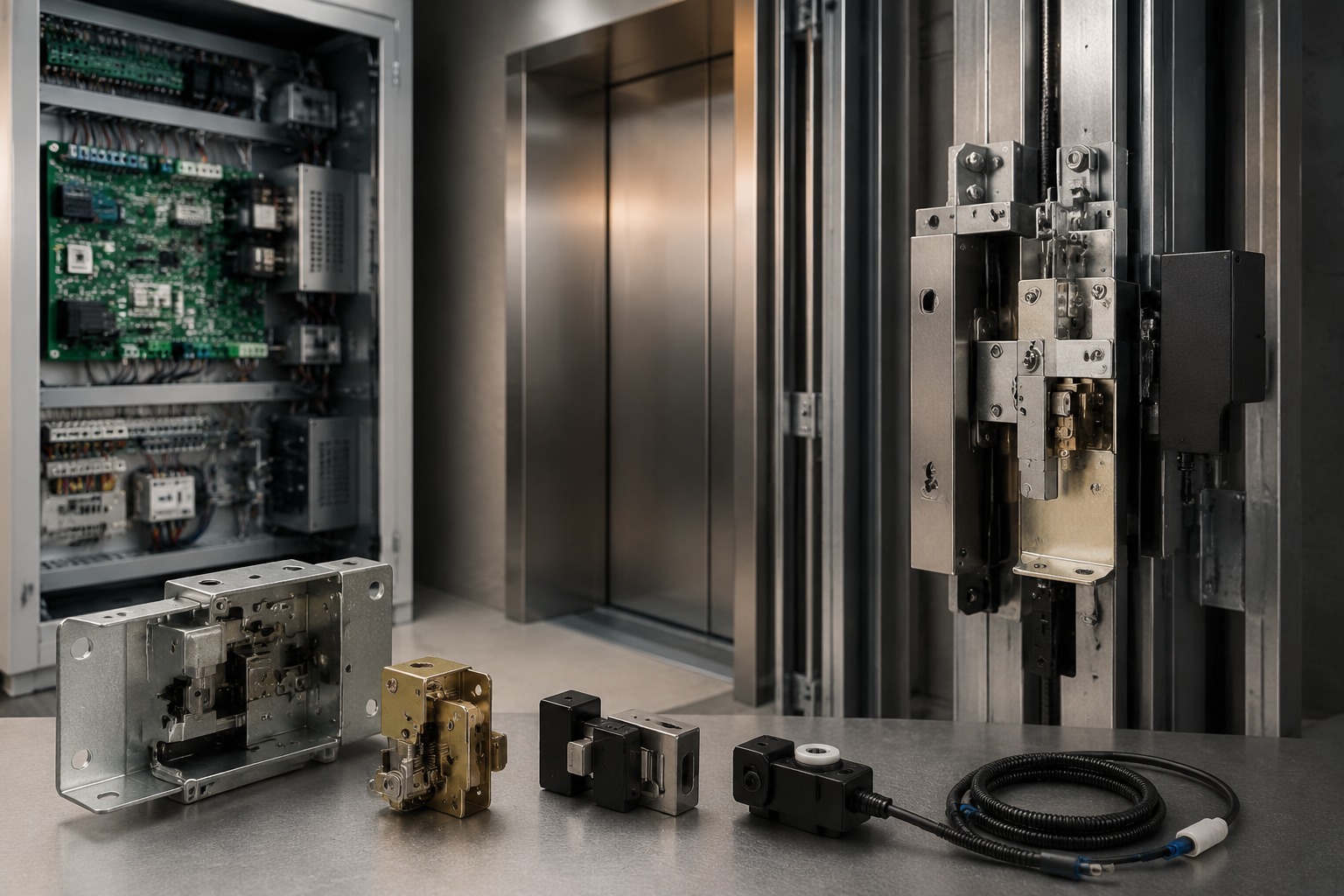
Elevator door locks are one of the most important safety devices in any traction or hydraulic elevator system. If a landing door is not securely locked, the elevator must not run. That basic rule protects passengers, service staff, tenants, and freight operators every day in apartment buildings, hospitals, hotels, warehouses, airports, and office towers across the United States. For maintenance companies and building owners, understanding how the hall door lock hook, lock contact switch, and lock spring work together is essential for reducing callbacks, preventing unsafe door conditions, and keeping equipment compliant with local code expectations.
The direct answer is simple: elevator door locks are critical because they confirm that landing doors are fully closed and mechanically secured before car movement is permitted. But in real field conditions, safety depends on several small components working together with consistent alignment, proper spring force, reliable electrical contact, and correct replacement parts. A worn hook, a weak spring, a misadjusted switch, or a poor-quality substitute can create nuisance shutdowns at best and hazardous conditions at worst.
In the United States market, this subject matters even more because equipment fleets are highly mixed. A single service route may include older low-rise hydraulic units in Phoenix, busy freight elevators in Chicago distribution centers, hotel elevators in Orlando, hospital modernization projects in Houston, and high-traffic multifamily properties in New York City or Los Angeles. Each environment places different stress on landing door locking systems. Preventive planning and accurate parts sourcing help minimize downtime while supporting safe operation.
This guide explains how lock hooks, contact switches, and springs affect elevator safety; when to replace them; how to verify contact reliability after repair; and how to source certified, compatible parts. It also reviews market trends, industry demand, practical buying advice, and maintenance scheduling for the United States in 2026 and beyond.
Why Elevator Door Locks Matter So Much for Safety
Every landing door lock serves two connected functions: mechanical locking and electrical verification. The mechanical portion keeps the hall door secured when the car is not at the landing. The electrical portion, usually through lock contacts or a contact switch, tells the controller that the lock has reached the proper secured position. Only when the lock circuit is proven can the elevator be allowed to move.
This is why technicians pay close attention to the full lock assembly rather than a single part. A hook that does not fully engage, a roller that binds, a contact switch that closes inconsistently, or a spring that has lost tension can all compromise system performance. In heavy-use buildings such as office towers in Dallas or mixed-use properties in Seattle, repeated cycling accelerates wear. In coastal regions such as Miami, Tampa, Long Beach, and the Port of Newark area, humidity and corrosion can affect metal surfaces and contact reliability. In industrial settings near Atlanta logistics hubs or Inland Empire freight corridors, dust, vibration, and high-duty cycles create another set of maintenance demands.
For building owners, the practical consequence is straightforward: reliable landing door locks reduce shutdowns, improve passenger confidence, support inspection readiness, and lower long-term maintenance costs. For maintenance firms, lock performance is a high-value preventive item because a relatively small component can create repeated entrapments, intermittent faults, or code-sensitive service issues if overlooked.
| Safety Function | Main Component | What It Does | Typical Failure Symptom | Operational Risk | Recommended Action |
|---|---|---|---|---|---|
| Mechanical securing | Lock hook | Engages keeper and holds landing door closed | Door does not lock cleanly | Unsafe door status or shutdown | Inspect wear pattern and alignment |
| Electrical proving | Contact switch | Confirms lock is in safe position | Intermittent lock circuit faults | No-run condition or callbacks | Test continuity and contact repeatability |
| Return force | Lock spring | Maintains engagement pressure and reset action | Weak or delayed locking action | Incomplete lock engagement | Replace fatigued spring |
| Alignment transfer | Linkage and rollers | Moves force between door and lock body | Rubbing, drag, noisy operation | Accelerated wear and false faults | Adjust and lubricate where permitted |
| Circuit integrity | Wiring terminals | Carries signal from lock to controller | Random open circuit alarms | Downtime and misdiagnosis | Tighten, clean, and verify insulation |
| Compliance support | Certified replacement part | Restores intended design behavior | Fit mismatch or unreliable cycling | Inspection concerns and repeat repairs | Source verified compatible parts |
The table above shows why these parts should be evaluated as a safety chain, not as isolated items. In the field, many recurring lock faults come from combinations of minor wear and marginal adjustment rather than a single catastrophic break.
From a market perspective, demand for replacement lock parts remains steady in the United States because many installed elevators are in mid-life or late-life service phases. Modernization can solve repeated legacy issues, but large portions of the market still rely on ongoing replacement of compatible door lock components to extend equipment life. This is especially true in major service centers such as New York, Chicago, Los Angeles, Houston, Philadelphia, and Atlanta, where mixed-brand inventories are common and downtime costs are high.
Signs a Hall Door Lock Hook Needs Replacement
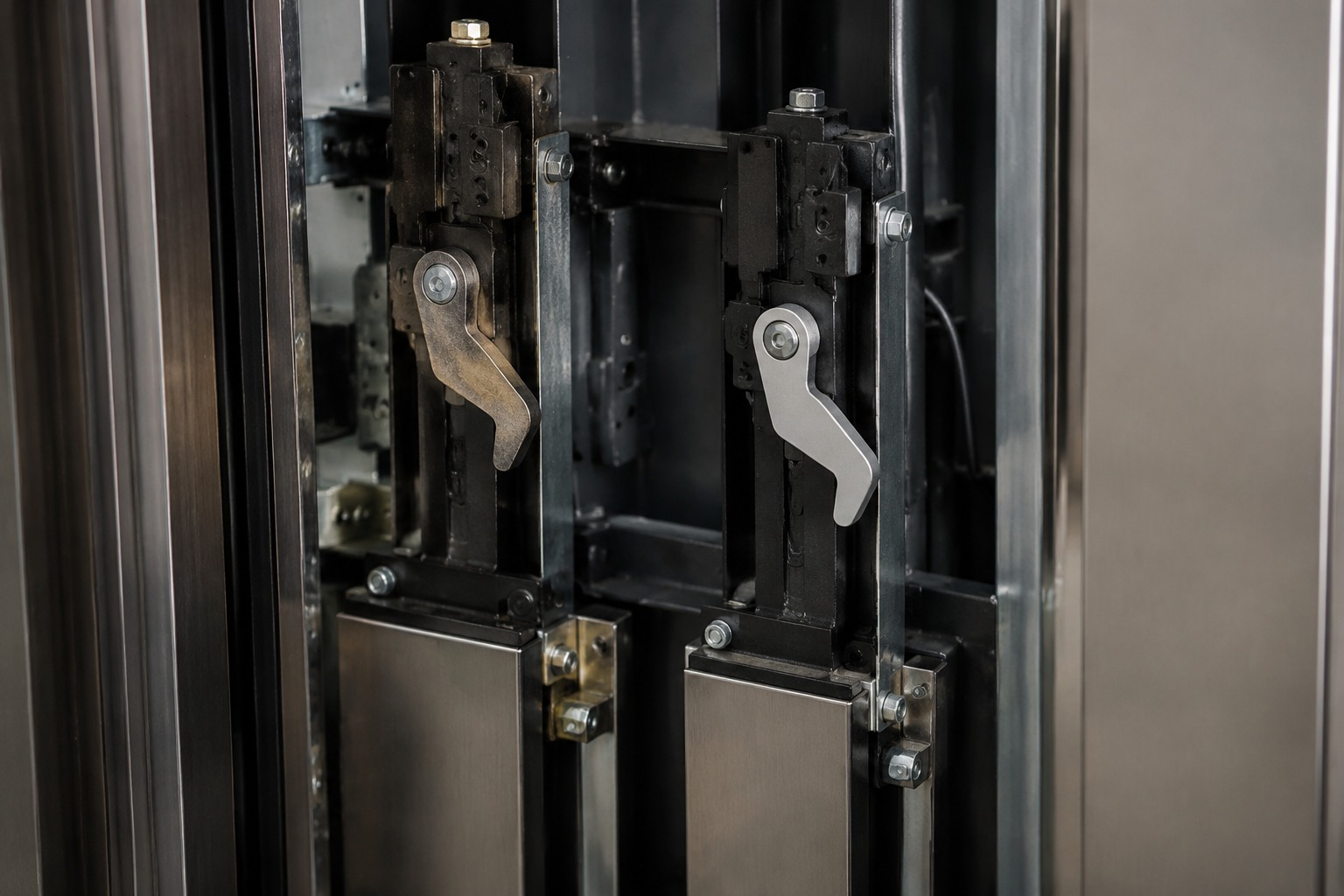
The hall door lock hook is a small part with a large job. As doors cycle open and closed thousands of times, the hook surface can wear, round off, chip, or lose the precise geometry needed for secure engagement. In some cases, the problem is visible during inspection. In others, technicians first notice service complaints: intermittent door lock faults, landing doors that require extra force to close, or random shutdowns at one floor only.
Common replacement signs include uneven wear marks, deformation at the contact edge, burrs, excessive side play, corrosion, impact damage, and failure to fully mesh with the mating lock surface. On older units, technicians may also find that a previous temporary repair altered the part profile, causing poor engagement depth. If the hook does not enter and hold correctly, the switch may not prove consistently, even if the electrical component itself still tests good.
Another clear field clue is floor-specific repeat failure. If one landing repeatedly reports lock circuit problems while adjacent floors remain stable, the hook and its alignment should be examined closely. This is common in high-use floors such as lobbies, parking transfer levels, loading docks, and amenity floors. For example, a multifamily building in Austin may see more wear at the garage-to-lobby level, while a hotel in Las Vegas may wear faster at the casino access floor.
When replacement is necessary, matching the hook profile, dimensions, mounting points, and compatible lock assembly is essential. Using a close-looking but non-matching part can create false economy through callbacks and labor waste. For teams looking for a compatible replacement, the hall door lock hook for elevator landing doors should be selected only after confirming model details and fitment.
| Observed Sign | Likely Cause | Field Effect | Inspection Method | Replace Now? | Notes |
|---|---|---|---|---|---|
| Rounded engagement edge | Long-term friction wear | Shallow or unstable locking | Visual check and compare with new profile | Usually yes | Common in high-traffic lobby floors |
| Metal burrs | Misalignment or impact | Drag and incomplete closure | Touch-safe visual inspection | Often yes | May also damage mating surfaces |
| Hook deformation | Forceful door closing or shock load | Erratic engagement depth | Straight-edge comparison | Yes | Check keeper alignment too |
| Corrosion pitting | Humidity, coastal air, chemical exposure | Rough movement and reduced reliability | Surface inspection | Depends on severity | Common near coasts and parking structures |
| Excessive side play | Bushing or mounting wear | Contact inconsistency | Manual movement test | Often yes | Inspect related hardware |
| Repeated faults at one floor | Localized wear or alignment issue | Callbacks and no-run events | Cycle test at affected landing | After diagnosis | Do not assume switch-only failure |
The most important takeaway is that hooks rarely fail in isolation. When replacing a worn hook, technicians should inspect the strike surfaces, lock body, fasteners, alignment, and spring condition at the same time. That approach lowers the risk of replacing one part only to discover that poor return force or contact position still causes intermittent faults.
Selecting the Right Lock Contact Switch for Freight Elevators
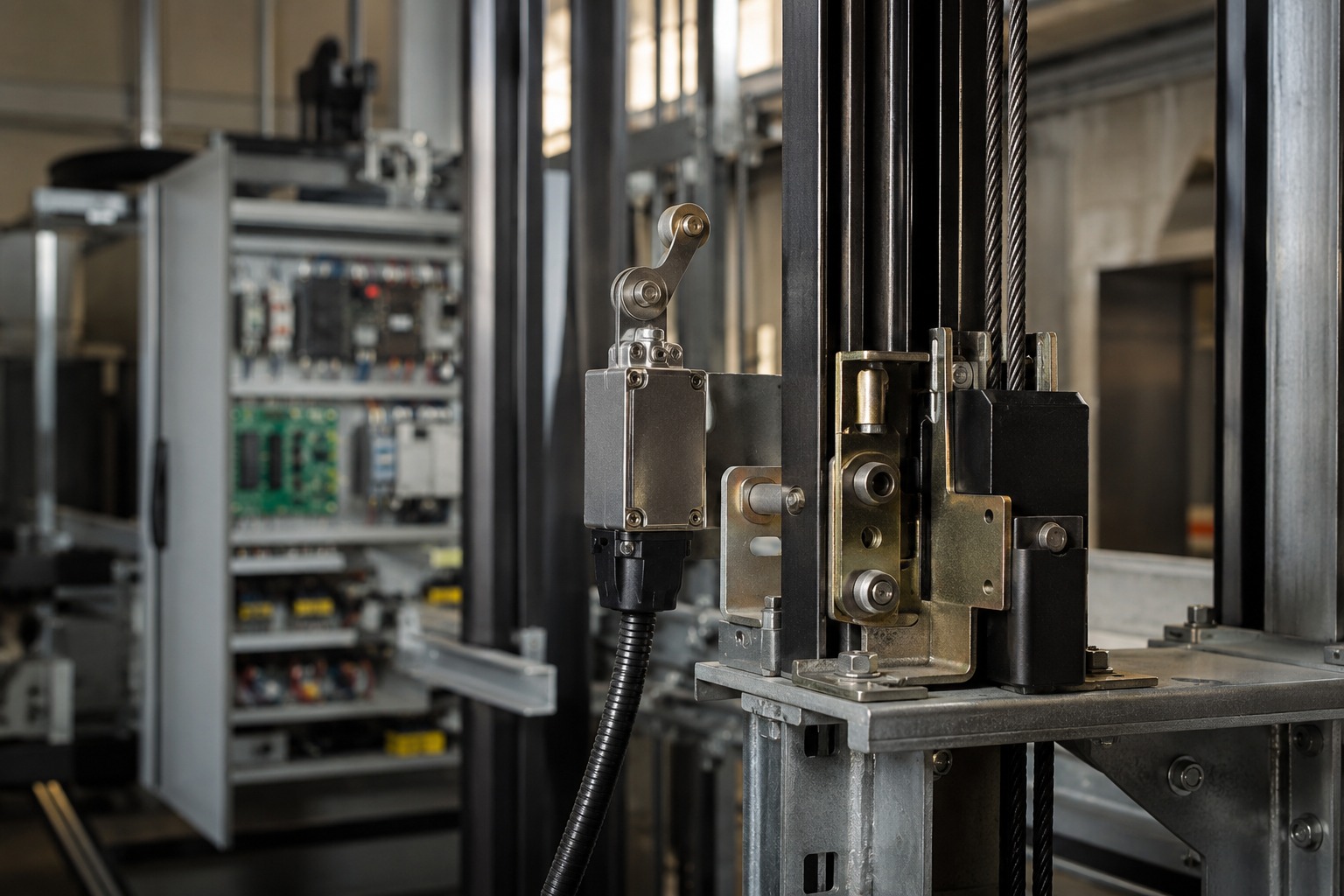
Freight elevators place unique demands on door lock components. Compared with passenger elevators, they often operate with heavier doors, stronger vibration, more abusive loading conditions, and a higher likelihood of dust, debris, or impact at the landing entrance. In warehouse and manufacturing environments from Memphis to Columbus to the Port of Los Angeles, contact switches for freight door locks must be chosen with durability, compatibility, and stable electrical performance in mind.
The first selection factor is exact compatibility with the lock assembly and controller logic. The second is environmental suitability. A freight site with forklift traffic, airborne particles, or temperature swings may need more robust switch construction and better terminal protection than a climate-controlled office building. The third is cycle reliability. Frequent loading operations can expose weak switches quickly, especially if the lock mechanism has any drag or misalignment.
Technicians should also consider terminal style, actuation force, contact rating, mounting footprint, and the consistency of switch travel relative to the lock hook movement. A switch that proves too early or too late can create nuisance issues even if it is technically functional. For freight applications, dependable field matching matters more than generic substitution.
Where a verified replacement is needed, a freight elevator door lock contact switch should be sourced based on model confirmation, electrical characteristics, and operating environment. This is particularly important for building owners trying to avoid repeated shutdowns at loading docks and service corridors.
| Selection Factor | Why It Matters | Passenger Use Priority | Freight Use Priority | Risk If Ignored | Best Practice |
|---|---|---|---|---|---|
| Mechanical fit | Ensures proper switch travel | High | High | Misoperation and callbacks | Verify dimensions and mounting points |
| Contact rating | Supports reliable electrical proving | Medium | High | Premature contact degradation | Match circuit requirements |
| Environmental resistance | Protects against dust and humidity | Medium | High | Corrosion and intermittent faults | Review site conditions before ordering |
| Actuation consistency | Aligns with lock engagement point | High | High | False lock proofing or no-run | Bench and field test after installation |
| Terminal protection | Reduces loose or contaminated connections | Medium | High | Random open circuit alarms | Inspect wiring and strain relief |
| Cycle durability | Supports heavy-duty operation | Medium | Very high | Short service life | Choose proven freight-compatible parts |
Demand for freight-elevator lock switches is growing in logistics-driven regions. Distribution activity around Savannah, Houston, New Jersey, Southern California, and Louisville continues to support freight elevator service and modernization work. This drives stronger demand for dependable replacement parts that can withstand more severe operating conditions than standard passenger equipment.
Door Lock Spring Wear and How to Inspect It
The lock spring is often underestimated because it is inexpensive compared with larger door operator assemblies, yet it directly affects how the locking mechanism returns, seats, and maintains tension. A spring that has lost elasticity may still appear intact, but the lock can become slow to reset, weak in holding force, or inconsistent in repeated cycling. In real service conditions, that means intermittent lock proofing, door closure delays, and difficult troubleshooting.
Spring wear usually develops through metal fatigue, repeated stress cycles, corrosion, and contamination. In parking garages, coastal properties, and industrial spaces, environmental factors can shorten spring life. A weak spring may not always cause immediate total failure. Instead, it creates 鈥渁lmost working鈥?conditions that generate nuisance shutdowns and confusing intermittent symptoms.
Inspection should include visible corrosion, elongation, distortion, surface cracks, uneven coil spacing where relevant, mounting point wear, and comparison of return force against expected movement. Technicians should also observe whether the lock snaps back positively or drifts into position. If the mechanism only proves after a second push, manual assist, or slight door movement, spring fatigue should be suspected along with hook and alignment checks.
When replacement is needed, the elevator hall door lock spring should be matched for size, tension characteristics, and intended lock model. An incorrect spring can change travel behavior, switch timing, and engagement quality.
| Inspection Point | What to Look For | Possible Symptom | Severity Level | Repair Decision | Field Tip |
|---|---|---|---|---|---|
| Surface condition | Rust, pitting, discoloration | Rough motion or reduced life | Medium to high | Replace if corrosion is active | Common in humid machine-room-adjacent spaces |
| Spring tension | Weak return action | Lock fails to seat firmly | High | Replace | Compare against known good landing |
| Shape integrity | Stretching or distortion | Inconsistent movement path | High | Replace | Often linked to overtravel stress |
| Mounting ends | Wear or cracking at hooks | Sudden loss of force | High | Replace immediately | Check anchors and pins too |
| Reset speed | Slow or hesitant return | Delayed lock proof | Medium | Test further or replace | Watch during repeated cycling |
| Noise during motion | Ping, scrape, or chatter | Binding or unstable movement | Medium | Inspect full mechanism | Noise may indicate combined wear |
For buying advice, many maintenance teams now prefer replacing low-cost, wear-prone components such as springs proactively during lock repair rather than waiting for a second service call. That is usually cost-effective in cities with high labor costs like San Francisco, Boston, and New York, where avoiding one extra trip can outweigh the part price.
How to Test Contact Reliability After Repair
Replacing parts is only half the job. The real proof is consistent lock performance after repair. Contact reliability testing should confirm that the lock engages properly, the switch changes state at the correct moment, continuity remains stable during repeated cycles, and the complete system behaves consistently under normal operating conditions.
A strong post-repair process often includes visual inspection, mechanical hand-cycling where appropriate, continuity checks, repeated door operation tests, controller input confirmation, and floor-specific verification if the problem was intermittent. Testing should also be done under conditions close to actual use, not only during a single slow manual cycle. Some faults appear only during repeated automatic runs or after minor vibration.
Good practice is to test multiple cycles at the repaired landing and compare readings with a known-good floor. If available, maintenance logs should be reviewed to identify whether the same landing has a history of contact-related faults. If the issue returns after hook or spring replacement, then switch position, wiring condition, controller interpretation, or door alignment should be revisited.
For modernization contractors and service providers, documenting contact reliability after repair is especially useful in hospitals, schools, and public buildings, where safety documentation and service traceability are important. It also helps building owners see the value of preventive replacement rather than emergency-only response.
| Test Step | Purpose | Tool or Method | Pass Indicator | Failure Indicator | Next Action |
|---|---|---|---|---|---|
| Visual confirmation | Check assembly condition | Lighting and close inspection | No rubbing or loose hardware | Visible damage or misalignment | Correct setup before energizing |
| Manual lock cycle | Verify smooth engagement | Controlled hand movement | Positive seating and reset | Sticking or hesitation | Inspect hook, spring, linkage |
| Continuity test | Check electrical proving | Meter across contacts | Stable open/closed state | Fluctuation or chatter | Recheck switch and terminals |
| Repeated automatic runs | Simulate real use | Multi-cycle operation | Consistent normal operation | Intermittent no-run or fault | Expand diagnosis to alignment and wiring |
| Controller input check | Confirm signal is received correctly | Diagnostic display or monitoring | Clean input transition | Delayed or unstable status | Inspect control path |
| Final floor comparison | Benchmark against good landing | Cross-floor observation | Similar movement and proving | Localized abnormal behavior | Focus on floor-specific hardware |
The trend in 2026 is toward more data-backed maintenance. Even where full remote monitoring is not installed, service organizations increasingly record repeat lock events, floor-specific faults, cycle counts, and replacement history. This supports predictive maintenance and helps identify whether a lock issue is isolated or part of a broader door system pattern.
How to Source Certified Elevator Door Lock Parts
Sourcing certified and compatible elevator door lock parts is about more than finding the lowest listed price. In the United States, maintenance companies, distributors, and building owners often manage diverse equipment portfolios with mixed installation dates, legacy model variations, and modernization history. A part that looks similar in a catalog photo may still differ in dimensions, actuation travel, contact arrangement, or material quality.
Reliable sourcing starts with accurate model matching. This includes brand, equipment type, lock assembly details, dimensions, mounting style, photos of the original part, and any markings from the removed component. For older elevators, cross-reference support becomes especially valuable because part numbers may have changed over time or been replaced by updated equivalents.
Technological capability in sourcing also matters. A supplier that can assist with model verification, compare old and new part specifications, and review photos before shipment helps reduce misorders. For customers managing equipment from brands such as Hitachi, Toshiba, KONE, Mitsubishi, and other major elevator systems, practical compatibility support can save days of downtime.
Manufacturing capability is equally important. Buyers should look for stable quality inspection, consistent materials, dimensional control, and protective packaging. Door lock parts can be relatively compact, but they must arrive undamaged and ready for dependable field installation. Poor packaging can bend small components or compromise switch integrity before they even reach the job site.
Service capability completes the picture. Responsive communication, shipment tracking, replacement support, and attention to urgent downtime situations are often the difference between a routine repair and an extended outage. This is particularly important for customers serving hospitals in Cleveland, senior housing in Florida, high-rise residential buildings in Jersey City, and distribution facilities near major trade hubs such as Savannah or Oakland.
| Sourcing Criterion | Why It Matters | What Good Suppliers Provide | Buyer Red Flag | Best Fit For | Result |
|---|---|---|---|---|---|
| Model matching support | Prevents ordering errors | Photo review and spec confirmation | 鈥淯niversal fit鈥?claims without detail | Maintenance companies | Fewer callbacks and returns |
| Quality inspection | Supports consistent installation | Dimensional and functional checks | No inspection process stated | Distributors | More stable field performance |
| Part traceability | Improves accountability | Clear labeling and documentation | Anonymous packaging | Building owners | Better service records |
| Protective packaging | Reduces transit damage | Secured packing for metal and switch parts | Loose bulk packaging | Modernization contractors | Higher installation success |
| Responsive service | Speeds urgent repairs | Fast quotation and order updates | Delayed communication | All buyer groups | Lower downtime cost |
| Multi-brand support | Helps mixed fleets | Broad compatible parts coverage | Very narrow product knowledge | Route-based service firms | Simpler procurement workflow |
Across the United States, local suppliers remain important for immediate emergency needs, but many buyers now use hybrid sourcing: local stock for urgent outages and specialized suppliers for accurate matching, harder-to-find models, and planned replacement programs. This is common in large metro areas like Chicago, Atlanta, Los Angeles, and Houston, where response speed and inventory breadth both matter.
Our own role in this market is built around practical support for elevator parts procurement. On the technology side, we focus on careful model matching and compatibility review for door locks, sensors, control boards, inverters, and other lift accessories. On the manufacturing and quality side, we emphasize stable inspection and secure packaging so parts arrive ready for service use. On the service side, we respond quickly to maintenance firms, distributors, building owners, and modernization contractors who need dependable sourcing to reduce downtime and keep systems operating safely.
Recommended Maintenance Schedules for Door Lock Components
There is no single schedule that fits every building, but a structured program is far better than reactive replacement. The right maintenance frequency depends on traffic volume, door type, environmental conditions, equipment age, and whether the elevator serves passengers, freight, or both. A luxury condominium in Miami, a college dorm in Boston, and a distribution center in Kansas City will not stress door lock parts in the same way.
As a baseline, visual checks should be included during routine maintenance visits, while functional lock testing should be performed at regular intervals consistent with the building鈥檚 usage profile and local service plan. High-traffic or heavy-duty sites may justify more frequent inspection of hook wear, spring tension, and switch reliability. Any recurring faults should trigger a targeted review rather than waiting for the next general visit.
For 2026 and beyond, maintenance schedules are increasingly shaped by three trends. First, policy and compliance expectations continue to favor documented preventive care. Second, technology allows better tracking of repeat events and cycle-related wear. Third, sustainability goals encourage extending equipment life through planned component replacement instead of waiting for larger failures.
| Building Type | Traffic Level | Visual Check | Functional Lock Test | Wear-Part Review | Recommended Focus |
|---|---|---|---|---|---|
| Low-rise residential | Moderate | Monthly | Quarterly | Every 6 months | Basic wear and alignment |
| High-rise multifamily | High | Monthly | Monthly to quarterly | Quarterly | Lobby floor hook and switch wear |
| Commercial office | High weekday | Monthly | Quarterly | Quarterly | Peak traffic cycle fatigue |
| Hotel and hospitality | Variable high | Monthly | Monthly | Quarterly | Guest-facing uptime and smooth door operation |
| Hospital and healthcare | High critical use | Monthly | Monthly | Quarterly | Reliability and documentation |
| Industrial or freight | Heavy duty | Monthly | Monthly | Monthly to quarterly | Switch durability, contamination, impact damage |
The table above should be treated as a planning guide rather than a legal standard. Actual service schedules should follow applicable code, site conditions, and the maintenance control approach used by the responsible elevator service provider.
For applications, door lock parts are critical across residential towers, office buildings, retail centers, hospitals, hotels, campuses, airports, manufacturing plants, storage facilities, and public buildings. In each case, good maintenance protects uptime, tenant satisfaction, and service labor efficiency.
Case studies in the field often show the same pattern: a building experiences repeated intermittent lock faults, several service calls focus on resets or switch cleaning, and the root cause turns out to be a worn hook or weakened spring causing marginal contact proving. Once the full mechanism is restored and tested correctly, callbacks drop sharply. This is why experienced buyers increasingly replace related wear items together instead of treating each symptom separately.
Frequently Asked Questions About Elevator Door Locks
What is the main purpose of an elevator door lock?
Its purpose is to keep the landing door mechanically secured and to electrically prove that secure status before elevator movement is allowed.
Can an elevator still run if the hall door lock is worn?
It may become intermittent before total failure, but it should not be relied upon. A worn lock hook or weak spring can create unsafe conditions or repeated shutdowns, and the issue should be corrected promptly.
How do I know whether the hook, spring, or switch is the real problem?
The best approach is a combined mechanical and electrical inspection. Look for hook wear, weak return action, alignment issues, and unstable continuity. Many faults involve more than one component.
Are freight elevator lock switches different from passenger elevator switches?
They can be. Freight applications often need stronger durability, better environmental resistance, and more robust operation under vibration, dirt, or impact-heavy conditions.
Should springs be replaced only after they break?
No. Springs often lose performance before they break. If return force is weak, movement is delayed, or corrosion is visible, proactive replacement is usually the better choice.
Why is post-repair testing so important?
Because installing a new part does not automatically prove safe operation. The lock must engage correctly, the contact must switch reliably, and repeated cycles must remain stable under actual operating conditions.
How can buyers in the United States reduce misordered lock parts?
Provide photos, measurements, brand and model details, and any markings from the old part. Work with a supplier that offers compatibility review rather than simple catalog-only selling.
What industries most often need door lock replacements?
High-demand sectors include multifamily housing, healthcare, hospitality, office buildings, education, and industrial or warehouse facilities with service or freight elevators.
What are the 2026 trends affecting elevator door lock parts?
The biggest trends are more predictive maintenance, stronger documentation expectations, wider use of data to track recurring faults, and a sustainability focus on extending elevator life through planned replacement of critical components.
Is it better to buy from a local supplier or a specialized elevator parts source?
Many buyers use both. Local stock can help with immediate emergencies, while specialized sources often provide better model matching, broader multi-brand support, and more dependable replacement options for planned repairs.
In summary, safer landing doors depend on more than one part. The lock hook, contact switch, and spring must work as a coordinated safety mechanism. For the United States market, where equipment fleets are diverse and uptime expectations are high, the smartest approach is accurate diagnosis, certified and compatible replacement parts, careful post-repair testing, and a preventive maintenance schedule that reflects real building use. That strategy helps maintenance companies, distributors, building owners, and modernization contractors control downtime while supporting dependable elevator safety.