
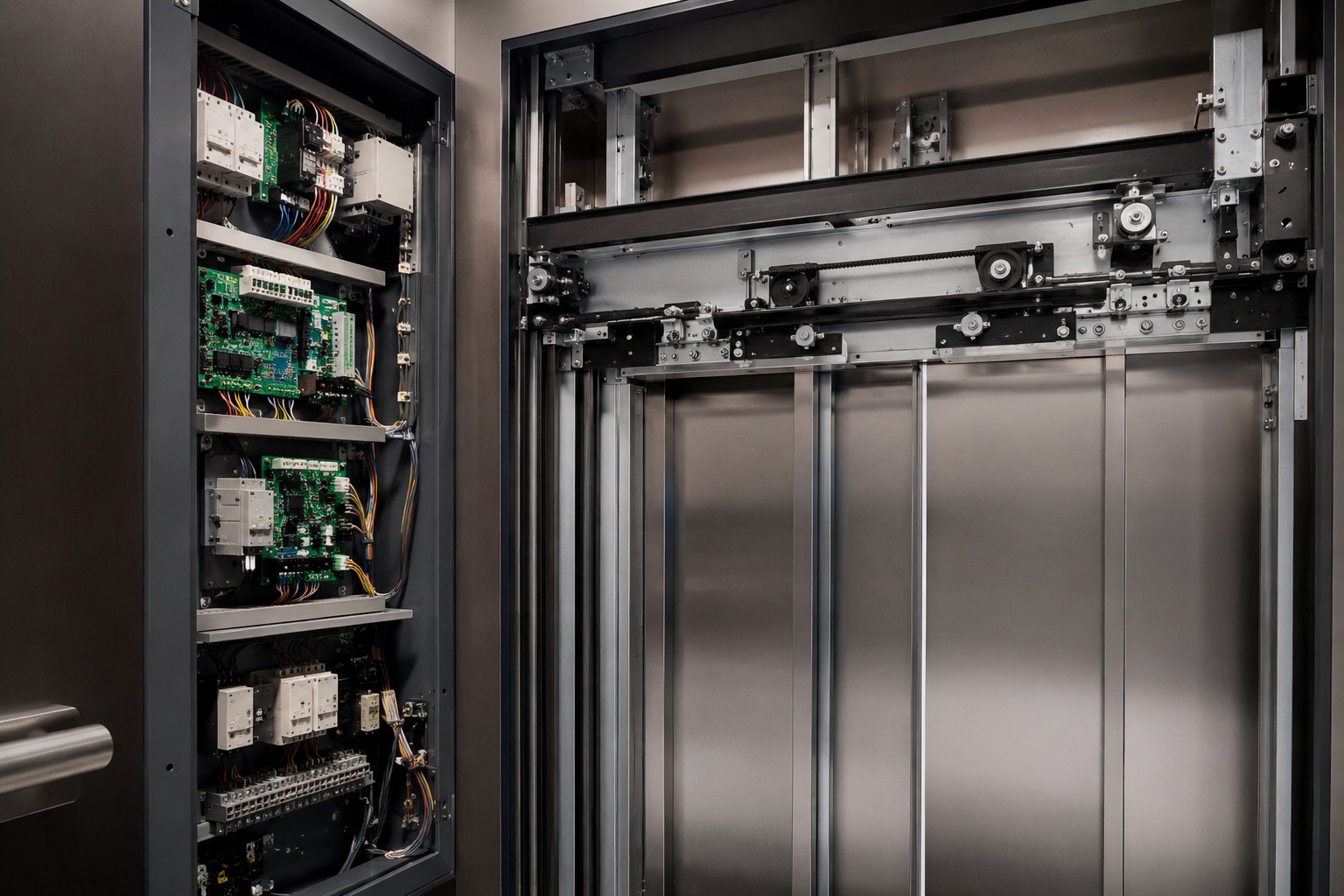
Elevator door control panels are the decision center of the door operator. They receive commands from the main controller, process signals from locks, encoders, limit switches, and light curtains, then regulate the motor so doors open and close smoothly, safely, and at the correct speed. In practical field service across the United States, most recurring door issues are not caused by the panel alone. They usually involve the interaction of the control board, motor, mechanical drag, door clutch, rollers, hanger alignment, lock circuit, and safety devices. A correct repair plan therefore starts with diagnosis, not blind replacement.
For maintenance companies in New York, Chicago, Los Angeles, Houston, Miami, Seattle, and other high-traffic building markets, elevator door performance directly affects callbacks, passenger complaints, and downtime costs. Door faults are among the most common service events in commercial offices, hotels, hospitals, residential towers, airports, and logistics buildings. Whether you are replacing a Toshiba board, adjusting door speed and torque, validating a light curtain circuit, or commissioning a door operator after modernization, a structured method reduces risk and shortens outages.
This guide explains what elevator door control panels do, how to approach Toshiba door control panel replacement, how to set door speed and torque, how to verify light curtain and lock signals, how to diagnose common faults, and what to inspect after installation. It also covers product types, buying advice, industry applications, local sourcing considerations, and 2026 trends in elevator door systems for the United States market.
How elevator door control panels coordinate motor sensors and safety devices
A door control panel acts as the interface between electrical commands and physical door movement. When the elevator receives an open or close command, the panel drives the door motor with a programmed speed profile. During movement, it monitors motor current, encoder feedback, door zone timing, lock input, nudging logic, and obstruction detection. If any condition falls outside the expected range, the panel can slow the door, reopen it, trigger a fault code, or inhibit the run command.
In a typical operator system, the board works with several components at once: the motor, an encoder or position sensor, the car door clutch, landing door locks, a light curtain, mechanical limits, and the main elevator controller. In modern systems, the board may also manage learning routines for travel distance and motor parameters. This is why replacing a control panel without checking the rest of the operator often leads to repeat failures.
Field technicians generally see five core functions from the door control panel:
- Door motion control through open, close, nudge, and hold commands
- Motor protection through current limiting, thermal logic, and overload detection
- Safety confirmation through lock, light curtain, and interlock signal monitoring
- Fault reporting through LEDs, error codes, or serial communication to the controller
- Adaptive tuning through speed, torque, learning cycles, and obstruction sensitivity
For high-use buildings near major trade and service hubs such as the Port of Los Angeles, Port of Long Beach, Port of Houston, Newark, and Savannah, door systems accumulate significant operating cycles. Traffic intensity makes stable board performance important, but so does clean installation practice. Vibration, dust, heat, moisture, and poor grounding can all affect a control panel over time.
| Function | What the Panel Monitors | Why It Matters | Typical Failure Symptom | Common Service Action | Risk if Ignored |
|---|---|---|---|---|---|
| Open/close motion | Command input and motor output | Controls smooth travel | Door stalls or jerks | Check output stage and motor load | Passenger complaints |
| Lock circuit | Door lock status | Prevents unsafe movement | Door closes but no run | Verify lock signal continuity | Car unavailable |
| Obstruction detection | Current rise or sensor input | Protects passengers | Repeated reopen cycles | Adjust sensitivity and inspect drag | Nuisance callbacks |
| Encoder feedback | Position and speed feedback | Supports accurate control | Overspeed or mis-timing | Check encoder wiring and pulse quality | Board faults |
| Light curtain | Beam interruption input | Stops closure on obstruction | Door will not close | Clean, align, or replace sensor | Service disruption |
| Thermal/load protection | Motor current and temperature logic | Protects motor and board | Trips after several cycles | Inspect torque settings and mechanical resistance | Component damage |
The table above shows why the board should be viewed as part of a full door operator system rather than a single isolated spare part. Correct repair depends on understanding which input or load condition is driving the fault.
What elevator door control panels do
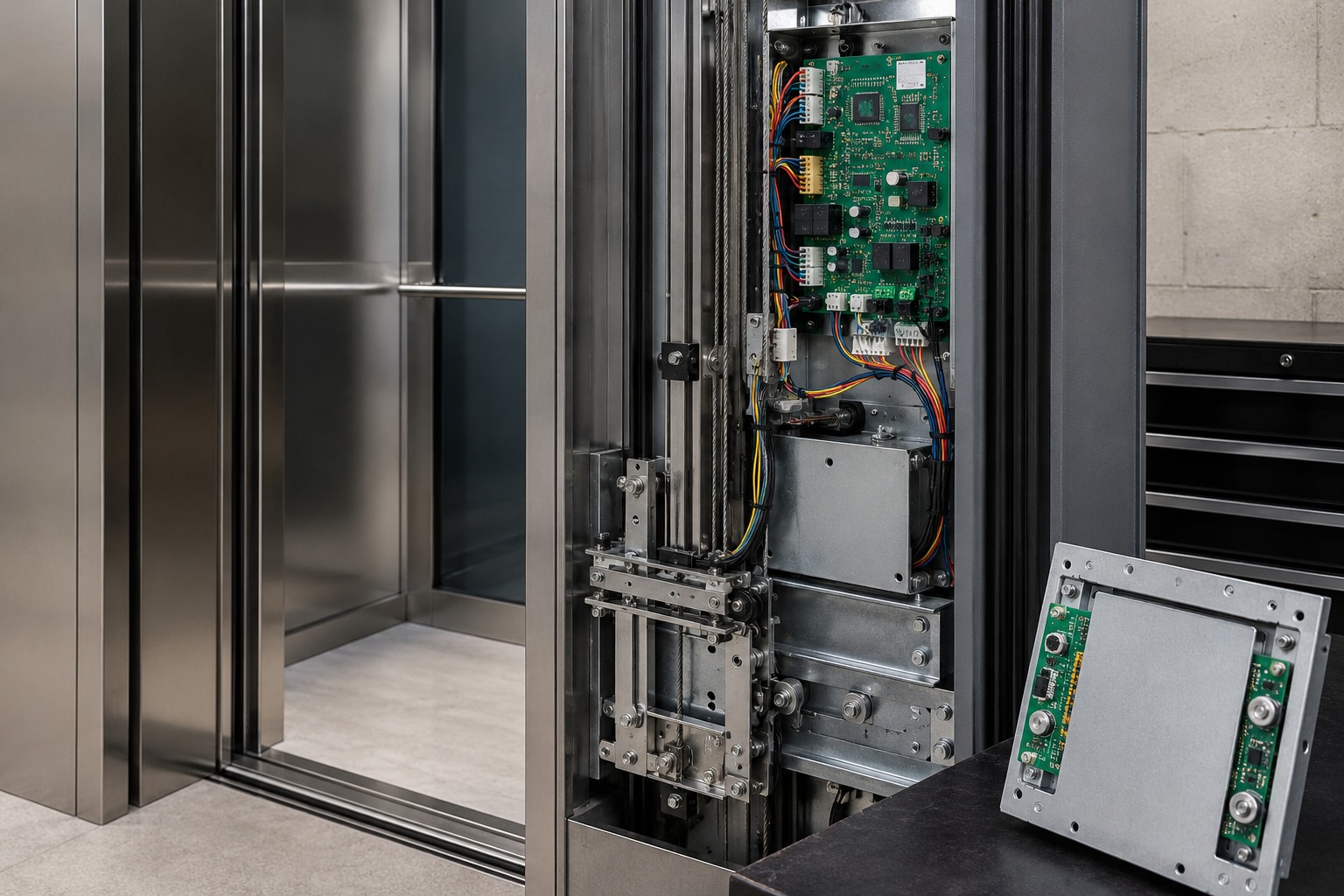
In direct terms, elevator door control panels control when the doors move, how fast they move, how much force they apply, when they stop, and whether the system is safe enough to let the elevator continue service. They also store adjustable parameters that affect comfort and code-compliant operation.
On older operators, the panel may be relatively simple and rely on fixed analog adjustments. On newer systems, the board often includes microprocessor logic, stored fault history, learned travel profiles, and communication with the main controller. Some panels are highly brand-specific, while others can be adapted to specific operator assemblies if the motor type, encoder, and signal logic match exactly.
In the United States market, customers typically look for the following outcomes from a replacement board:
- Compatibility with the exact elevator brand and operator model
- Stable door opening and closing in high-cycle environments
- Reliable response to safety devices and lock inputs
- Reduced nuisance faults and fewer repeated service calls
- Protective packaging and accurate model matching for shipment
When sourcing a replacement, technicians often need photographs of the original board label, connector orientation, software or version code, and associated motor data. For branded parts, exact model matching matters because a board with similar appearance may use different firmware, parameter ranges, or connector functions.
If you are reviewing replacement options for Toshiba equipment, a dedicated Toshiba elevator door control panel page can help identify board style and application range before ordering. That is especially useful for modernization contractors and distributors who manage multiple buildings at once.
Toshiba door control panel replacement notes
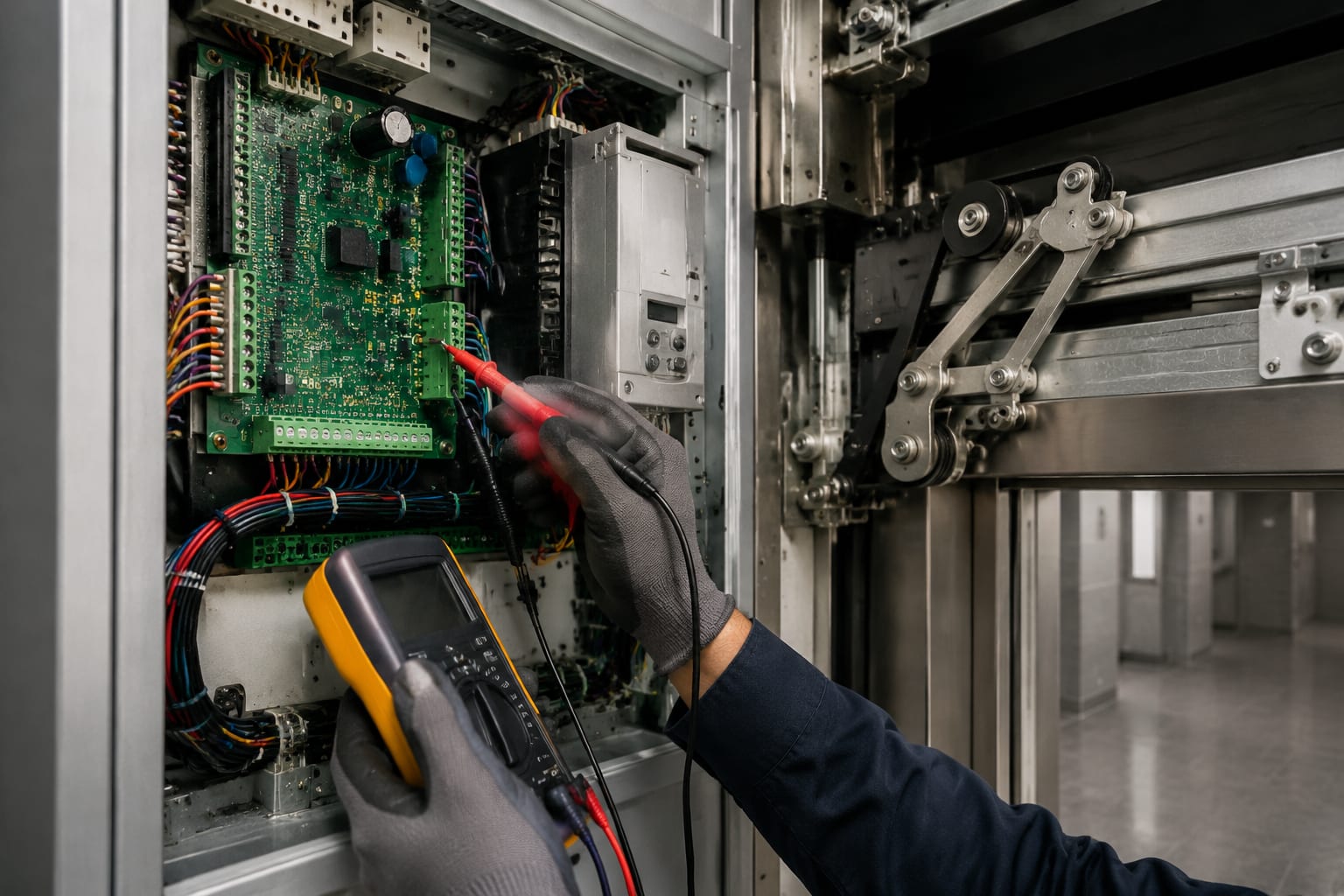
Toshiba door systems are known for model-specific configurations, so replacement work should begin with nameplate confirmation and wiring documentation. A board that physically fits may still be unsuitable if the firmware version, motor feedback type, or input logic differs from the original setup. During replacement, technicians should record all dip switch positions, parameter values, connector numbers, wire colors, error codes, and any visible grounding or shielding details before removing the old board.
Best practice for Toshiba board replacement includes these steps:
- Lock out and tag out the equipment according to site procedure.
- Confirm the exact board part number, revision, and related operator model.
- Photograph all connectors before removal.
- Inspect the cabinet for heat marks, moisture, loose terminals, and contamination.
- Check the motor, encoder, light curtain, lock circuit, and door mechanics before installing the new panel.
- Transfer parameters only after confirming compatibility.
- Run a commissioning cycle and verify error-free operation under repeated use.
Many field failures blamed on a Toshiba door board are actually secondary effects caused by a dragging door leaf, failing encoder, weak power supply, or intermittent lock input. Replacing the board alone may temporarily change the symptom, but not solve the root cause. On higher-rise sites in Manhattan, downtown Chicago, or high-density residential towers in Miami, repeated callbacks from unresolved door faults can quickly exceed the cost of proper diagnosis.
| Replacement Checkpoint | What to Confirm | Tool Needed | Common Oversight | Result of Oversight | Recommended Action |
|---|---|---|---|---|---|
| Part number | Exact Toshiba model and revision | Photo and label check | Matching by appearance only | Startup failure | Verify full code string |
| Connector layout | Pin position and terminal naming | Wiring diagram | Reversed plug placement | Input/output error | Mark connectors before removal |
| Power input | Correct voltage and polarity | Multimeter | Ignoring unstable supply | Board damage or resets | Measure under load |
| Encoder type | Pulse feedback compatibility | Manual and inspection | Assuming same encoder family | Erratic speed control | Cross-check motor data |
| Parameter transfer | Speed, torque, learn values | Service tool or keypad | Using old values blindly | Poor door behavior | Review one by one |
| Mechanical condition | Rollers, track, clutch, hanger | Visual and hand test | Skipping mechanical inspection | Overcurrent and faults | Repair drag before power-up |
The table above matters because successful board replacement depends on electrical matching and mechanical readiness at the same time. When both are confirmed, commissioning is faster and more predictable.
Door speed and torque settings
Door speed and torque settings determine how the operator behaves in real traffic conditions. Speed affects passenger comfort and cycle time. Torque affects how strongly the motor starts, accelerates, and overcomes resistance. If speed is too high, the door may slam, overshoot, or trigger faults. If torque is too low, the door may hesitate, stop midway, or fail to close under wind pressure or stack effect. If torque is too high, the board may mask mechanical drag while increasing wear on rollers, tracks, and locks.
Most technicians adjust speed and torque only after confirming that the door mechanics are free and aligned. A bad mechanical system should never be corrected with excessive torque. The right sequence is: inspect mechanics, verify signals, install or repair the board, then tune motion.
Typical adjustable items may include:
- Open speed
- Close speed
- Start torque
- Hold torque
- Nudging speed
- Reopen response
- Acceleration and deceleration times
- Obstacle sensitivity
Where motor replacement is involved, technicians should also validate compatibility between the board and the door motor. In some cases, a permanent magnet synchronous door motor replacement requires fresh parameter review rather than simple board reuse, especially if encoder characteristics or current behavior differ.
| Setting | Purpose | If Set Too Low | If Set Too High | Field Clue | Tuning Advice |
|---|---|---|---|---|---|
| Open speed | Controls opening time | Slow service response | Harsh stop or vibration | Passengers notice abrupt motion | Increase gradually and test 10 cycles |
| Close speed | Controls closing efficiency | Long dwell and delays | Aggressive closure | Frequent reopen events | Balance speed with sensor response |
| Start torque | Overcomes initial inertia | Door hesitates at start | Mechanical shock | Jerky first movement | Set only high enough for smooth start |
| Running torque | Maintains movement | Stall during travel | Current too high | Board runs hot | Correct drag before raising value |
| Nudging speed | Low-speed forced closing | Excess delay during recovery | Uncomfortable closure feel | Noise at final close | Follow site safety requirements |
| Obstacle sensitivity | Responds to resistance | Late reversal | Too many nuisance reversals | Repeated reopen without obstruction | Test with normal traffic conditions |
The practical lesson from this table is simple: stable settings are achieved by balancing performance and protection, not by maximizing force or speed.
Light curtain and lock signal checks
Two of the most important safety-related inputs to a door control panel are the light curtain and the lock circuit. A faulty light curtain can prevent closing, create random reopening, or stop the car from returning to normal service. A bad lock signal can leave doors apparently closed while the controller still refuses to run the elevator.
Light curtain checks should include physical alignment, lens cleanliness, cable condition, connector tightness, supply voltage, and input state at the board. In dusty warehouses, coastal properties, hospitals with frequent cleaning, or buildings with heavy cart traffic, sensor contamination and impact damage are common. If replacement is needed, a compatible elevator light curtain should match beam arrangement, mounting, and electrical characteristics.
Lock signal checks should begin mechanically. Confirm that the landing doors align, that the clutch engages correctly, and that the lock closes positively. Electrically, verify continuity, terminal condition, and input voltage at the control board. Intermittent lock signals may appear only during vibration or just before full close, so repeated cycle testing is important.
| Item to Check | Normal Condition | Abnormal Sign | Likely Cause | How to Test | Corrective Action |
|---|---|---|---|---|---|
| Light curtain alignment | Stable beam path | Door reopens randomly | Misalignment or bracket shift | Observe input during movement | Realign and secure mounting |
| Light curtain lens | Clean and clear | False obstruction | Dust or film buildup | Visual inspection | Clean with approved method |
| Sensor cable | No cuts or pinch points | Intermittent faults | Door travel cable wear | Wiggle test and continuity check | Repair or replace cable |
| Lock contact | Positive closure | No run after close | Worn or drifting lock | Continuity and mechanical observation | Adjust or replace lock parts |
| Board input terminal | Stable signal state | Input flicker | Loose terminal or poor grounding | Meter and terminal torque check | Reterminate and tighten |
| Clutch engagement | Consistent pick-up and release | Incomplete landing door close | Mechanical misadjustment | Cycle with car top observation | Adjust clutch and door clearances |
This table shows why electrical checks should always be paired with mechanical observation. A stable input signal depends on stable physical engagement.
Fault diagnosis workflow
The fastest way to diagnose a door operator problem is to follow a repeatable workflow. Random part swapping increases downtime and can introduce new faults. A good workflow moves from the simplest and highest-probability checks toward board-level conclusions.
A practical workflow for United States field service teams is:
- Confirm the complaint: no open, no close, reopens, no lock, noisy motion, or intermittent fault.
- Review fault history on the controller and door board if available.
- Inspect the door path for drag, contamination, broken rollers, hanger wear, and clutch issues.
- Check supply voltage, fuses, grounding, and terminal tightness.
- Validate light curtain, lock, limit, and encoder inputs.
- Run the door manually if safe and permitted to assess mechanical resistance.
- Compare actual motor current behavior to expected operation.
- Only then decide whether the board is defective or the issue is elsewhere.
Common symptoms and likely causes often overlap. For example, a door that closes halfway and reopens could be caused by a dirty light curtain, over-sensitive obstruction logic, high track resistance, or incorrect torque tuning. A door that fully closes but gives no ready signal could be caused by lock drift, connector oxidation, or board input failure. The discipline is to verify each layer in order.
| Observed Symptom | First Check | Second Check | Third Check | Likely Root Cause | Repair Priority |
|---|---|---|---|---|---|
| Door does not open | Command input | Power supply | Motor output | Board output or motor issue | High |
| Door does not close | Light curtain input | Close command | Mechanical obstruction | Sensor fault or drag | High |
| Door reopens repeatedly | Light curtain | Obstacle sensitivity | Track resistance | False obstruction detection | Medium |
| No run after close | Lock signal | Clutch alignment | Input terminal | Interlock circuit issue | Critical |
| Jerky movement | Rollers and hanger | Encoder feedback | Torque settings | Mechanical wear or tuning error | Medium |
| Board trips hot | Motor current | Door drag | Ventilation | Overload or poor cooling | High |
The explanation behind this table is that symptom-based triage saves time, but the final decision should still be based on measured evidence. That is the difference between a temporary fix and a reliable repair.
The line chart above reflects a realistic upward demand pattern driven by aging installed equipment, modernization cycles, and the need to reduce downtime in high-traffic properties across the United States.
Commissioning after replacement
Once a door control panel has been replaced, commissioning is the step that turns installation into reliable service. This is where parameters, motor response, safety inputs, and repeated-cycle performance are validated. Skipping commissioning is one of the main reasons new boards generate callbacks.
A strong commissioning routine includes:
- Power-up inspection for smoke, unusual heat, or immediate fault indication
- Verification of all inputs before commanding door movement
- Parameter confirmation for speed, torque, direction, and logic type
- Learning run or calibration sequence if required by the operator design
- At least 20 to 50 door cycles under observation
- Testing of obstruction response and light curtain function
- Verification that full close produces a stable lock signal and normal car operation
- Final check for connector security after vibration from repeated operation
In modernization projects from Boston to Dallas to San Francisco, commissioning should also account for traffic patterns. A hospital door operator may need conservative tuning for beds and carts. A luxury residential tower may prioritize smoothness and low noise. A freight-oriented service elevator may need stronger torque reserves but still within safe operating limits.
Document all final parameters, observed current behavior, and fault history reset status. That record helps future service teams compare later changes and spot drifting components before failure occurs.
The bar chart highlights where elevator door operator demand is strongest. Hospitals, office towers, and high-rise residences usually create the highest service frequency because of traffic intensity and uptime expectations.
Maintenance tips for door operators
Preventive maintenance remains the lowest-cost way to avoid unplanned door faults. A good door operator can still fail early if the track is dirty, the rollers are worn, the clutch drifts, or the board is exposed to heat and loose terminals. Maintenance should therefore combine cleaning, mechanical adjustment, and electrical validation.
Recommended routine maintenance actions include:
- Clean tracks, sills, and sensor surfaces
- Inspect rollers, hangers, gibs, and clutch wear points
- Check terminal tightness and signs of oxidation
- Measure supply voltage stability
- Verify the light curtain and lock input operation
- Listen for changes in motor noise or door impact at end travel
- Review fault codes even if the elevator is currently operating
- Replace worn components before they create overload on the board
From a technology standpoint, reliable parts sourcing matters as much as field labor. Our technological capabilities focus on careful model matching for boards, motors, sensors, and operator accessories so the replacement part aligns with the installed system rather than just the brand name. Our manufacturing capabilities emphasize stable quality inspection, connector protection, and shipment-ready packaging to reduce transit damage for customers receiving parts in inland cities and coastal logistics corridors alike. Our service capabilities center on responsive support, application confirmation, and practical assistance for maintenance providers, distributors, building owners, and modernization contractors who need to reduce downtime.
For local buyers in the United States, nearby inventory is useful, but availability alone should not drive the decision. The better supplier is the one that can confirm compatibility, inspect quality, package parts securely for shipment to places like Atlanta, Phoenix, Denver, or Portland, and respond quickly when a site needs verification before installation.
The area chart shows the trend toward smarter diagnostics, more sensor integration, and more data-driven maintenance. By 2026, this trend is expected to grow further as building owners prioritize uptime, service transparency, and modernization efficiency.
FAQ about elevator door control panels
What is the main job of an elevator door control panel?
It controls door motion, monitors safety devices, manages motor behavior, and sends or receives status signals required for normal elevator operation.
How do I know if the board is bad?
Do not assume immediately. First verify power supply, wiring, motor load, lock input, light curtain input, and mechanical drag. A confirmed bad board usually shows failed outputs, unstable logic, burn marks, or repeat faults after external causes have been ruled out.
Can I replace a Toshiba door control panel with a similar-looking board?
Not safely. Toshiba applications often depend on exact part number, revision, firmware, connector mapping, and parameter compatibility. Visual similarity is not enough.
Why does the door reopen even when nothing is in the way?
Common reasons include dirty or misaligned light curtains, excessive obstacle sensitivity, track resistance, clutch drag, or unstable input wiring.
Should I increase torque to solve a weak-closing door?
Only after checking the mechanics. If the door has drag or a lock alignment problem, increasing torque may hide the real issue while increasing wear and current.
How many test cycles are recommended after replacement?
A practical field target is 20 to 50 cycles with observation of open, close, reversal, lock confirmation, and normal return to service.
What industries need reliable door operator repair parts most urgently?
Hospitals, office buildings, airports, hotels, residential high-rises, and transit-connected properties usually place the highest value on fast and accurate parts replacement.
What should buyers ask a supplier before ordering?
Ask about exact model matching, board revision confirmation, condition, test process, packaging, lead time, and support for related components such as motors, locks, sensors, and light curtains.
The comparison chart summarizes the capabilities buyers should compare when selecting a door panel supplier. Strong support is not just about stock; it is about accuracy, quality control, and dependable service before and after shipment.
United States market, product types, buying advice, and 2026 outlook
The United States elevator parts market continues to be shaped by modernization demand, aging installed equipment, and higher expectations for uptime. Cities with dense elevator populations such as New York City, Los Angeles, Chicago, Houston, Philadelphia, Washington, and San Diego all generate regular demand for door boards, motors, locks, and sensors. Coastal gateways and large inland logistics markets also influence availability because imported parts often move through Los Angeles, Long Beach, Houston, Savannah, Newark, and rail-linked distribution centers before reaching local service teams.
Common product types in this segment include brand-specific door control boards, universal or semi-compatible operator modules, PM motors, DC motors, encoders, lock assemblies, clutch parts, light curtains, guide shoes, sensors, and power supplies. Buyers should think in system terms. If the board has failed due to overload, it may be wise to inspect or replace the associated motor, encoder, or safety sensors at the same time to avoid a second outage.
For purchasing, four rules matter most:
- Match the exact part number and revision whenever possible.
- Provide clear photos of labels and connectors if the original documentation is incomplete.
- Ask whether the board has been checked for appearance, terminals, and packaging condition.
- Plan for commissioning labor, not just part delivery.
In terms of applications, door control panels serve office towers, mixed-use developments, schools, hospitals, hotels, apartment buildings, parking structures, airports, stations, and industrial service lifts. A single failure can block traffic and frustrate tenants, patients, or visitors, which is why building owners increasingly focus on compatible replacement parts and preventive maintenance.
Case experience across the United States often follows a familiar pattern. A downtown office tower experiences repeat reopen faults during peak traffic. The site suspects the board, but inspection finds a combination of dirty light curtain lenses and rising hanger resistance. After cleaning, roller replacement, and moderate sensitivity adjustment, the original board remains serviceable. In another case, a residential building near the coast suffers intermittent no-run conditions after close. Corrosion at terminals and drifting lock alignment are found, and a replacement board is installed only after the lock circuit is stabilized. These examples show that successful repair depends on diagnosis discipline.
Looking toward 2026, three trends are especially relevant. First, technology will continue moving toward smarter diagnostics, better fault logging, and more precise motor control. Second, policy and building management practices will increasingly emphasize safety documentation, traceable maintenance, and reduced downtime. Third, sustainability will matter more in modernization decisions, favoring parts that extend equipment life, reduce unnecessary replacement, and improve energy efficiency through smoother motor control and lower mechanical stress.
For companies that manage local supply decisions, the most reliable partners will be those that combine technical understanding with disciplined sourcing. That means confirming compatibility for branded elevator systems, maintaining stable quality inspection standards, using protective packaging for sensitive boards and sensors, and responding quickly when technicians need guidance. In a market where time on site is expensive and callbacks hurt service reputation, that combination creates measurable value.