
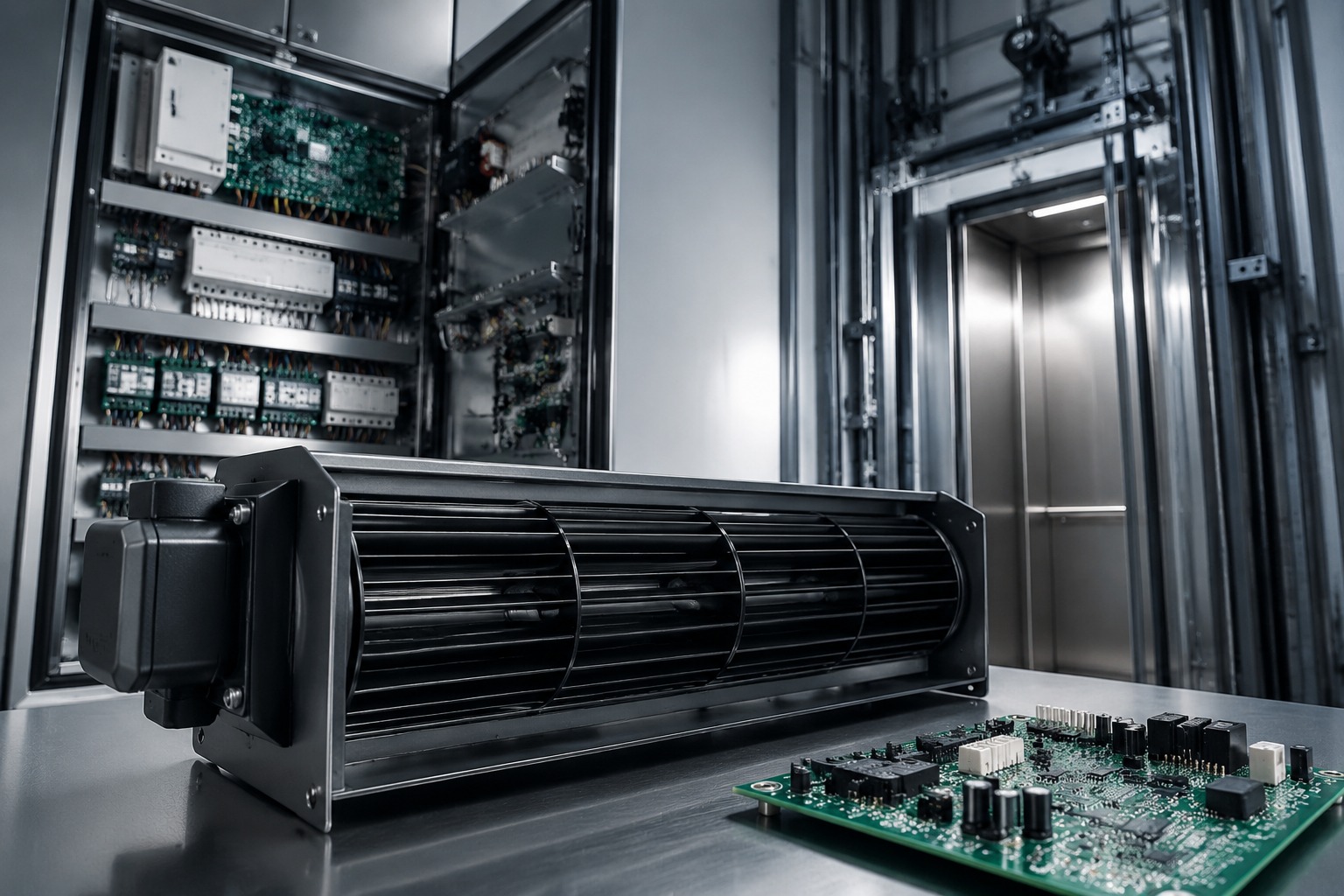
In the United States, elevator fans are not small accessories with minor importance. They directly affect passenger comfort in the car, heat management inside the controller or inverter cabinet, and the long-term reliability of electronic parts. The short answer is simple: cross flow fans are often preferred when wide, even air distribution is needed across a cabin panel or cabinet opening, while axial fans are commonly used when straightforward spot cooling, compact installation, and low-cost replacement are the main priorities. Choosing the right fan means matching voltage, dimensions, mounting style, airflow, operating temperature, noise level, and site conditions such as dust, vibration, and maintenance access.
For building owners, elevator maintenance firms, modernization contractors, and distributors in markets such as New York City, Chicago, Los Angeles, Houston, Miami, Seattle, and Atlanta, fan selection has become more important as cabs add larger displays, tighter ceiling designs, LED lighting, and more electronic control hardware. Modern elevator systems often operate in mixed conditions: air-conditioned office towers, humid coastal hotels near Miami and Long Beach, cold northern high-rises near Boston, and industrial facilities around Dallas or Detroit. Each environment changes how an elevator cabin fan or inverter cabinet fan should be chosen and maintained.
This guide explains practical selection steps, replacement notes, inspection points, and maintenance intervals for elevator cross flow fans, axial flow fans, and cabinet cooling fans. If you are sourcing replacements, you can review options for elevator cross flow fan assemblies in passenger cars, compare compact cross flow fan models for lift ventilation, evaluate axial flow elevator fan replacements, or check inverter control cabinet fan solutions for controller cooling.
Across the United States market, fan demand is shaped by modernization projects, energy-conscious retrofits, aging inventory in commercial buildings, and the need to reduce elevator downtime. Ports and distribution hubs such as Los Angeles, Savannah, Newark, and Houston also influence delivery timing for imported and replacement parts, which matters when a failed fan threatens service continuity in residential towers, hospitals, airports, or transit facilities.
Common Elevator Applications for Cross Flow Fans
Cross flow fans are used in elevators when designers need broad and uniform airflow rather than a narrow stream. In a passenger cab, the fan may be integrated into the ceiling or upper panel area to move air across a longer outlet slot. This creates a more even comfort zone for riders and reduces the “hot spot” effect that can happen with basic point-source ventilation. In cabinet cooling, cross flow fans can also be used where the airflow needs to cover a line of heat-generating components rather than a single concentrated area.
Typical elevator locations for cross flow fans include passenger cabin ceiling modules, decorative ceiling plenums, COP-adjacent upper air channels, return-air arrangements in premium interiors, and some controller or inverter compartments where a slim fan format is useful. These fans are especially valuable in modernization work where the installer must fit ventilation into limited space without redesigning the entire ceiling layout.
In the United States, cross flow fans are often chosen for mid-rise and high-rise office towers, hotels, hospitals, university buildings, and premium residential properties. In cities with hotter summers such as Phoenix, Las Vegas, Austin, and Orlando, a wide and gentle airflow pattern can noticeably improve passenger perception, especially during peak traffic. In coastal areas such as Tampa or San Diego, stable internal airflow can also help reduce localized moisture buildup around electronic displays and lighting assemblies inside the cab.
| Elevator Location | Typical Fan Type | Main Purpose | Why Cross Flow Works | Common Site Type | Replacement Priority |
|---|---|---|---|---|---|
| Passenger cabin ceiling | Cross flow | Passenger comfort ventilation | Even airflow across the cabin width | Office towers | High |
| Decorative ceiling plenum | Cross flow | Hidden air delivery | Long slim profile fits narrow spaces | Hotels | High |
| COP upper panel air path | Cross flow | Air circulation near electronics | Distributed flow prevents hot spots | Modernized cabs | Medium |
| Controller side vent | Cross flow or axial | Component cooling | Useful when heat sources are spread out | Machine rooms | High |
| Inverter cabinet opening | Cross flow in limited spaces | Drive cooling | Can sweep air across multiple boards | Retrofit sites | High |
| Special narrow bulkhead spaces | Cross flow | Compact ventilation routing | Shallow height and wide discharge | Custom interiors | Medium |
The table above shows that cross flow fans are selected less by brand preference and more by airflow geometry. If the goal is to move air evenly across a broad opening, cross flow designs are often the better match.
Cross Flow Fans Compared with Axial Fans
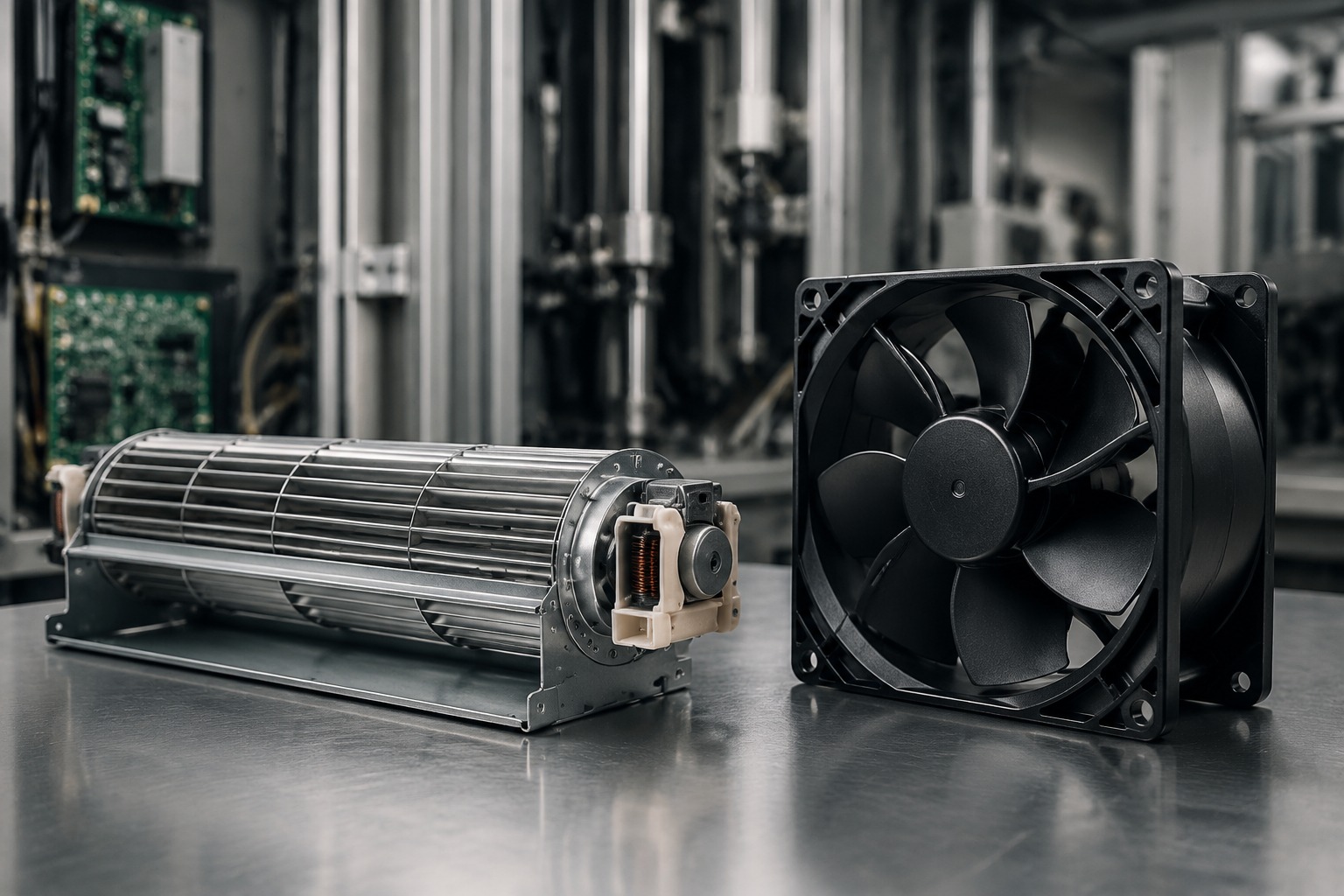
The main difference between cross flow fans and axial fans is how they move air. A cross flow fan pulls air across a long cylindrical impeller and discharges it in a wide curtain-like stream. An axial fan pushes air straight through the fan body, similar to a conventional propeller fan. That difference changes performance, installation options, noise behavior, and cost.
Axial fans are common in elevator cabinet cooling because they are simple, widely available, and easy to replace when voltage and frame size match. Cross flow fans are more specialized and often better for cabin comfort where air needs to feel balanced rather than forceful. Axial fans can offer higher localized airflow for the size, but they may create more obvious directional drafts if used in a passenger cabin without proper ducting.
From a modernization standpoint in the United States, axial fans are often chosen where standardization matters across a service fleet. Cross flow fans are more common where aesthetics and airflow distribution matter, such as premium apartment towers in Manhattan, hospitality projects in Las Vegas, or upgraded office buildings in San Francisco.
| Feature | Cross Flow Fan | Axial Fan | Best Use Case | Main Advantage | Main Limitation |
|---|---|---|---|---|---|
| Air pattern | Wide and even | Direct and concentrated | Cab comfort vs cabinet spot cooling | Better distribution | Less common stock |
| Shape | Long and slim | Round or square compact frame | Narrow ceiling channels | Fits linear spaces | Model matching needed |
| Noise character | Smoother perceived airflow | Can be more direct | Quiet passenger cabins | Comfortable sound profile | Depends on mounting |
| Installation | Often custom bracketed | Usually straightforward | Retrofits and service calls | Axial is easier to swap | Cross flow needs closer fit check |
| Cooling coverage | Broad component coverage | Focused cooling path | Spread heat loads | Cross flow covers more width | Lower static pressure in some cases |
| Cost and sourcing | Can be more specialized | Usually more standardized | Fast replacement needs | Axial availability | May not match comfort goals |
The comparison above helps explain why both types remain important. In practice, the best choice depends on the original equipment design, the available mounting envelope, and whether the fan is cooling people, electronics, or both.
Selecting the Right Voltage, Dimensions, and Airflow
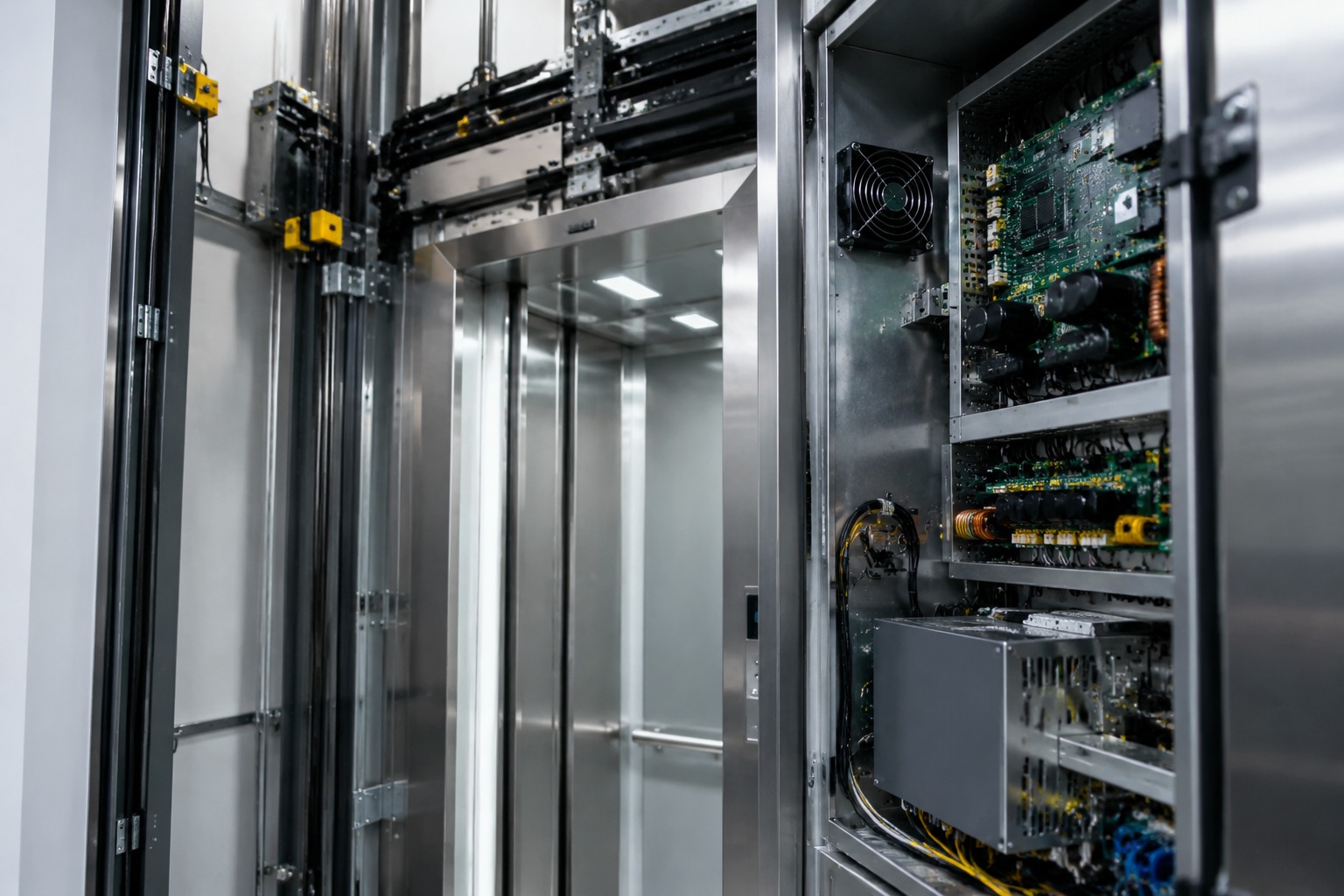
Correct fan selection starts with the nameplate and ends with the operating environment. Never choose only by appearance. A fan that looks similar but has the wrong voltage, frequency, depth, airflow, connector type, or rotation direction can lead to weak cooling, nuisance shutdowns, or premature failure.
For elevator applications in the United States, the most common checks include AC or DC supply, rated voltage, frequency if AC powered, fan length or frame size, mounting hole spacing, outlet orientation, airflow rating, current draw, insulation class, and expected ambient temperature. When replacing a cabin fan, also review how the ceiling panel, diffuser, grille, and lighting arrangement affect actual airflow felt by passengers.
Airflow should be selected according to the heat load and space volume. For cabin fans, comfort matters as much as raw CFM. For control cabinets, stable component temperature is the priority. A fan that is too small may allow overheating of inverters, braking resistors, power modules, and control boards. A fan that is too large may increase dust intake, noise, and unnecessary power use.
| Selection Item | What to Check | Why It Matters | Common Risk if Wrong | Typical U.S. Field Note | Decision Tip |
|---|---|---|---|---|---|
| Voltage | AC/DC and rated value | Electrical compatibility | No start or motor damage | Mixed legacy systems are common | Match exact nameplate first |
| Frequency | 50/60 Hz for AC fans | Speed and output | Low airflow or overheating | 60 Hz is standard in the U.S. | Confirm imported parts carefully |
| Fan size | Length, width, depth | Mechanical fit | Bracket interference | Modernized cabs often have tight clearances | Measure before ordering |
| Airflow | CFM or m3/h | Cooling performance | Weak ventilation | Cab comfort complaints rise in summer | Base on load and enclosure |
| Connector and wiring | Terminal, plug, lead length | Installation time and safety | Miswiring or loose connection | Site swaps must be fast | Photograph existing setup |
| Noise level | dB rating and vibration | Passenger experience | Customer complaints | Luxury properties are sensitive to sound | Check operating noise at installed speed |
As a practical buying rule, use original specifications whenever possible. If the original fan is obsolete, match the electrical rating first, then the geometry, then the airflow range, and finally the connector or bracket details. In modernization work, a careful cross-reference process reduces field returns and repeat service trips.
Demand for replacement fans has grown steadily with elevator modernization activity in U.S. metro areas, especially in aging commercial stock from the 1980s through the early 2000s.
Important Notes When Replacing Inverter Cabinet Fans
Inverter cabinet fan replacement deserves special attention because the cooling fan helps protect expensive electronic components. A failed cabinet fan may not produce an immediate shutdown, but repeated high temperatures can shorten the life of capacitors, power semiconductors, relays, and communication boards. In high-duty elevators found in hospitals, airports, distribution centers, and multifamily towers, cabinet heat is one of the most underestimated reliability risks.
Before replacement, isolate power according to site procedures and verify that the fan is actually the root cause. Sometimes the fan motor is fine, but airflow is blocked by dust mats, clogged filters, damaged louvers, or failed temperature control circuitry. Also inspect whether the old fan failed from age, bearing wear, supply instability, or contamination. If the root cause remains, even a new fan may fail early.
For inverter cabinets, airflow direction is critical. A fan installed backwards can recirculate hot air and create thermal pockets around the drive. Check arrows on the fan housing, cabinet intake and exhaust paths, filter orientation, and any ducted channels. In machine-room-less layouts, cramped spaces make this even more important because heat can accumulate faster.
| Replacement Checkpoint | What to Verify | Reason | Common Problem | Impact on Drive Life | Action |
|---|---|---|---|---|---|
| Airflow direction | Intake vs exhaust | Ensures proper heat removal | Backwards installation | High | Check housing arrow and cabinet path |
| Filter condition | Dust load and fit | Maintains airflow volume | Clogged filter | High | Replace filter with fan service |
| Voltage stability | Input supply quality | Protects fan motor | Undervoltage or spikes | Medium | Measure during operation |
| Mounting integrity | Screws, clips, bracket | Reduces vibration | Loose frame resonance | Medium | Retighten and use correct hardware |
| Heat source layout | Drive, resistor, boards | Confirms coverage | Dead zone near hot components | High | Review airflow path after install |
| Alarm history | Overtemp and fan fault logs | Supports root-cause analysis | Replacing wrong part | High | Read maintenance records first |
Many U.S. service teams now replace cabinet fans proactively during major modernization or control-board upgrades because the cost is small compared with an inverter failure. This is particularly sensible in climates with high ambient heat, such as Arizona, Nevada, Texas, and parts of inland California.
Checking Noise, Vibration, and Dust Conditions
Noise, vibration, and dust are often treated as secondary issues, but they are strong indicators of whether an elevator fan is correctly selected and correctly installed. A fan that hums, rattles, or transmits vibration into the cab ceiling frame can trigger passenger complaints even if airflow is acceptable. In control cabinets, excess vibration can loosen connectors or speed up bearing wear.
Noise checks should include startup sound, steady-state sound, and structure-borne noise transferred into sheet metal or decorative panels. Vibration checks should focus on cracked mounts, imbalanced impellers, worn bearings, and bent brackets. Dust checks should inspect both the fan itself and the larger air path. A clean impeller moving through a dirty filter still delivers poor cooling.
Buildings near highways, freight corridors, manufacturing zones, ports, or construction areas often see faster dust accumulation. That includes properties near Newark, Houston Ship Channel, the Port of Los Angeles, Chicago industrial belts, and logistics hubs around Memphis. In such locations, shorter inspection intervals are justified.
| Condition | Symptom | Likely Cause | Where Seen Often | Operational Risk | Recommended Response |
|---|---|---|---|---|---|
| Rattling noise | Intermittent metallic sound | Loose mount or grille | Cab ceilings | Medium | Retighten hardware and isolate vibration |
| Low hum with heat alarm | Fan runs but cooling is weak | Blocked filter or worn motor | Inverter cabinets | High | Measure airflow and replace filter |
| Grinding sound | Rough mechanical noise | Bearing failure | Older fans | High | Replace fan immediately |
| Dust cake on blades | Reduced output | Poor maintenance interval | Industrial buildings | High | Clean path and review site frequency |
| Panel vibration | Buzzing ceiling or cabinet skin | Resonance and poor damping | Retrofit installations | Medium | Add proper grommets or bracket support |
| Passenger comfort complaints | Cab feels stale or too drafty | Wrong airflow pattern | Residential and hospitality | Medium | Review fan type, vent design, and speed |
The chart below reflects how industry demand for elevator ventilation parts differs by building segment in the United States.
Installation and Wiring Best Practices
Good installation is the difference between a fan that lasts and a fan that becomes a callback. Before removing the old fan, document the existing arrangement with photos. Record wire colors, terminals, airflow direction, bracket position, spacer use, connector orientation, and any labels on the housing. This is especially important when servicing older imported systems or mixed-equipment modernization jobs where field modifications may not match factory drawings.
Use the correct mounting hardware and avoid overtightening plastic fan frames. If rubber isolation mounts or grommets were present, reuse or replace them as needed. Confirm that wires are routed away from moving parts, sharp edges, and heated components. In elevator cabins, make sure decorative trim, diffuser panels, and light covers do not obstruct the airflow path after reassembly.
From a wiring standpoint, verify polarity on DC fans and supply rating on AC fans. If a cabinet fan is temperature controlled, check the thermostat, thermal switch, or control-board output that commands fan operation. In some systems, technicians may think a replacement fan is defective when the real issue is a fan relay, fuse, or command signal. After installation, run the elevator under normal duty and observe startup, current draw if practical, vibration, and temperature response.
For projects in dense service markets such as New York, Northern New Jersey, Los Angeles County, or downtown Chicago, installation speed matters. But speed should not replace verification. One incorrect voltage match or airflow reversal can create repeat labor, tenant complaints, or equipment stress.
Recommended Maintenance Schedule for Elevator Fans
An elevator fan maintenance schedule should be based on traffic level, environment, and criticality. A lightly used residential building in a clean suburban area does not need the same interval as a hospital, warehouse, or coastal hotel. However, all elevator ventilation fans benefit from routine inspection because they are relatively low-cost parts protecting higher-value systems and public comfort.
A practical U.S. maintenance approach is to inspect fan operation during regular elevator visits, clean visible dust at scheduled intervals, replace filters where used, and proactively replace aging cabinet fans before they become a heat-related shutdown risk. Sites with high traffic, dust, salt exposure, or mechanical-room heat should use tighter intervals.
| Maintenance Interval | Cabin Fan Task | Cabinet Fan Task | Site Type | Main Goal | Notes |
|---|---|---|---|---|---|
| Monthly visual check | Listen for noise, verify airflow | Confirm fan operation and vent path | All buildings | Early fault detection | Include passenger complaint review |
| Quarterly cleaning | Clean grille and accessible dust | Clean intake area and louvers | Standard commercial | Restore airflow | Do not damage blades or wiring |
| Quarterly filter service | As applicable | Replace or clean cabinet filters | Dusty or urban sites | Protect electronics | Important near logistics corridors |
| Semiannual inspection | Check mounts and noise level | Check current draw and vibration | Hotels and residential towers | Prevent nuisance complaints | Useful before summer peaks |
| Annual performance review | Review comfort and airflow balance | Check cabinet temperature trend | Healthcare and office high-rises | Lifecycle planning | Compare with alarm history |
| 3-5 year proactive replacement | Depending on duty and condition | Strongly consider for inverters | High-duty sites | Reduce downtime risk | Shorter interval in harsh climates |
The schedule above is a guideline, not a fixed code requirement. Buildings in Phoenix, Las Vegas, Miami, New Orleans, or heavy industrial zones may need more frequent attention because heat, humidity, or particulate load accelerates wear.
The trend in the United States is moving from reactive replacement toward predictive maintenance, especially where elevators are monitored remotely and downtime carries high tenant or operational cost.
Frequently Asked Questions About Elevator Fans
What is the best fan type for an elevator cabin?
For a cabin, the best choice usually depends on the ceiling design and desired airflow feel. Cross flow fans are often preferred when broad, even ventilation is needed across a linear outlet. Axial fans may work if the design supports direct airflow without creating drafts.
Can I replace a cross flow fan with an axial fan?
Only after checking mechanical fit, airflow path, comfort impact, and electrical compatibility. Even if the motor voltage matches, the airflow pattern is different, and the result may be poor comfort or ineffective cooling.
How do I know if a cabinet fan is failing?
Typical signs include heat alarms, unusual fan noise, weak airflow, visible dust buildup, intermittent inverter faults, or a fan that starts slowly or stops unexpectedly.
Should I replace the filter when I replace the fan?
Yes, in most cabinet applications. A new fan working through a clogged filter still delivers poor cooling and may fail early from overload or heat stress.
What voltage should I order?
Always match the existing nameplate or the equipment manual. In the United States, 60 Hz supply is standard for AC fans, but imported elevator equipment may have model variations that require careful verification.
How important is noise rating?
Very important in passenger cabins, hotels, luxury residences, hospitals, and premium office buildings. The installed sound result also depends on brackets, panel resonance, and grille design, not just the fan spec alone.
How often should elevator fans be replaced?
There is no universal interval, but cabinet fans in high-duty sites are often replaced proactively within several years, while cabin fans may remain longer if clean, quiet, and properly ventilating.
Are elevator fan replacements usually brand-specific?
Some are highly model-specific, especially when brackets, connectors, or dimensions are unique. Others can be matched by specification. Accurate model identification reduces delays and field mismatch.
United States Market, Product Types, and Buying Advice
The United States elevator parts market values dependable model matching, fast logistics, and reduced downtime. Maintenance companies often need replacements on short notice for downtown commercial buildings, airport facilities, multifamily portfolios, and modernization jobs spread across several states. Product types generally fall into four groups: cabin cross flow fans, compact linear fans, axial ventilation fans, and inverter or control cabinet fans. The best purchasing decision depends on whether you are solving a passenger comfort issue, a thermal protection issue, or both.
When buying, start with exact equipment data. Confirm the elevator brand, fan model, dimensions, voltage, mounting details, and application location. Next, consider whether the building would benefit from stocking critical spares onsite. This is common in hospitals, large campuses, and transit-facing properties where downtime is costly. Finally, consider packaging quality and inspection discipline. Fans can be damaged by poor shipping protection, bent shafts, or crushed housings, particularly when moving through busy freight routes linked to Newark, Los Angeles, Houston, or Savannah.
From an applications perspective, elevator fans are used across commercial real estate, multifamily housing, healthcare, hospitality, education, public infrastructure, and industrial campuses. Case studies in the field often show the same lesson: a relatively inexpensive fan, when incorrectly selected or neglected, can contribute to expensive callbacks, passenger dissatisfaction, or drive overheating.
One common modernization example involves an aging office tower in Chicago where cab ceilings were upgraded with LED lighting and new finishes. The original axial arrangement created uneven airflow and audible noise at the front of the car. Switching to a properly matched cross flow fan improved airflow balance and reduced perceived draft. Another example is a residential high-rise in Miami where repeated inverter temperature alarms were traced not to the drive itself but to reduced airflow from a dust-loaded cabinet fan and clogged filter. Replacing both restored stable operation.
Our Technology, Production, and Service Approach
For elevator fan sourcing, buyers in the United States typically need more than a basic catalog listing. They need reliable identification, stable quality, and packaging that supports field-ready replacement. Our approach is built around three practical capabilities.
Technological capabilities: We support careful model matching for elevator spare parts across multiple major brands, including systems commonly seen in the U.S. modernization and maintenance market. That includes attention to fan dimensions, electrical ratings, connector details, and application differences between passenger cabins and inverter cabinets. This helps maintenance teams reduce mismatch risk when cross-referencing legacy parts, imported equipment, or discontinued models.
Manufacturing capabilities: We focus on stable sourcing and consistent quality inspection before shipment. For sensitive elevator accessories such as fans, boards, sensors, encoders, power supplies, and door operator components, inspection and protective packaging matter because field installation reliability starts long before the part reaches the jobsite. Proper handling helps prevent transit damage across long-distance logistics lanes serving markets such as Seattle, Dallas, New Jersey, and Southern California.
Service capabilities: We work with maintenance companies, distributors, building owners, and modernization contractors that need responsive support, clearer confirmation, and reduced downtime. In practical terms, that means helping customers verify compatibility, organize replacement purchasing more efficiently, and source a broad range of lift accessories beyond fans, including control boards, light curtains, guide shoes, intercom parts, buttons, COP panels, door locks, and other components that often move together during repair or upgrade cycles.
As 2026 approaches, elevator ventilation choices will increasingly be shaped by smarter maintenance practices, sustainability goals, and evolving building expectations. More sites are looking for energy-conscious fan motors, quieter operation in mixed-use buildings, better dust control in dense urban areas, and maintenance planning supported by remote diagnostics. Policy and ESG pressure are also pushing owners to extend equipment life rather than wait for major failure, which supports proactive cabinet cooling service. At the same time, electrification trends, denser electronic packaging, and modernization of older U.S. buildings will keep fan reliability a meaningful issue.
In short, the right elevator fan protects both comfort and equipment. Cross flow fans are often the better answer for wide, even air delivery in cabins or narrow linear spaces, while axial fans remain a strong choice for straightforward cabinet cooling and easy replacement. The best result comes from exact specification matching, attention to airflow direction, and regular maintenance tuned to the site environment.