
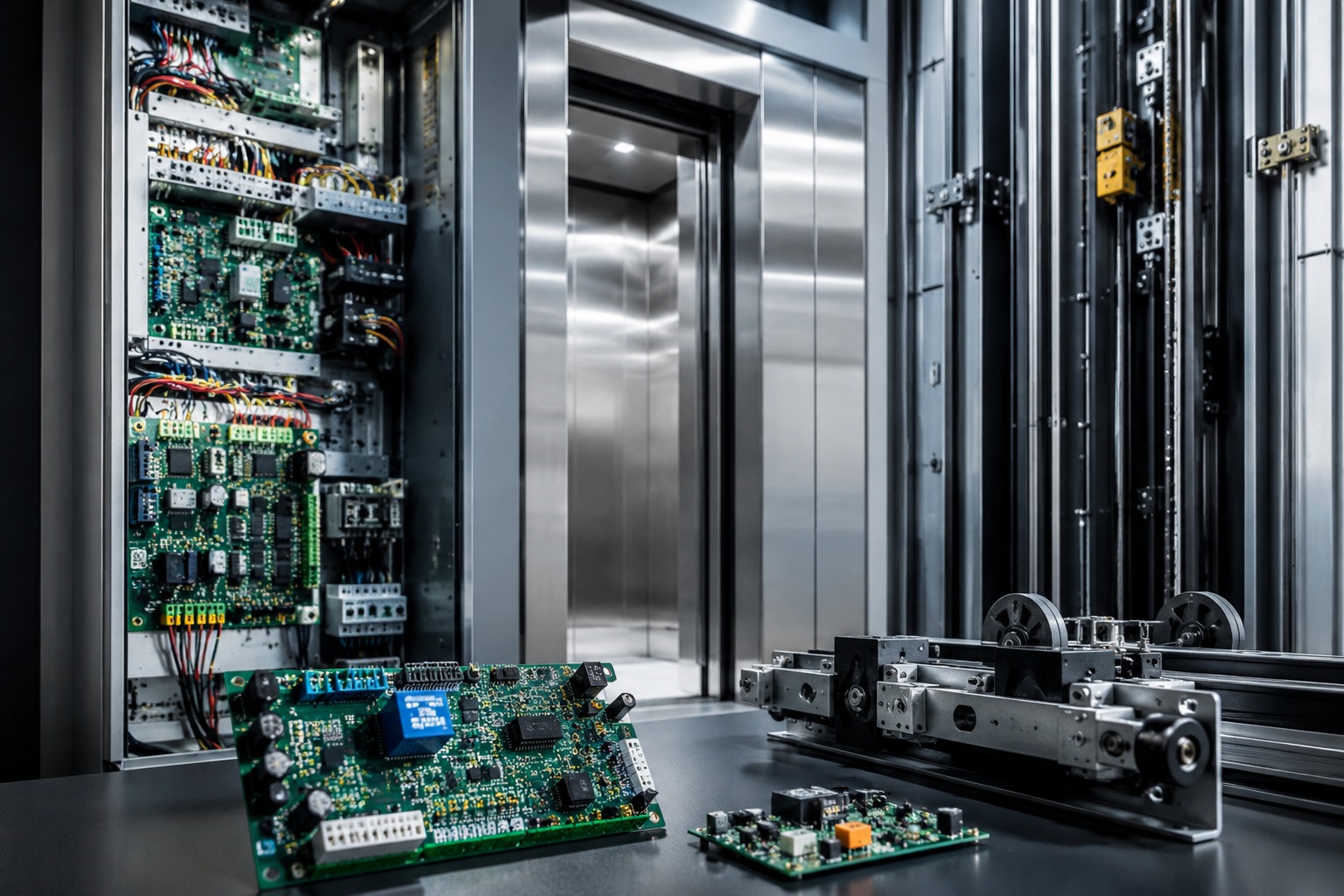
Elevator control boards have a direct effect on lift logic, ride quality, dispatch behavior, door timing, fault reporting, and overall service reliability. When a board begins to fail, the symptoms are often confusing: random shutdowns, intermittent door errors, loss of floor calls, leveling issues, communication alarms, or repeated resets that appear unrelated. In the United States, where maintenance teams support older high-rise equipment in New York and Chicago, heavy-use hospital and hotel elevators in Los Angeles and Miami, and modernization projects across Dallas, Houston, Atlanta, and Seattle, fast and accurate control board troubleshooting can significantly reduce downtime and avoid unnecessary part replacement.
For most buyers, the practical answer is simple: confirm the exact model and software compatibility, diagnose the fault path before replacing the board, choose a supplier that can verify part identity and handling quality, and complete structured commissioning after installation. Whether the requirement involves brand-new original boards, tested replacement units, or expansion boards for legacy systems, careful model matching matters more than a fast guess. A wrong board revision can create new logic faults even if the original failure looked solved.
The U.S. market for elevator electronics is shaped by three realities. First, many buildings operate mixed fleets that include older controllers alongside modernized systems. Second, freight timing matters because service companies often need parts moved quickly through hubs such as Newark, Long Beach, Savannah, and Houston. Third, building owners increasingly ask for documentation on quality inspection, electrostatic discharge protection, traceability, and commissioning records. These requirements are especially common in airports, healthcare facilities, data centers, office towers, universities, and public infrastructure projects.
Control boards in elevator systems can include main controller motherboards, drive interface boards, communication boards, I/O boards, car top boards, expansion boards, power interface boards, and door operator control boards. Different failure patterns point toward different board families. A car that cannot register hall calls may not need a main board at all; the real issue may be an expansion board, a communication fault, a connector problem, or a damaged power section. A disciplined troubleshooting process saves labor and prevents costly return visits.
Buyers in the United States usually compare four options: new original stock, new compatible replacements, professionally refurbished boards, and repair service for the failed board. The best choice depends on project urgency, code constraints, lifecycle goals, and the availability of exact firmware or revision levels. For example, a modernization contractor in Boston working under a tight opening schedule may prioritize a verified new board with quick shipping. A maintenance provider in Phoenix supporting a legacy building may prefer a carefully tested replacement for a discontinued platform. In both cases, the supplier’s technical screening and protective packaging standards are just as important as price.
Common application sectors include commercial high-rises, residential towers, hospitals, hotels, industrial plants, logistics centers, government buildings, campuses, and transit facilities. Each has different operating profiles. High-rise office buildings in Manhattan may experience intense traffic peaks and demand quick turnaround. Hospitals in Cleveland or San Diego require dependable leveling, door protection, and low downtime. Warehouses near inland logistics corridors may focus on freight lift durability and straightforward serviceability. Understanding the end use helps determine whether a board replacement should be paired with a power supply check, encoder inspection, communication cable review, or software parameter verification.
A typical real-world case involves an aging traction elevator in a mixed-use tower. The building reports random shutdowns during morning traffic. Initial assumptions point to a drive fault, but diagnostic logs show unstable communication between the controller and an auxiliary board. After voltage checks, connector inspection, and swap testing, technicians identify a failing board with intermittent signal loss when warm. Replacing only the defective module restores reliability and avoids replacing a much more expensive assembly. Another common case is a Toshiba controller in a hotel where repeated resets are traced to a motherboard power regulation issue rather than a door operator problem. These examples show why symptom-based part buying alone is risky.
Local sourcing conditions also influence purchasing. Contractors in coastal markets often need expedited shipments through major ports and air cargo gateways, while inland service providers may value stock depth and responsive model confirmation more than same-day logistics. Reliable suppliers support this process by checking part numbers, board photos, connector layouts, revision marks, and application data before shipping. That approach reduces mismatch risk, especially for high-value boards.
Our role in this market is focused on dependable parts sourcing for maintenance companies, distributors, building owners, and modernization contractors. We support model matching for elevator control boards, inverter parts, door operator components, door locks, light curtains, guide shoes, sensors, encoders, power supplies, buttons, COP panels, intercom parts, and related lift accessories across major brands. The emphasis is not simply on moving inventory, but on helping customers reduce downtime through careful identification, stable quality inspection, protective packaging, and responsive service throughout the ordering process.
Signs of Elevator Control Board Failure
Common control board failure signs usually appear as system behavior problems before they appear as visible board damage. In many U.S. service calls, technicians first notice intermittent faults: the elevator works for several trips, then loses commands or returns to inspection mode, shows unexplained error codes, or stalls with door timing anomalies. Heat, vibration, aging capacitors, poor power quality, contamination, connector wear, or prior handling damage can all contribute to board instability.
One of the clearest warning signs is intermittent logic loss. The elevator may reset unexpectedly, fail to respond to floor calls, or operate normally after a power cycle only to fail again under traffic load. Another indicator is unreliable I/O behavior, such as doors reopening without obstruction, hall lanterns missing calls, or car position indicators freezing while the lift still moves. These are not always board faults, but they are strong signals that control electronics should be evaluated alongside field devices and wiring.
Visual clues matter, but they should be interpreted carefully. Burn marks, swollen capacitors, darkened solder areas, corroded terminals, broken connector housings, and moisture stains can confirm damage, yet many failing boards look physically normal. In humid regions such as Florida or Gulf Coast locations, corrosion and contamination are more common. In older machine rooms in the Northeast or Midwest, temperature swings and dust accumulation can accelerate aging of electronic assemblies.
| Failure sign | Typical field symptom | Possible board area involved | Common misdiagnosis | Operational impact | Recommended next step |
|---|---|---|---|---|---|
| Intermittent resets | Controller reboots during service | Power regulation or CPU section | Assumed incoming utility problem only | Random shutdowns and callbacks | Check voltage stability, logs, and board power section |
| Loss of call registration | Car or hall calls do not latch | I/O or communication board | Buttons replaced without board testing | Passenger service interruptions | Trace input signals and bus communication |
| Door timing errors | Doors reopen or fail to close consistently | Door control interface or main logic board | Door operator replaced first | Frequent nuisance faults | Compare commands, sensor status, and output response |
| Position or leveling anomalies | Incorrect floor display or rough stop | Processing or feedback interface board | Encoder blamed without logic review | Ride quality and safety concerns | Verify feedback inputs, parameters, and connectors |
| Communication alarms | Board-to-board link faults | Serial communication module | Cable issue assumed as only cause | Controller offline or partial operation | Test cable continuity and communication board integrity |
| No visible response at power-up | Dead indicators, no startup sequence | Power input or protection circuit | Main disconnect issue assumed | Full outage | Inspect fuses, input voltage, and board protection devices |
The table above helps separate symptom patterns from likely board areas. In practice, experienced technicians do not replace boards based on one symptom alone. They compare event history, environmental conditions, fault repeatability, and supporting electrical tests. That process is especially important in high-use environments such as hotels in Las Vegas or medical campuses in Houston, where an intermittent issue can quickly become a major service disruption.
This market growth trend reflects ongoing modernization, aging installed bases, and stronger expectations for uptime in the United States. By 2026, demand is expected to remain supported by retrofit work, selective board replacement in legacy systems, and broader adoption of preventive maintenance using event logs and condition-based service planning.
How Technicians Diagnose Elevator Board Faults
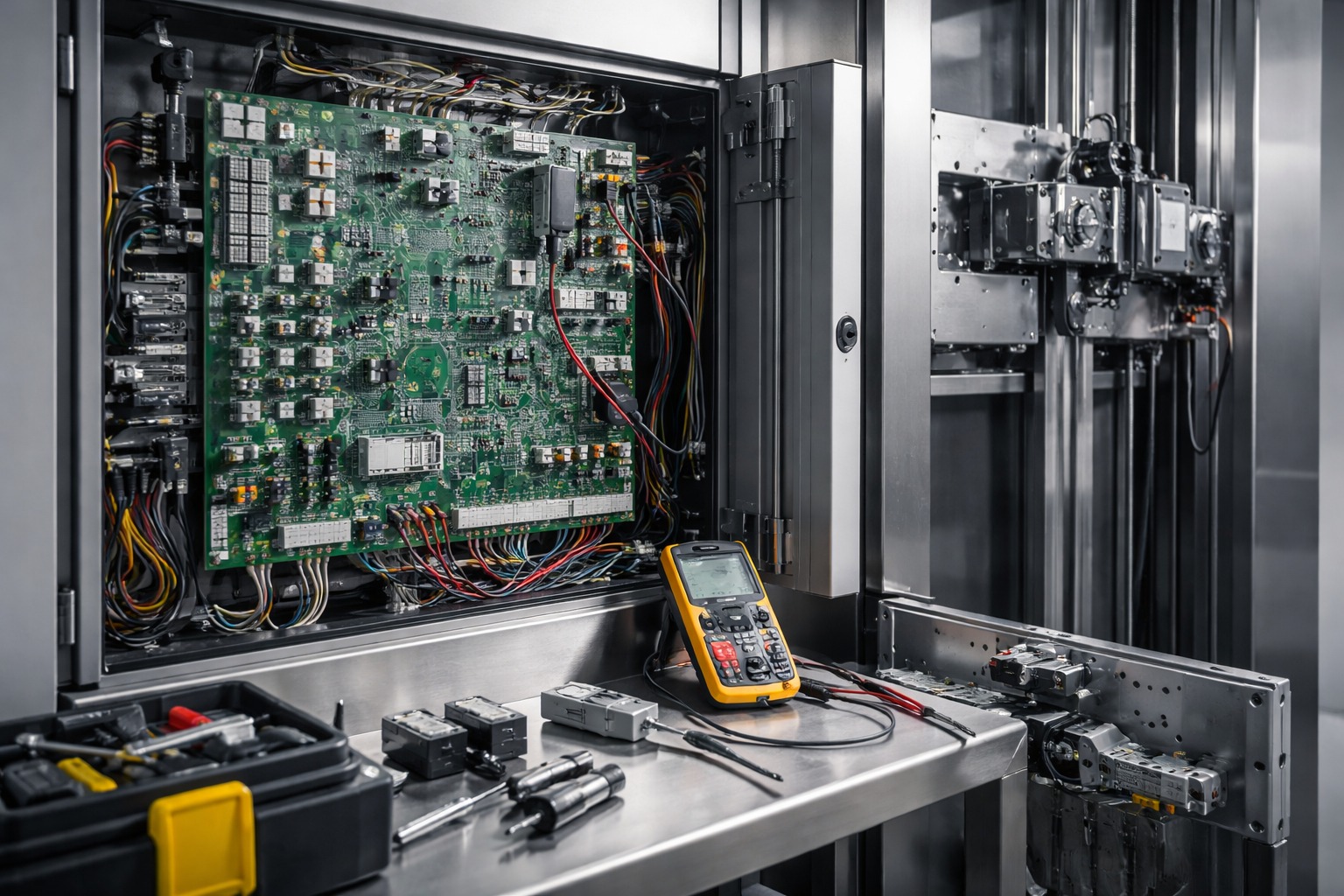
How technicians diagnose board faults is often the difference between a one-visit repair and a long chain of callbacks. A proper diagnosis starts with system context. Which functions failed? Did the fault begin after a power event, another repair, water exposure, or a machine room temperature spike? Is the issue repeatable under the same conditions? Does the event log point to a communication path, a drive command issue, an input loss, or internal watchdog behavior?
Technicians normally work from outside to inside. They verify incoming power quality, grounding condition, fuse status, terminal tightness, and environmental factors before concluding that the board itself is defective. Many so-called board faults are actually caused by loose connectors, poor shielding, unstable power supplies, damaged sensors, failed relays, or door system issues feeding bad signals into an otherwise healthy controller.
After external checks, the technician evaluates board behavior. This can include LED status, startup sequence, diagnostic menus, signal tracing, communication link status, and comparison with known good parameters. If the system allows, they review stored errors and compare them with actual field conditions. A board that repeatedly drops communication under heat may pass a quick cold inspection but fail after normal operation. This is why some workshops perform longer bench testing and load simulation rather than only power-on verification.
| Diagnostic step | Purpose | Tools commonly used | What it confirms | Risk if skipped | Best practice |
|---|---|---|---|---|---|
| Review fault history | Find repeated patterns | Controller logs, service tool | Whether the event is random or consistent | Wrong part replaced | Capture logs before power cycling |
| Verify supply voltage | Rule out unstable power | Multimeter, power quality meter | Board is receiving correct input | Healthy board misjudged as failed | Measure under load, not only idle |
| Inspect connectors and terminals | Check for loose or corroded contact | Visual inspection, contact test | Signal path integrity | Intermittent issue remains unresolved | Document connector position before removal |
| Compare I/O response | See if inputs and outputs act correctly | Service mode, meter, diagnostic screen | Logic processing path | Field devices blamed incorrectly | Test one signal path at a time |
| Substitute known good board | Confirm board-specific failure | Matched spare part | Whether fault follows the board | Uncertain diagnosis | Use only exact or verified compatible revision |
| Bench or soak test | Detect heat-related intermittent faults | Workshop test setup | Longer-term stability | Failure repeats after reinstall | Test beyond a simple startup check |
The diagnostic workflow above is especially useful for service companies handling older equipment fleets. In practical U.S. operations, technicians often cover routes with mixed brands and controller generations. A standardized troubleshooting sequence reduces dependence on guesswork and helps maintain documentation for building owners. It also supports internal quality control for distributors and contractors who keep rotating spare boards in stock.
When technicians need replacement options for legacy Japanese-brand systems, clear board identification becomes critical. Product photos, edge labels, connector positions, software markings, and machine serial data all help improve matching accuracy. That is why many buyers prefer suppliers who can cross-check this information before release, rather than shipping based only on a short part number description.
The bar chart highlights why uptime-sensitive sectors often prioritize quick board sourcing and stronger pre-shipment checks. Hospitals and office towers typically accept less risk from uncertain parts because service interruptions directly affect operations and occupant confidence.
Hitachi Elevator Board Sourcing Considerations
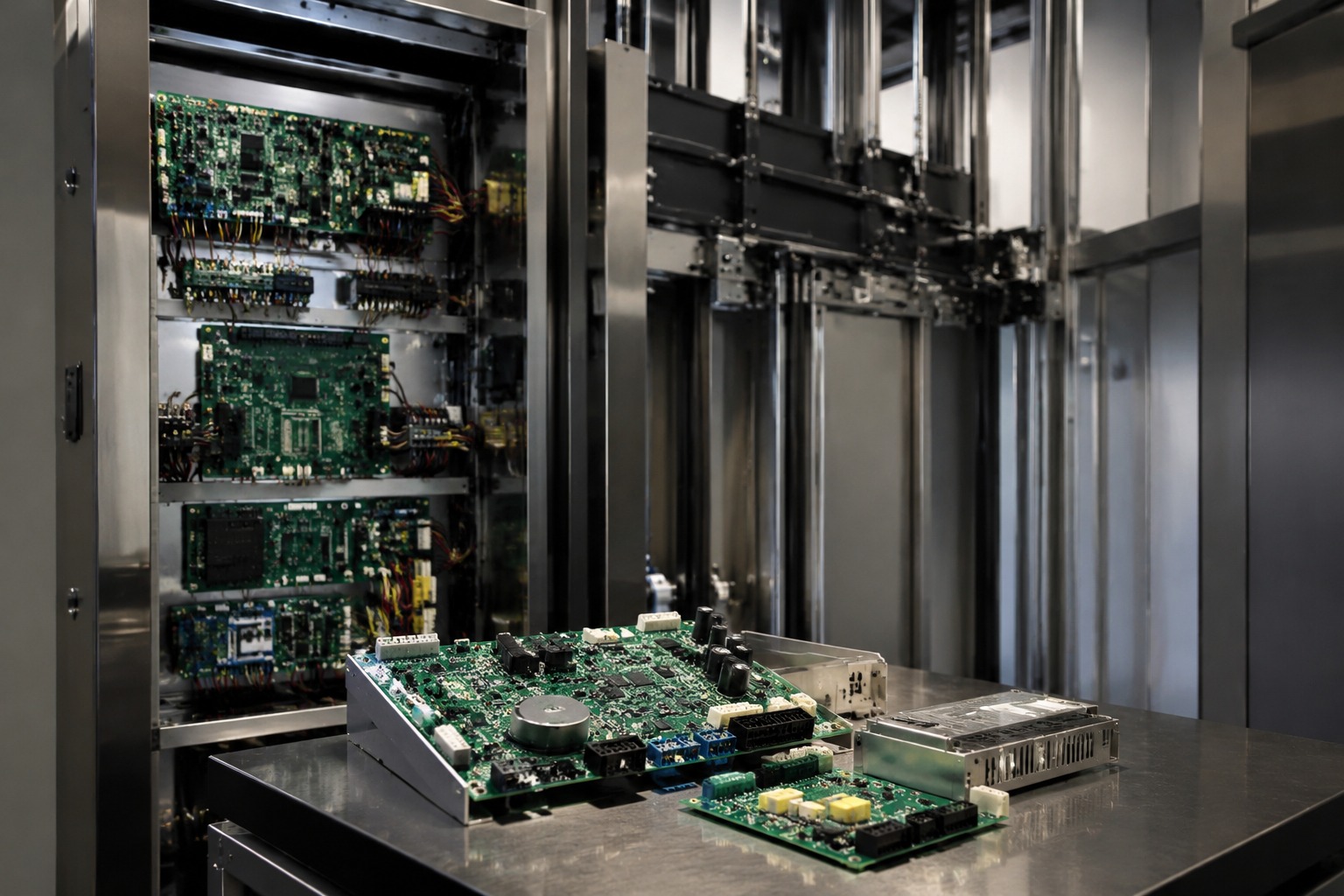
Hitachi control board sourcing considerations usually center on exact model matching, revision control, connector layout confirmation, and realistic availability for older systems. Buyers should not assume that two similar-looking boards are interchangeable. Even when mounting points match, differences in firmware, parameter handling, communication protocol, or I/O assignment can create startup faults or unstable operation.
For U.S. buyers, one effective approach is to compare the existing board against detailed product images and supplier confirmation notes. When reviewing options such as Hitachi elevator control boards, maintenance teams should verify the full part number, board code, software label if available, and the intended application in the controller architecture. If the board is used in a high-traffic property in cities like New York, San Francisco, or Washington, DC, it is often worth requesting additional checks before shipment to reduce outage time on arrival.
Lead time and logistics also matter. Boards moving into the United States may travel by air for urgent outages or by sea for stock replenishment through gateways such as Long Beach, Los Angeles, Savannah, or Newark. Buyers should ask not only whether the board is available, but whether the supplier can document inspection, anti-static handling, and packing method. A rushed shipment with weak protection can turn a good board into a damaged arrival.
| Sourcing factor | Why it matters | What buyers should verify | Common risk | Impact on project | Practical advice |
|---|---|---|---|---|---|
| Exact part number | Prevents mismatch | Label, board code, revision | Near-match shipped by mistake | Installation delay | Send clear photos of both sides |
| Firmware or revision level | Affects compatibility | Software mark or serial note | Unexpected logic faults | Repeat visit required | Confirm before payment and shipment |
| Connector layout | Ensures physical fit | Terminal positions, plug type | Incorrect harness interface | Board unusable on site | Compare high-resolution images |
| Inspection status | Improves reliability | Visual and electrical check report | Unscreened defective stock | Higher callback risk | Request test confirmation for key functions |
| Packaging quality | Protects electronics in transit | ESD bag, foam, rigid carton | Shipping damage | Delayed restart | Ask for packaging photos when urgent |
| Supplier responsiveness | Speeds model confirmation | Technical review and order support | Slow clarification cycle | Longer downtime | Choose suppliers used to complex part matching |
The sourcing table is valuable because control board purchases are rarely generic. A supplier who understands board-level identification can help reduce uncertainty before the part leaves the warehouse. That is particularly useful when supporting modernization contractors, independent service companies, and distributors who may not have a deep spare inventory for every Hitachi platform in the field.
From a technological capability standpoint, our process emphasizes model screening, board image comparison, connector verification, and stable quality inspection before dispatch. That technical support helps customers narrow down compatible options more efficiently, especially when legacy documentation is incomplete or when the failed board’s label has become difficult to read after years in service.
Notes on Replacing Toshiba Elevator Motherboards
Toshiba motherboard replacement notes should begin with one rule: do not remove and install a main board until all surrounding causes have been reviewed. A motherboard sits at the center of the elevator’s logic flow. If a power supply issue, grounding problem, shorted peripheral, or communication bus fault is still present, a newly installed board may fail to initialize correctly or may even be damaged after installation.
When a replacement is necessary, documentation is essential. Record terminal positions, connector orientations, dip switch settings, parameter references, and any software or option labels before removal. Many U.S. technicians take high-resolution photos and mark harness groups to avoid reinstallation mistakes. This is particularly helpful in service environments where more than one technician may be involved during emergency repairs or overnight building shutdown windows.
For buyers seeking new original Toshiba elevator motherboards, it is wise to confirm whether the board ships as a bare module, includes specific accessories, or requires parameter transfer or initialization after installation. In some systems, a motherboard replacement may also require checking companion modules such as I/O, communication, or option boards. Where expansion capacity is relevant, Toshiba elevator expansion boards should be reviewed separately rather than assumed to be part of the same replacement scope.
Toshiba systems in the U.S. are often found in commercial, hospitality, and residential applications where downtime has a visible occupant impact. In a downtown hotel in Chicago or an apartment tower in Jersey City, a motherboard replacement must be planned around access, service windows, and post-installation testing. Replacing the board without a commissioning checklist can leave unresolved floor call mapping, door timing, or communication issues that only become obvious once traffic resumes.
| Replacement item | What to document before removal | Why it matters | Common mistake | Effect after startup | Recommended control measure |
|---|---|---|---|---|---|
| Main power connectors | Input location and polarity | Prevents power-up errors | Misplaced connector | No startup or board damage | Photograph and label all plugs |
| Communication harnesses | Port assignment and cable route | Restores network path correctly | Swapped communication ports | Bus faults and offline modules | Tag each cable before removal |
| Parameter references | Controller settings record | Maintains functional behavior | Assuming default settings will work | Leveling or dispatch issues | Back up or transcribe key settings |
| Expansion board relationship | Associated option modules | Confirms full system compatibility | Ignoring companion board dependence | Missing functions after installation | Review full board architecture |
| Firmware or revision labels | Board identity details | Avoids wrong revision substitution | Ordering by partial number only | Intermittent logic mismatch | Send label photos to supplier |
| Startup checklist | Test sequence after installation | Ensures safe return to service | Skipping full operational tests | Callbacks under traffic conditions | Complete no-load and normal-load checks |
The explanation behind this table is straightforward: motherboard replacement is not only a hardware swap. It is a system restoration process. In many cases, the quality of documentation before removal determines how smoothly the elevator returns to service after installation.
From a manufacturing capability perspective, disciplined product handling and quality control are essential before a replacement board ever reaches the site. That includes verifying board identity, screening physical condition, maintaining clean storage, and using protective materials appropriate for electronic assemblies. Buyers should look for suppliers who can support this consistency rather than relying on loose, undocumented stock movement.
Why Refurbished Elevator Boards Require Careful Testing
Why refurbished boards need careful testing is one of the most important questions in the replacement market. Refurbished or repaired boards can be a practical solution when original new stock is limited, lead times are long, or the installed equipment is no longer supported through standard channels. However, a refurbished board is only as dependable as the testing process behind it.
Simple power-on confirmation is not enough. A board may energize and still fail under sustained operation, vibration, or thermal load. Intermittent communication faults, weak solder joints, aging capacitors, unstable regulators, and marginal relay or driver sections may only appear after time in service. For that reason, professional evaluation should include visual inspection, cleaning where appropriate, basic electrical checks, and a meaningful operational test routine whenever possible.
In the United States, refurbished boards are often used to support legacy equipment in mid-rise residential buildings, older office properties, and selective modernization phases where full controller replacement is not yet budgeted. These are valid applications, but they demand realistic risk assessment. A well-tested refurbished board can provide strong value. An untested board can extend downtime, increase labor cost, and damage customer trust.
Buyers should ask practical questions. Was the board tested on a compatible setup? Were known wear components evaluated? Was the board inspected for corrosion, prior field repair quality, connector damage, and contamination? Is there any record of failure mode or repair action? Even when a board is sold as refurbished rather than repaired, evidence of technical screening improves confidence.
The area chart shows a broader trend shift in the U.S. market: more owners and service firms are moving from purely reactive replacement to planned, condition-based parts sourcing. This trend is expected to continue through 2026 as maintenance records, fault logs, and modernization planning become more data-driven.
Service capability matters here. A responsive supplier should be able to discuss replacement options, compare new versus refurbished paths, and help customers balance urgency, budget, and compatibility. Fast answers on model confirmation, stock status, and packaging can materially reduce downtime for field teams working under pressure.
ESD Packaging and Shipping Requirements for Boards
ESD packaging and shipping requirements are not a minor detail for elevator control boards. Electrostatic discharge can damage sensitive electronic components even when there is no obvious visible sign. In addition, vibration, impact, moisture, and compression during transport can create mechanical or latent failures that only appear after the part is installed. For U.S. buyers receiving shipments through parcel networks, air freight terminals, or port-connected distribution chains, strong packaging discipline is essential.
At minimum, boards should be packed in anti-static bags, cushioned to prevent movement, separated from direct pressure on components, and placed in rigid outer cartons. Connectors, exposed pins, and edge contacts deserve extra protection. For higher-value or fragile boards, layered foam support, corner reinforcement, and moisture control are advisable. Labels indicating electronic contents and static-sensitive handling are also helpful, especially when shipments pass through multiple transfer points.
Shipping routes influence risk. A board traveling to Seattle in winter or to Miami during humid weather may face very different conditions. Long domestic routes through hubs such as Memphis, Louisville, or regional freight centers can add handling cycles. International arrivals through Newark, Los Angeles, or Houston may require additional protective planning if transloading or onward domestic distribution is involved.
| Packaging requirement | Function | Risk prevented | Minimum good practice | Higher standard option | Why buyers should care |
|---|---|---|---|---|---|
| Anti-static bag | Protects against ESD exposure | Latent electronic damage | Sealed ESD bag sized to board | Shielding-grade bag with label | Reduces invisible component failure risk |
| Internal cushioning | Limits movement in transit | Cracked solder joints, bent parts | Foam support around board | Custom-cut anti-static foam | Protects against vibration and drops |
| Connector protection | Guards sensitive interfaces | Broken pins and damaged sockets | Cap or foam barrier | Dedicated connector guards | Avoids installation problems on arrival |
| Rigid outer carton | Resists compression and impact | Board flex and carton crush | Strong double-wall box | Reinforced export carton | Improves survival through carrier networks |
| Moisture control | Reduces humidity exposure | Corrosion and contamination | Dry packing environment | Desiccant and sealed barrier | Important for coastal and humid destinations |
| Clear shipping labels | Improves handling awareness | Rough treatment in transit | Electronic parts labeling | ESD and fragile handling labels | Supports better carrier treatment |
This table explains why packaging quality should be part of supplier evaluation, not an afterthought. A correctly identified board can still become a failed delivery if it is not protected throughout the shipping chain.
Commissioning Steps After Board Replacement
Commissioning steps after board replacement should be planned before the first connector is moved. Replacement is only complete when the elevator has been tested through a structured return-to-service process by qualified personnel. This process should include power-up verification, fault review, configuration confirmation, communication checks, door operation testing, travel tests, leveling verification, and normal service observation under realistic conditions.
For elevators in heavily occupied U.S. buildings, it is good practice to perform a staged return. First, confirm safe startup in controlled conditions. Second, verify all relevant inputs and outputs, including floor calls, door protection devices, indicators, and safety-related interfaces according to the system design and applicable procedures. Third, run the elevator through multiple trips and monitor event history. Finally, return the unit to normal traffic and observe behavior during live service when possible.
Commissioning is especially important after motherboard or communication board replacement because some faults do not appear until the system interacts with companion modules, traffic demand, or door cycles. A board can look healthy during a brief inspection trip and still fail during peak use if a parameter, connector, or communication path is incorrect.
| Commissioning step | Objective | What to verify | Typical issue found | Consequence if missed | Recommended record |
|---|---|---|---|---|---|
| Initial power-up check | Confirm safe startup | LED sequence, alarms, display status | No boot or immediate fault | Unsafe or incomplete startup | Power-up observations and alarm codes |
| Configuration review | Ensure correct settings | Parameters, switches, board recognition | Default or wrong values active | Abnormal logic behavior | Settings confirmation sheet |
| Communication verification | Restore board network integrity | Links to drive, I/O, door and car devices | Offline module or unstable bus | Intermittent service faults | Communication status log |
| Door operation test | Check passenger interface reliability | Open, close, reopen, dwell timing | Door cycles inconsistent | Frequent callbacks | Door cycle test notes |
| Travel and leveling test | Confirm ride performance | Floor accuracy, acceleration behavior | Incorrect position handling | Ride complaints or shutdowns | Trip test results by floor |
| Normal service observation | Validate real operation | Calls, traffic response, event log stability | Fault appears only under use | Failure after release to occupants | Final return-to-service checklist |
The commissioning checklist above helps field teams close the loop between part replacement and verified performance. It is also useful documentation for building managers, especially in regulated or high-visibility environments such as government facilities, hospitals, and Class A office towers.
The comparison chart summarizes what many professional buyers prioritize beyond unit price. In the U.S. elevator parts market, dependable matching, inspection depth, and packaging often have a greater impact on total repair cost than a small purchase-price difference.
Our service process is built around this practical reality. Customers typically need more than a catalog listing; they need support with model confirmation, stable quality checks, protective shipping preparation, and quick communication when a site outage is active. That service capability becomes particularly valuable for contractors coordinating crews across multiple states or managing emergency failures outside normal ordering hours.
U.S. Market, Buying Advice, and 2026 Trends
In the United States, elevator control board purchasing is increasingly influenced by lifecycle planning rather than emergency replacement alone. Building owners in markets such as New York, Los Angeles, Chicago, Houston, Atlanta, and Miami are paying closer attention to mean time between failures, tenant expectations, and the cost of repeat service calls. As a result, more buyers are creating spare strategies for critical buildings instead of waiting for a breakdown before identifying part sources.
Good buying advice starts with asset classification. Identify which elevators are critical to occupancy, accessibility, healthcare operations, hospitality revenue, or freight movement. High-priority units may justify holding verified spares or prequalifying suppliers for specific board families. Lower-priority units may be managed with longer lead-time planning. This approach reduces panic purchasing and improves budget control.
Another important buying factor is total installed risk. A cheaper board is not automatically a better value if it creates additional diagnosis time, uncertain compatibility, or packaging-related damage. Buyers should evaluate lead time, technical confirmation, inspection quality, shipment protection, and after-sales responsiveness together. This is especially relevant for distributors and independent service firms that must protect their own reputation with end users.
Looking toward 2026, three trends are likely to shape the market. First, predictive maintenance and data-informed replacement will expand, supported by better use of controller logs and service history. Second, policy and compliance expectations around building uptime, safety records, and documented maintenance will continue to encourage traceable parts sourcing. Third, sustainability goals will keep selective board replacement and carefully managed refurbishment relevant, particularly when these options extend equipment life without compromising reliability. For many buildings, replacing a failed or unstable board at the right time can be a practical sustainability decision when paired with proper testing and documentation.
These trends also reinforce the importance of supplier discipline. Customers increasingly want clear answers on whether a part is new original, replacement stock, or refurbished; how it was inspected; how it will be packed; and how quickly it can move through domestic or international logistics channels. Suppliers who can support those expectations will remain stronger partners in the U.S. market.
FAQ About Elevator Control Boards
What are the most common control board failure signs in an elevator?
The most common signs are intermittent resets, unexplained shutdowns, lost call registration, communication alarms, inconsistent door behavior, position display issues, and startup failures. These symptoms do not always prove the board is defective, but they strongly justify structured diagnostics.
Can a technician confirm a board fault without replacing the board first?
Often yes. Technicians can review logs, verify power quality, inspect connectors, test signal paths, and compare behavior with expected inputs and outputs. A matched substitute board may still be used as part of confirmation when available.
Why is exact model matching so important for elevator boards?
Because boards that look similar may differ in firmware, revision, connector layout, or communication behavior. An incorrect match can create new logic problems, prevent startup, or cause intermittent faults that are harder to diagnose later.
Should buyers choose new original or refurbished boards?
It depends on urgency, system age, budget, and availability. New original boards are often preferred for critical uptime and traceability. Refurbished boards can be practical for legacy equipment if they have been carefully inspected and tested.
Why does packaging matter so much for control boards?
Control boards are sensitive to electrostatic discharge, moisture, impact, and vibration. Poor packaging can damage a good board before it reaches the site. Anti-static protection and rigid cushioning are basic requirements.
What should be checked after a board is installed?
Startup status, alarms, parameters, communication links, door operation, floor call response, ride performance, leveling, and event logs should all be reviewed. A short startup alone is not enough for reliable commissioning.
Do Toshiba motherboard replacements usually require additional checks?
Yes. Technicians should document connectors, settings, communication links, and related modules before removal. Motherboard replacement often interacts with I/O and communication functions, so full commissioning is important.
How can a supplier help reduce downtime?
A strong supplier helps by confirming part identity, checking condition, protecting the board with ESD-safe packaging, communicating quickly, and helping buyers compare replacement options based on urgency and compatibility.
What kinds of customers typically buy elevator control boards?
Maintenance companies, distributors, building owners, and modernization contractors are the main buyers. Their priorities vary, but all benefit from reliable sourcing, stable quality inspection, and responsive service.
What is the best way to start a board inquiry?
Provide the brand, full part number, clear board photos, machine or controller details if available, and a short description of the fault. This gives the supplier enough information to support accurate matching and faster quoting.
For companies operating across the United States, the best results come from combining careful troubleshooting with disciplined sourcing and commissioning. Elevator control boards are central to system logic and reliability, but they should never be treated as generic plug-in parts. When diagnosis is structured, model matching is verified, packaging is handled correctly, and startup checks are completed thoroughly, replacement work becomes more predictable and downtime becomes easier to control.